by Pablo Meriguet
March 30, 2026
Since December 2025, Cuba has received no oil, which has severely compromised its energy system. The arrival of the Russian oil tanker is expected to alleviate the dire situation facing the island.
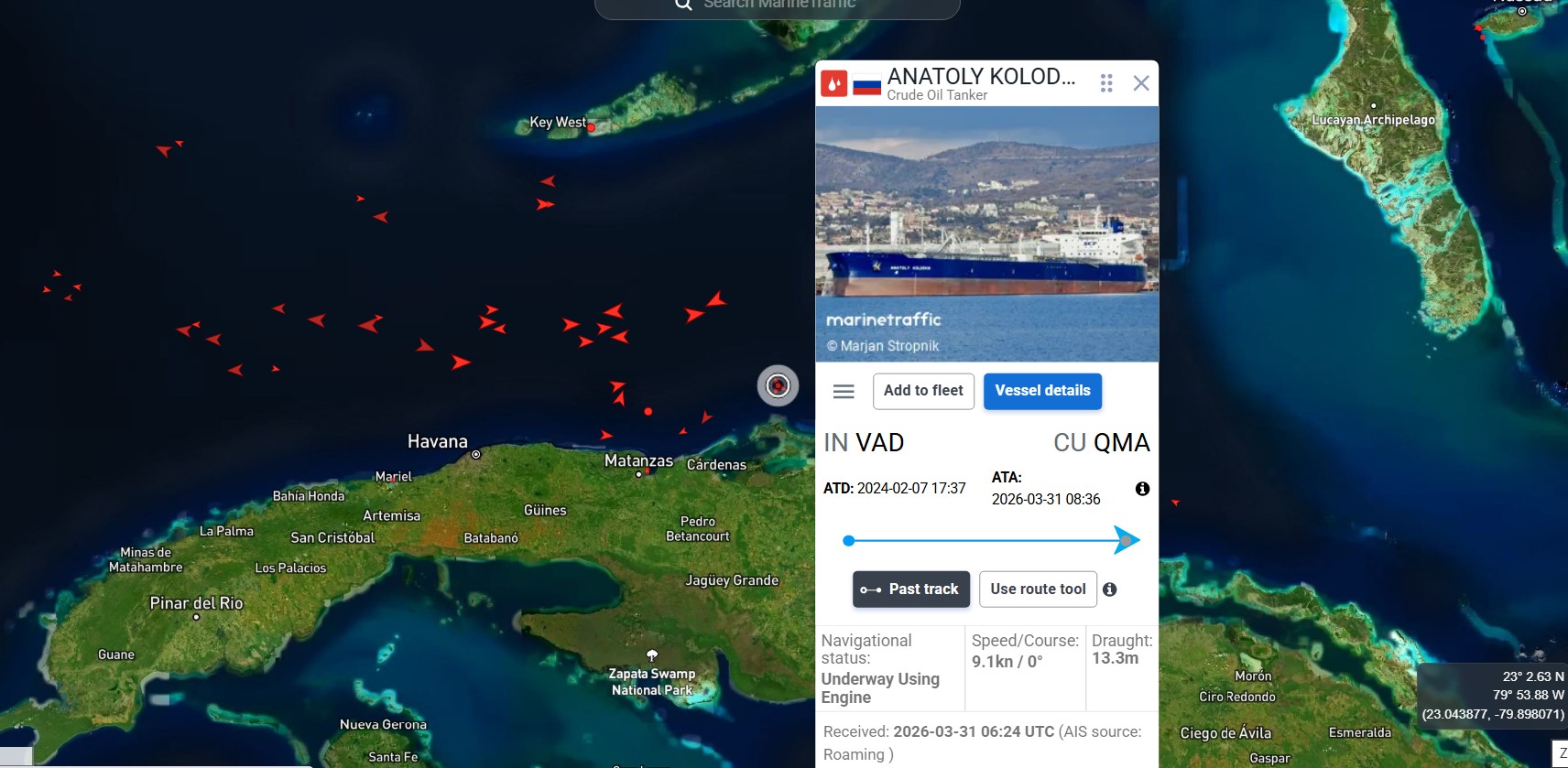
Several weeks ago, the Kremlin announced that the oil tanker “Anatoly Kolodkin” was sailing in international waters to deliver 100,000 of barrels of oil to Cuba as it faces a severe energy crisis due to the tightened US blockade. According to Russia, the oil tanker arrived on March 30.
The Russian president’s spokesperson Dmitry Peskov said in a press statement, “Russia considers it its duty not to stand idly by, but rather to provide the necessary assistance to our Cuban friends. We will continue our work. I emphasize once again: the desperate situation in which the Cuban people currently find themselves cannot, of course, leave us indifferent; therefore, we will continue working on this matter.”
Russian Ambassador to Cuba Victor Koronelli said that Anatoly Kolodkin arrived to Cuba with 100,000 tons of oil as “humanitarian aid for our Cuban friends” as a demonstration of Russia’s “readiness to provide Cuba with all possible support” in response to the “unprecedented pressure and threats from the United States”.
According to Russian authorities, the oil tanker’s arrival was made possible through diplomacy. Several discussions between high-ranking officials in Washington and Moscow reportedly took place to allow the Anatoly Kolodkin to dock on the coast of Matanzas, Cuba, and thus supply the island with fuel.
For his part, Donald Trump has downplayed both the impact of the Russian ship’s arrival and his own efforts to impede fuel from reaching Cuba. He stated, “We don’t mind having somebody get a boatload because they need [it]… they have to survive… We don’t care if they receive a shipment.” Furthermore, Trump has stated that, since the government in Havana “is finished,” it doesn’t really matter if other countries help Cuba: “If a country wants to send some oil to Cuba right now, I have no problem with that, whether it’s Russia or not.”
So far, Cuban authorities have not issued an official statement regarding the arrival of the Russian oil tanker, although media outlets on the island have confirmed that it has already arrived.
Unnamed experts cited in mainstream media allege that the oil could help generate power for about two weeks, meaning Havana must once again find a way to circumvent pressure from Washington, which shows no signs of backing down.
A crisis promoted by Washington
The oil arrives at a critical moment in Cuba’s recent history. In addition to the six-decade long commercial and economic blockade unilaterally imposed by the United States, Cuba now faces an oil blockade promoted by the Donald Trump administration in an attempt, once again, to destroy the revolutionary process launched in 1959 by Fidel Castro.
Due to Washington’s unilateral sanctions – which have been condemned on numerous occasions by the United Nations General Assembly – Cuba cannot access global oil markets and purchase crude oil like any other country in the world.
This situation worsened in 2026. Following the US attack on Venezuela on January 3, in which President Nicolás Maduro and his wife Cilia Flores were taken prisoner, Cuba was cut off from a major oil supplier which is used to keep its electricity, production, and food distribution systems running. On January 31, through an executive order, US President Donald Trump declared that the island nation represents an “unusual and extraordinary threat” to US national security and threatened 20% sanctions against any nation that sells fuel to it.
Cuba is a country that lacks significant oil deposits or hydroelectric resources due to its limited freshwater resources. Consequently, following the escalation of hostilities against Cuba by Washington, the island has endured historic power outages, cancellations of surgeries and classes, progressive cuts to its transportation system, and difficulties in distributing water to the civilian population, among other hardships. This has led to what some experts have termed “a humanitarian crisis provoked from abroad.”
Mexico, another major fuel supplier to Cuba, has made some overtures regarding its disposition to resume oil shipments to the island but has yet to concretize when and how this would take place.
.
We remind our readers that publication of articles on our site does not mean that we agree with what is written. Our policy is to publish anything which we consider of interest, so as to assist our readers in forming their opinions. Sometimes we even publish articles with which we totally disagree, since we believe it is important for our readers to be informed on as wide a spectrum of views as possible.