


Sarantis Michalopoulos Euractiv | May 23, 2026
If Turkey passes the legislation then ‘the EU will have no alternative but to impose sanctions’ and provide Greece with military support, said Greek MEP Nikolas Farantouris
Turkey is preparing to turn its “Blue Homeland” strategy into law formalising as state policy a grab for greater control over the Aegean and Eastern Mediterranean seas that rings alarm bells in Athens and Brussels.
The Blue Homeland is a Turkish revisionist doctrine that questions the existing borders in the southeastern Mediterranean. If the bill is passed, Ankara would formally challenge the sovereignty of more than 150 islands in the Aegean.
Ankara argues that maritime boundaries in the Aegean sea should be drawn roughly along a median line between the Greek mainland and the Turkish coast. Its main contention is that Greek islands close to the Turkish mainland should not automatically generate full Exclusive Economic Zones (EEZs), areas setting rights to maritime resources.
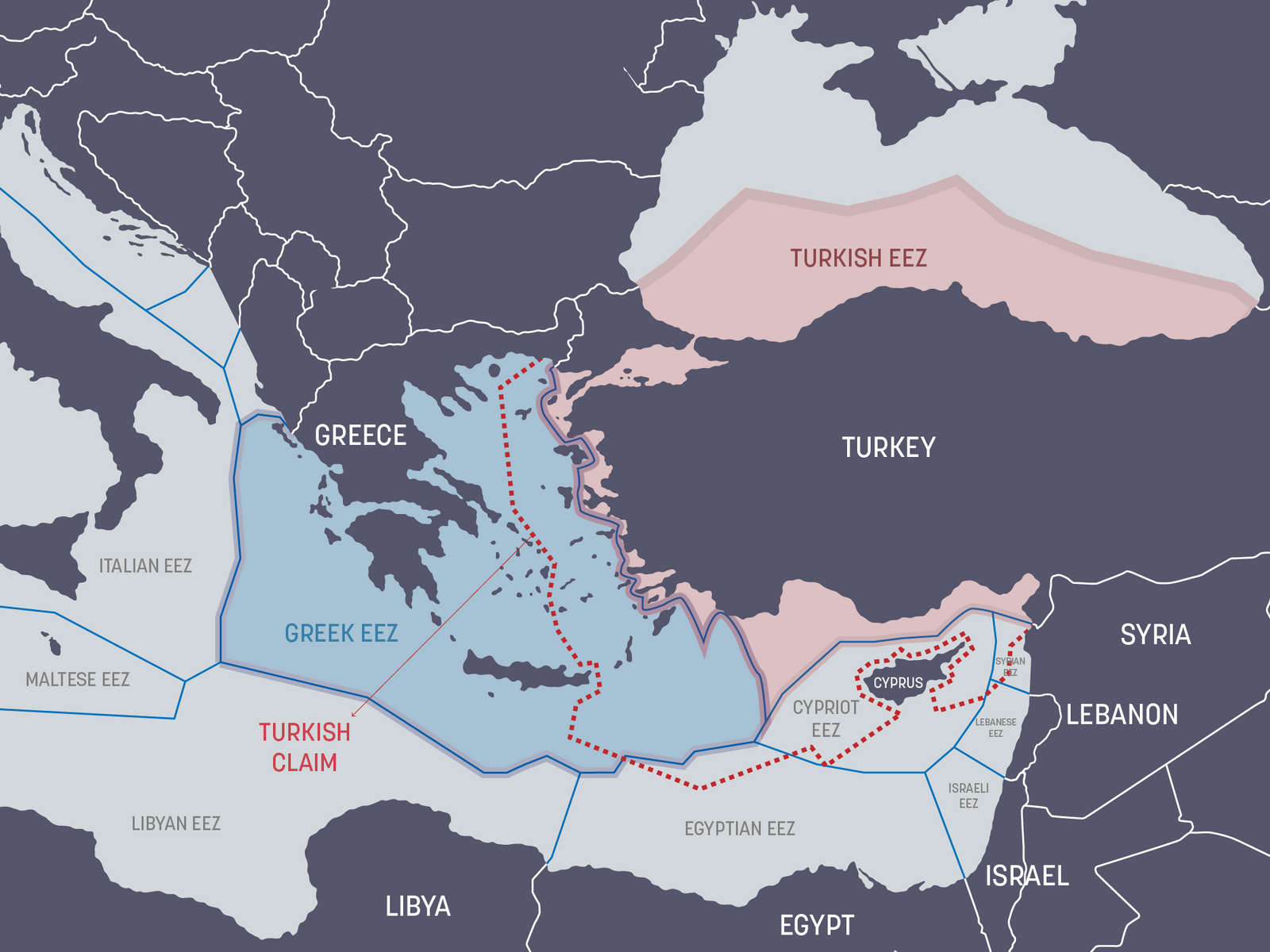
The dispute comes amid reported gas and oil reserves in the region that have also attracted US interest, while looming elections in both Greece and Turkey are fuelling domestic political pressure on both governments.
Turkey also disputes Greece’s right to extend its territorial waters from six to 12 nautical miles under the UN Convention on the Law of the Sea (UNCLOS), warning that such a move could constitute a casus belli. Greece is a signatory to UNCLOS, while Turkey is not.
A divided EU
The dispute has flared up at a difficult geopolitical moment for Europe, which is increasingly finding itself marginalised in the Middle East.
The Turkish bill, which Greek diplomatic sources expect in early June, has reportedly been discussed at senior levels within the European Commission. An EU diplomat told Euractiv that Turkey’s challenge to what they described as Europe’s “much-needed energy resources” has raised concerns, although the Commission has declined to comment officially.
“If Turkey proceeds by denying Greece – and therefore the EU – an EEZ and continental shelf around the islands, then the EU will have no alternative but to impose sanctions and invoke Article 42(7) TEU on mutual defence assistance,” Greek Socialist MEP Nikolas Farantouris told Euractiv.
The tensions have also exposed concerns that the EU appears unprepared for a potentially explosive crisis with Turkey, with another EU diplomat suggesting that “Greece will soon take stock of [its] EU friends”.
Divisions were highlighted in April, when Ursula von der Leyen, the European Commission president, grouped Turkey alongside Russia and China as sources of negative influence.
Charles Michel, a former European Council president, hit back, describing Turkey as a key NATO ally and an important migration partner.
His comments were poorly received in Athens, as Michel was leading the European Council when Turkey opened its borders in 2020 and pushed thousands of migrants towards Greece.
Maxime Prévot, Belgium’s foreign minister, also stated earlier this month that there can be no discussion of a European security architecture without Turkey, comments that alarmed Greece. Meanwhile, Queen Mathilde led a major economic mission to Turkey last week, resulting in 40 trade and investment agreements.
“Several EU countries tend to view EU-Turkey relations primarily through an economic lens and overlook the security implications,” said George Tzogopoulos, senior fellow at the Hellenic Foundation for European and Foreign Policy.
He added that if Turkish threats against Athens and Nicosia are ignored, it will be difficult for Europe to recalibrate its partnership with Turkey in a changing geopolitical environment.
Spain may pose another challenge for Athens. Madrid was the leading EU arms exporter to Turkey between 2020 and 2024, while bilateral trade reached a record €17.5 billion in 2025.
Germany, meanwhile, has traditionally maintained a more cautious stance in Greek-Turkish disputes. In defence matters, it first supplied Greece with advanced Type 214 submarines and later, despite Greek objections, provided similar capabilities to Turkey. Migration, particularly flows of refugees and migrants attempting to reach Europe via Turkey, remains another key factor.
France is viewed in Athens as a more reliable partner on the issue. Paris and Athens recently renewed a defence agreement that includes a mutual assistance clause.
Israel in the equation
Diplomatic sources in Athens say Greece’s strategic alignment with Israel plays a significant role in Turkey’s calculations. “With this bill, they want to set the record straight,” the sources said.
Ankara argues that the Greece-Israel-Cyprus triangle destabilises the region and has accused Israel of committing genocide in Gaza. Israel, in turn, accuses Turkey of seeking regional hegemony.
A key moment is expected to be the NATO summit on 7-8 July in Ankara, and whether Donald Trump will visit Athens before the US president attends the meeting.
Both countries have stated that they do not want external mediation in their bilateral disputes.
The Turkish foreign ministry did not respond to a request for comment.
We remind our readers that publication of articles on our site does not mean that we agree with what is written. Our policy is to publish anything which we consider of interest, so as to assist our readers in forming their opinions. Sometimes we even publish articles with which we totally disagree, since we believe it is important for our readers to be informed on as wide a spectrum of views as possible.