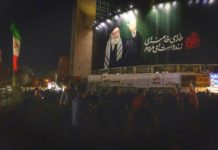
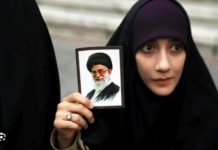
Dedicated to those who wonder why some of us are thrilled by the grandeur of soul that is true political Resistance
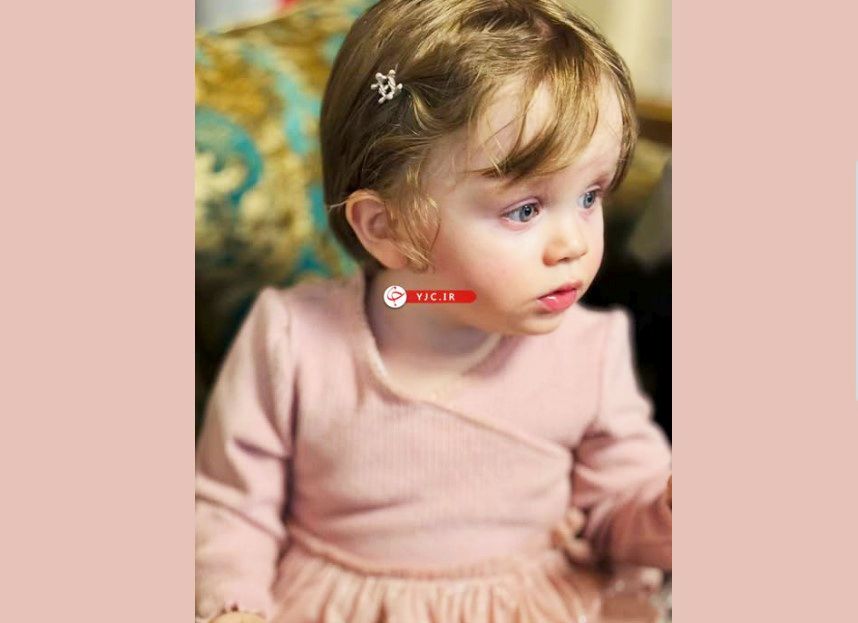
The little girl in the photograph is Khamenei’s granddaughter. She was martyred along with his family by the fire of the genocidal pedophiles who attacked her autonomous country to plunder its natural wealth and control West Asia, as a launching pad for the grand ambitions they hold for the rest of the continent.
Khamenei was sacrificed along with his family because he refused to hide in the final hour when his citizens were under the barbarians’ fire, seeking to inspire and rouse the world to resistance rather than subjugate it to the colonizers.
His sacrifice bears the mettle of Ancient Greek tragedy.
Without hiding, without using body doubles, without playing with AI, he sat there, in his office, planning his country’s defense like another Darius, together with his generals and his beloved ones.
A density of spirited beings against the most corrosive and inhuman system in the world.
A healthy pulsating heart against cold-blooded capitalism.
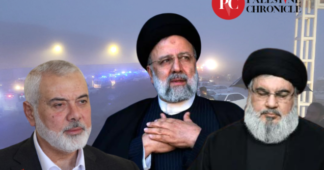
He was murdered by the same criminals who seek to erase whatever higher has trodden upon these Asian lands—Sinwar, Nasrallah, and all those who resist the homogenization of our brains, those who control our minds.
.
Khamenei was the Son of Resistance.
Like Khomeini.
They took a country that was a puppet of the Shahs and America, and made it strong.
There is a fundamental difference between those who see politics as a negotiation for power and those who perceive it as an existential battle for dignity.
The way of thinking of true revolutionaries, the one expressed through the so-called “Axis of Resistance,” is not merely an alternative ideology; it is an entire worldview that the West, with its commodified spirit, is unable to comprehend.
Morality and the hierarchy of values shift from Individualism and Survival to Collective Sacrifice.
In the Western world, morality is often measured in terms of individual liberation and consumer choices.
On the opposite side, revolutionary thought is imbued by the highest morality, infusing solidarity and self-sacrifice for the collective good.
The ethical stance in life is defined by self-respect, which is not a personal matter but a public commitment.
Iran’s support for Palestine is not a geopolitical chessboard but a moral imperative, a support for the Palestinian people’s hopes and the resistance groups’ efforts for their inalienable right to self-determination.
It is a life stance against occupation and Zionist aggression, inscribed in the collective consciousness.
Western society promotes individual success, often at the expense of the social whole. How many times do we receive advice on how to take care of ourselves?
Revolutionary thought, on the contrary, cultivates a strong unity, a sense that the individual is fulfilled only within their homeland and the broader community of struggling peoples.
This unity is not static or navel-gazing but dynamic; it is fueled by the common struggle against global injustice and by a sense of moral fulfillment that has no need to be constantly completed through the acquisition of material goods.
Protesters in the West who shout about the genocide in Palestine but ignore the harsh sanctions against a state that defends its right to exist in order to survive, without having manifested imperialist or expansionist intentions, demonstrate that their own “unity” is selective, a hollow representation of their own imagination without perception. For the revolutionary, solidarity is universal or it is nothing.
Westerners fail to grasp concepts like homeland and tradition, where the roots of dignity and freedom develop.
For the West, tradition is often seen as an obstacle to progress, and the adoption of a homogenized lifestyle based on “innovation”, and “development” is seen as an attainment of freedom.
For the revolutionary way of thinking, tradition and love for the community, which begins with the tenderest bonds within the family, is the source of resilience.
The imprisoned sons of Palestine, if they are lucky enough to be released, fall and kiss their mothers’ feet. And their wives wait for them for entire years because their love is rooted deeper than the olive trees.
Unfathomable things for the West.
Iran, despite decades of war and sanctions, has built a culture of self-sufficiency rooted in this resilience, self-reliance, and ingenuity. It does not depend on imports or the culture of advertising.
But love for the homeland is not a nationalist exaltation; it is a daily act of resistance against foreign imperialism that wants to dictate its fate.
Western capitalism promises development but produces the harshest inequality. Revolutionary thought places at its center the struggles of the popular classes: workers, peasants, students.
The dignity of a country is inextricably linked to the autonomy of its economy and its self-determination from the centers of global capitalism that dictate what we cultivate, what we eat, what we wear, how we think.
Sanctions are not an economic tool but a form of warfare, a neo-colonial strategy for controlling resources and punishing sovereignty.
The very same thing is playing out in Latin America with the noose around the necks of Venezuela and Cuba.
The response is not submission, but the strengthening of domestic production and, in Iran’s case, its national defense, such as the ballistic missile and drone programs developed despite the pressure, and which now respond to the American-Israeli Nazi Axis of aggression.
Iran is not on the Epstein list because it condemns corruption and resists Capitalism with abhorrence. Corruption in the West is often institutionalized, hidden behind lobbies and legal institutional bribery.
In revolutionary thought, the condemnation of corruption is identical to the condemnation of the global capitalist order, which drains the wealth of the Global South, whether it concerns natural resources or human consciousness, especially of young people.
The war against this worldview is not a bilateral episode but fits into the deeper logic of global war capitalism.
It is a system where “security” becomes the primary means of capital accumulation and fear becomes the greatest weapon of propaganda.
Why, then, will the West never understand this way of thinking? Because it requires seeing the world not as a market, where we are all bought and sold, but as a battlefield between the oppression of power and the sacredness of liberation.
It requires understanding that for millions of people, freedom lies not in consumption, but in resistance against it.
The West has become trapped in a pseudo-ethics of instrumentalized beliefs that is largely for show, while the Resistance has a substantive ethics of responsibility that can even cost lives.
Because life without struggle does not exist.
And of course, the illusory resistance of appearances is evident in the fact, as thinkers of the anti-colonial movement note, that focusing on women’s rights in terms of dress, for example, is a deeply capitalist, individualistic, white savior, and regressive method of evaluating liberation.
Real progress is measured by development, education, and national sovereignty, where women hold significant roles of responsibility.
These are the reasons why the spirit of Resistance will forever remain foreign to the West: because it speaks a language of sacrifice and dignity that Western consumerism has forgotten.
And this forgetfulness is the West’s weakness, and soon it will prove to be its Achilles’ heel.
Faye Tzanetoulakou
1/3/2026
 Sayyed Khamenei: Sayyed Nasrallah’s blood will…
 A towering figure: Palestinian factions mourn Sayyed…
 PROFILE: Ali Khamenei—The Architect of the Islamic…
 Lebanese leaders, parties mourn martyr Sayyed Hassan…
 The Popular Front for the Liberation of Palestine on Gaza
 ‘Supporter of the Oppressed’ – Palestinian, Arab…