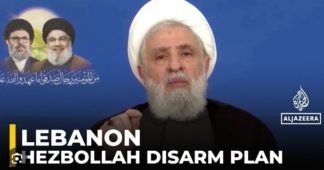
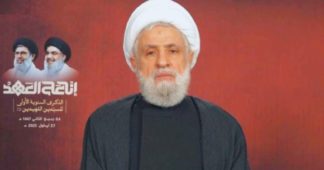
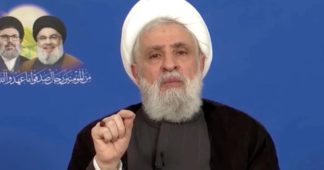
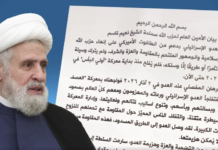
Hezbollah Secretary-General Sheikh Naim Qassem rejects direct negotiations as “null and void,” issuing five non-negotiable demands.
Apr 27, 2026
Hezbollah Secretary General Sheikh Naim Qassem affirmed in a statement on Monday that the Israeli occupation “will not remain on one inch of our occupied land, and our people will return to their land”.
Addressing the resistance community, he said: “O our people, just as we resisted together, we will rebuild together.”
Sheikh Qassem stressed that the entry point and solution to what is happening in Lebanon today is to obtain the five points before anything else.
The five demands are as follows:
- An end to Israeli aggression by land, sea, and air
- Israel’s withdrawal from all occupied Lebanese territory
- The release of all detainees
- The return of displaced residents to their towns and villages
- Reconstruction
He said the Israeli enemy, “backed by the American tyrant,” had bet on eliminating the Islamic Resistance and the Resistance community, but despite resorting to every possible means, it has failed since the launch of the People of Might battle on September 23, 2024.
Sheikh Qassem said the enemy made its decisive gamble on March 2, 2026, but the Resistance fighters confronted it in the Devoured Straw battle, surprising not only Israel and its allies, but also the wider world through their resilience, courage, and steadfastness, alongside diverse and effective tactics, disciplined command, and steadfast public unity despite displacement and heavy losses.
This steadfastness, he said, has driven the enemy into a dead end. “This resistance is enduring, powerful, and cannot be defeated,” he stressed.
‘A humiliating concession… the authority must return to its people’
Against this backdrop of steadfastness, Sheikh Qassem criticised the Lebanese authorities for rushing into a “gratuitous and humiliating concession,” one that was unnecessary and amounted to “submission without any return whatsoever.”
He reiterated his categorical rejection of direct negotiations, warning that the authorities’ conduct “will serve neither Lebanon nor themselves,” adding that “what the Israeli-American enemy wants from them [Lebanese authorities] is not theirs to give, and what they [Lebanese authorities] seek from [the US-Israeli enemy] will not be granted.”
Sheikh Qassem stressed that the current leadership “cannot continue while relinquishing Lebanon’s rights, conceding land, and confronting its own people,’ urging instead to return to governing as the authority of the entire nation rather than a faction, through the consensus underpinning the Taif Agreement and the Lebanese constitution.
He added that authorities must reverse their “grave mistakes,” halt direct talks with Israel in favor of indirect negotiations, and rescind the March 2 decision criminalizing the resistance and its supporters, who make up more than half of the Lebanese population, to enable meaningful internal dialogue free from external pressure.
‘We will not give up our weapons’
Sheikh Qassem explained that the resistance’s weapons are defensive in nature, intended to repel aggression, not its cause.
He added that the real objective of aggression is now clear for all: “the occupation of Lebanon as part of a so-called ‘Greater Israel’ project,” and it is precisely against that objective that the resistance’s weapons remain, at this stage, essential for survival.
Acknowledging the scale of sacrifice, he framed the choice plainly: “liberation and dignity, or occupation and humiliation, and humiliation is not an option for us.”
He reiterated that the resistance will not disarm, saying battlefield developments have demonstrated its readiness for sacrifice, adding that such sacrifices are “the price of liberation and dignified life.”
‘No ceasefire without Iran’
Sheikh Qassem criticized the proponents of surrender, saying they “are not directly targeted, yet profit from others’ suffering”, settling for “crumbs of power and minor gains” at the expense of their compatriots’ destruction and the occupation of part of their homeland. He called for a return to national unity, arguing it is the path to collective victory and the defeat of the enemy.
He credited the ceasefire to Iran’s role during the ceasefire negotiations in Islamabad, following the “legendary steadfastness” of the resistance and the Lebanese people.
He questioned the authorities’ stance, arguing that any ceasefire proposal, regardless of the mediator, should be accepted, while insisting that only Lebanon can negotiate its own terms.
‘A day of disgrace in Washington’
Sheikh Qassem recalled “Black Wednesday,” when the Israeli occupation launched 200 airstrikes across Beirut and Lebanon within ten minutes, killing more than 300 civilians and wounding over 1,200, claiming Lebanese authorities were not committed to a ceasefire.
What followed, he said, was worse. Lebanese officials met directly with the enemy in Washington in what constituted “a day of disgrace,” after which the US State Department announced that Lebanese authorities had signed an agreement, without even convening.
The terms of the agreement imposed a unilateral ceasefire on Lebanon while granting Israel freedom to continue its aggression, and included an acknowledgment by both governments of the need to curb the resistance’s activities and those of other so-called “rogue groups.”
Sheikh Qassem then questioned whether the governing authority had chosen to act alongside the Israeli enemy against their own people. Nonetheless, he expressed hope that they would reverse course, revealing that direct negotiations and their outcomes are “null and void for us and do not concern us in any way.”
Sheikh Qassem affirms resistance’s steadfastness
Sheikh Qassem affirmed that the resistance will continue defending Lebanon and its people, pledging no “return to the pre–March 2 reality.” He promised that the resistance will continue to “respond to Israeli aggression and confront it. No matter the threats, we will not retreat, we will not bow, and we will not be defeated.”
Addressing Israel, he said: “Threaten as you wish. The men of God in the field will not bow.”
He affirmed unity with the Amal Movement, national political forces, and figures across Lebanon’s regions and sects.
Sheikh Qassem vowed that the resistance would not betray the blood of its martyrs, “foremost among them the master of the martyrs of the nation, Sayyed Hassan Nasrallah, along with Sayyed Hashem Safieddine and all the martyrs,” nor the wounds of the injured, the suffering of the detained, or the sacrifices of the displaced.
On the question of the resistance’s capabilities, Sheikh Qassem rejected any time-bound measure, clarifying that “they are not measured in months or years. They are built on a triad: faith, will, and capacity, and this triad does not run dry.”
He stressed that these pillars are inexhaustible, citing both the fighters’ resilience and divine support, before concluding by welcoming any support for Lebanon’s liberation and reconstruction while rejecting those who serve the enemy’s agenda.
We remind our readers that publication of articles on our site does not mean that we agree with what is written. Our policy is to publish anything which we consider of interest, so as to assist our readers in forming their opinions. Sometimes we even publish articles with which we totally disagree, since we believe it is important for our readers to be informed on as wide a spectrum of views as possible.