By Shaimaa Eid*
Dec 12, 2025
Amid destroyed infrastructure, fuel shortages, power outages, and the ban on bringing in equipment, residents find themselves trapped in a vicious cycle of suffering.
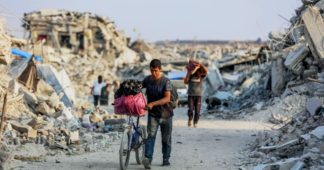
Despite the declared end of the war on the Gaza Strip, any sense of normal life remains out of reach for its residents—especially for those who lost their homes and are now displaced in tents that lack even the most basic necessities.
Chief among these needs is water, access to which has become a daily struggle that lays bare the extent of the destruction inflicted on Gaza’s infrastructure.
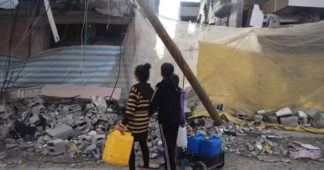
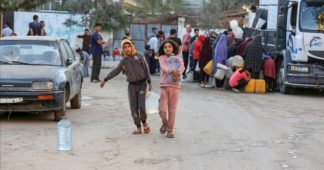
In overcrowded camps stretching along the coast and in completely destroyed neighborhoods, scenes of Gazans carrying empty water jugs and walking long distances, often in the rain or late at night, have become a daily occurrence. Many families send their children or women to fetch water from any nearby station that still provides small amounts of drinkable water, a routine that has become part of the daily struggle for survival.
Water Scarcity and a Daily Struggle to Drink
Abdel Fattah Hanoun, 44, whose home was destroyed in Al-Shati refugee camp in western Gaza, now lives in a tent near the beach in Deir Al-Balah.
“My family of seven and I suffer daily from the worsening water crisis. Securing water has become a constant worry that never leaves us,” he told The Palestine Chronicle.
Hanoun added that he often has to transport water from distant locations or chase after distribution trucks. At times, he is forced to buy water at high prices from small carts roaming the streets—an expense he cannot afford every day.
Children Carry Water instead of Schoolbags
Just a few meters from Hanoun’s tent, the Ghrabaly family of five lives under similar conditions. Suha Ghrabaly told The Palestine Chronicle that the water crisis has turned their lives upside down.
“My young children have to pull water jugs on a handcart every day after standing in a long line when water trucks arrive at the camp,” she said.
She explained that buying water from street vendors has become rare, forcing the family to rely mainly on distribution trucks or distant water lines located far from the tents, accessible only through unpaved, pothole-ridden, and hazardous roads.
“Even simple tasks like washing clothes, doing the dishes, or bathing the children now require prior planning and an amount of water we simply do not have,” Ghrabaly added, exhaustion evident in her voice.
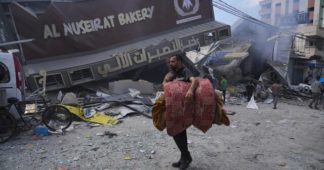
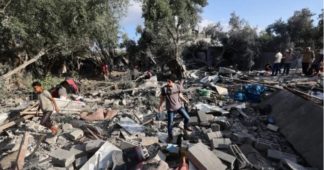
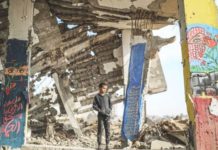
According to the Gaza Municipality, Israeli occupation forces destroyed more than 60 percent of the water and sewage networks, including main pumps that supply large areas of the Gaza Strip. The municipality stated that these damages cannot currently be repaired due to Israel’s prevention of importing the necessary materials and equipment, leaving dozens of neighborhoods exposed to prolonged and worsening crises.
Data from the United Nations Office for the Coordination of Humanitarian Affairs (OCHA) indicates that about 95 percent of Gaza Strip residents do not have access to potable water due to infrastructure destruction, fuel shortages, and power outages.
A Teenager Bearing the Responsibility of an Entire Family
In the Al-Mawasi Al-Qarara area of the southern Gaza Strip, 15-year-old Ahmed Barhoum stands every morning in a long line at a desalination station west of Deir Al-Balah.
Ahmed, who has become the primary water provider for his family, told The Palestine Chronicle that “the station is half a kilometer away from our tent. I start my day carrying empty jugs, then stand for hours waiting for my turn.”
He explained that filling the jugs is only part of the ordeal, as the most difficult task comes afterward.
“The path is rough and sandy, and the jugs are heavy. I return to the tent exhausted every day,” he said.
For Ahmed, studying and playing are no longer part of daily life. Water is all he thinks about. Other testimonies confirm that water has become one of Gaza’s most urgent crises following the supposed end of the war.
Amid destroyed infrastructure, fuel shortages, power outages, and the continued ban on importing equipment, residents remain trapped in a vicious cycle of suffering—deprived of the most basic necessities of life.
*Shaimaa Eid is a Gaza-based writer. She contributed this article to the Palestine Chronicle.
.
We remind our readers that publication of articles on our site does not mean that we agree with what is written. Our policy is to publish anything which we consider of interest, so as to assist our readers in forming their opinions. Sometimes we even publish articles with which we totally disagree, since we believe it is important for our readers to be informed on as wide a spectrum of views as possible.