Ricardo Vaz*
January 3, 2026
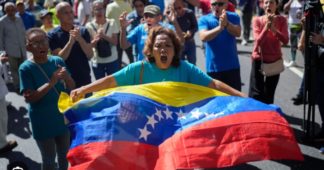
Caracas, January 3, 2026 – Venezuelan popular movements and international solidarity organizations have taken to the streets to condemn a US military attack against the country and the kidnapping of President Nicolás Maduro.
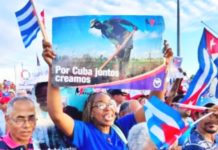
Following the bombings and special operations raid in the early hours of January 3, pro-government collectives began to concentrate in Caracas near Miraflores Presidential Palace. Demonstrations were likewise registered in many other Venezuelan cities.
“Long live a free and revolutionary Venezuela,” grassroots leader Mariela Machado told press in the Caracas demonstration. “International institutions must stop being accomplices and take a stance because our people are being massacred.”
She went on to state that “the US government is not the world’s police” and demanded the safe return of the Venezuelan President.
Venezuelan Interior Minister Diosdado Cabello and Defense Minister Vladimir Padrino López published statements in the early morning hours, urging the international community to take a stance against the US actions and calling for popular mobilization.
International solidarity organizations also set up emergency rallies in dozens of cities, including London, New York and several Latin American capitals.
US forces began the attack at 2 am local time with missiles fired against a number of Venezuela military installations in the capital and surrounding areas. Social media users broadcast fires and large columns of smoke emerging from Fuerte Tiuna, the main military installation in Caracas.
The port in La Guaira, an airbase in Higuerote, Miranda State, and a radar facility in El Hatillo, Eastern Caracas, were among the targets reportedly struck. Venezuelan authorities have not disclosed information concerning damages and casualties.
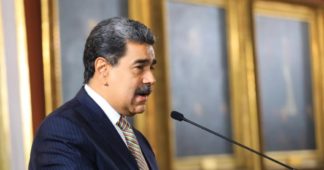
A few hours after the first bombings, US President Donald Trump announced that a special operations raid had kidnapped Maduro and first lady Cilia Flores and that the two were “flown out of the country.” The pair was reportedly taken aboard the USS Iwo Jima warship.
US Attorney General Pam Bondi stated that Maduro and Flores were indicted in a New York District Court on charges including “narco-terrorism conspiracy.” In recent years, US officials have repeatedly accused Maduro and other Venezuelan high-ranking officials of “flooding” the US with drugs. However, they have not presented any court-tested evidence, while UN and DEA reports have shown Venezuela to be a marginal player in global drug trafficking.
In a Saturday press conference, Trump stated that the US will “run” Venezuela until there are conditions for a “safe, proper and judicious transition.” He added that Secretary of State Marco Rubio and other officials will be charged with “running the country.”
The US president reiterated claims to Venezuelan oil resources and threatened that Venezuela would have to “reimburse” the US for oil nationalizations and damages from alleged drug trafficking. Trump went on to say that Rubio had held talks with Venezuelan Vice President Delcy Rodríguez, alleging that she had been sworn in and had vowed to accept US dictates.
Trump dismissed the idea of María Corina Machado taking power in the South American nation, affirming that the far-right leader lacks on-the-ground support.
Washington’s military attack and special operations raid followed months of buildup and escalating regime-change threats against Caracas. US forces have amassed the largest military deployment in decades in the Caribbean Sea while also conducting dozens of bombings against small boats accused of narcotics trafficking.
The military operation drew widespread international condemnation from Latin America and elsewhere.
“The US bombings and Maduro’s capture are unacceptable,” Brazilian President Lula da Silva wrote on social media. “These actions are an affront to Venezuelan sovereignty and set an extremely dangerous precedent for the international community.”
Colombian, Mexican and Cuban leaders were among those to strongly reject US actions and demand respect for international law.
Russian Foreign Minister Sergei Lavrov reportedly held a phone conversation with Vice President Rodríguez, reiterating Moscow’s support for the Venezuelan government and a call for dialogue.
For its part, the Chinese foreign ministry issued a statement “fiercely condemning the use of force against a sovereign nation.” Beijing urged Washington to cease its violations of international law and respect other countries’ sovereignty.
Venezuelan Foreign Minister Yván Gil held multiple phone conversations with counterparts from different countries who expressed their condemnation of the US attacks as violations of international law.
Caracas has likewise requested an emergency meeting of the United Nations Security Council. Two prior meetings called by Venezuela saw China, Russia and other countries criticize the US’ military actions but ultimately no resolutions were put forward.
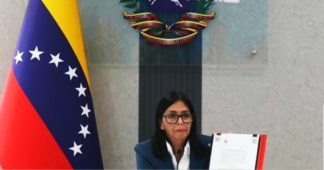
[UPDATE: Venezuelan Vice President Delcy Rodríguez gave a press conference on Saturday afternoon, vowing that the country would not “bow down to any empire.” Rodríguez demanded Maduro’s release and announced the activation of a state of commotion. On Saturday evening, Venezuela’s Supreme Court ruled that Rodríguez will assume the presidency on an interim basis.]
*Ricardo Vaz grew up in Mozambique. With very strong political leanings from an early age and a clear anti-imperialist outlook, he always felt a very strong affinity towards the Bolivarian Revolution and Chavismo, and has closely followed political developments in Venezuela. After living in different countries and continents, he moved to Venezuela in early 2019.
Although his background is in theoretical physics, he gradually moved towards journalism and political analysis and joined the VA staff as a writer and editor in 2018. Some of his main interests are sanctions, popular power organizations and the corporate media coverage of Venezuela. He is also a member of grassroots collectives Tatuy Tv and Utopix.
.
We remind our readers that publication of articles on our site does not mean that we agree with what is written. Our policy is to publish anything which we consider of interest, so as to assist our readers in forming their opinions. Sometimes we even publish articles with which we totally disagree, since we believe it is important for our readers to be informed on as wide a spectrum of views as possible.