By Atilio A. Boron
February 16, 2026
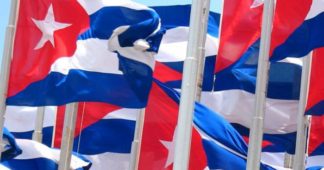
 “together we create for Cuba” all fotos: Bill Hackwell
A few days ago, the Cuban government informed airlines operating in the country that the supply of aviation fuel would be suspended as of midnight on Tuesday, February 10. Obediently, the empire’s powerful propaganda machine got to work and began to spread misinformation in a coordinated manner, attributing the situation to the “energy crisis” in Cuba. Its exponents in various countries—from El País in Spain to La Nación and Clarín in Argentina and El Mercurio in Chile, to mention only the best known—bombarded their readers, viewers, or whoever else was the victim of their information attack with a single message: Cuba’s energy crisis is the predictable and inevitable result of bad government, yet another example of the “failure” of the Cuban Revolution.
The fact is reported, but its causes are hidden; no mention is made of the fact that the energy crisis is a consequence of the criminal comprehensive blockade to which Cuba has been progressively subjected since the very dawn of the Revolution, claiming thousands of victims over seven decades. That policy, initiated by Dwight Eisenhower and strengthened by John F. Kennedy and his successors, had, and still has today, the objective of sabotaging the revolutionary process and demonstrating to the peoples of Our America that socialism inexorably leads to economic chaos and widespread poverty.
Let us remember that the first “sanctions” that affected the normal functioning of the Cuban economy were imposed by Eisenhower in July 1960 (reduction of the sugar quota) and in October of that same year, prohibiting U.S. exports to the island, with the exception of food and medicine. Since those distant days, the economic, commercial, and financial blockade imposed on Cuba has only expanded and hardened, building a monstrous global network that—through the illegal extraterritoriality of U.S. laws—not only sanctions the island but also those who dare to defy Washington’s mandates and maintain economic relations with the island from third countries.
In 1962, President Kennedy decreed a total trade embargo, citing the Foreign Assistance Act of 1961 in support. Trade agreements with the Soviet Union largely mitigated the tremendous impact of the US blockade, but the disintegration of the USSR in December 1991 left Cuba in a situation of extreme vulnerability. Seeing its prey weakened, the US Congress wasted no time in pouncing on it and, in October 1992, the Torricelli Act—misleadingly called the “Cuban Democracy Act”—which prohibited US companies located in third countries from trading with Cuba and even limited the autonomy of ships engaged in commercial maritime transport by stipulating that any ship calling at a Cuban port during the following 180 days would not be allowed to call at any US port. For an island like Cuba, this restriction has devastating effects, restricting access to imported goods, hindering exports, and greatly increasing the cost of freight.

Rev. Lucius Walker, Pastors for Peace, storms out of Jesse Helms office after condemning the 1996 Helms Burton Bill
A few years later, in 1996, another law with a name as pompous as it is deceitful was added: the Cuban Liberty and Democratic Solidarity Act. It was proposed by arch-conservative Republican Senator Jesse Helms and anti-vaccine activist and Republican Representative Dan Burton. This legal monstrosity established new restrictions on foreign investment in Cuba, further internationalized the persecution of companies or individuals who trade with it, and, above all, in Title III, allows U.S. citizens to file lawsuits in U.S. federal courts against companies (including non-U.S. companies) that have economic relations of any kind with properties confiscated in Cuba since 1959. Even more seriously, this piece of legislation—enacted by Bill Clinton in 1996—eliminates the president’s ability to override sanctions without congressional approval, turning what had previously been a presidential “executive order” into a law of the land that only Congress can modify.
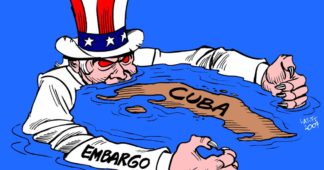
In addition to all this, there are restrictions on travel by Cuban nationals, discrimination against remittances that can be sent by relatives residing in the United States, prohibitions on U.S. citizens visiting the island and staying in Cuban state-owned hotels—and also in private residences!—as well as on cruise ships arriving on the island, among a myriad of limitations of all kinds that no economy can withstand without a significant decline in its ability to function. If the United States had been subjected to a tenth of the measures of the anti-Cuban blockade—which the mainstream press refers to with the kinder and more misleading term “embargo”—that country would have completely disintegrated and become a huge garbage dump where gangs of human debris —the kind we see every day wandering like zombies through the streets of some American cities—would be killing each other to get something to survive on, in the style of Ridley Scott’s remarkable film Blade Runner. But such an outcome did not occur in Cuba because the moral fiber of the island is infinitely healthier and stronger than that of American society.
With Trump in his first term, and even more so now, discriminatory measures have reached unprecedented extremes. The embargo and sanctions imposed on those who supply oil to Cuba are an act of war of the utmost gravity. The collective punishment of a country is genocide. There is no other word for it. The cumulative cost of seven decades of blockade amounts to $1.5 trillion in gold-indexed dollars, a figure that far exceeds the GDP of Argentina and other countries in the region such as Colombia, Peru, Chile, and almost all other countries in Latin America and the Caribbean. That figure is also equivalent to about seven times the cost of the Marshall Plan, which enabled the reconstruction of some European countries after the devastation of World War II. Today, a much larger amount is being spent to punish Cuba for its Revolution, despite which this country has maintained for decades levels of social, educational, health, and cultural development that in many cases were better than those of several developed countries. For example, the infant mortality rate. Despite this, the empire’s parrots insist on characterizing Cuba as a “failed state” when, in reality, having managed to maintain the quality of medical care for its population for so long amid the turmoil of the blockade indicates precisely the opposite. Something that, for example, the United States has not yet achieved.

Operation Milagro brought eye sight to hundred of thousands of people in Latin America
Which is the “failed state” in this case? Cuba stands out in this world ruled by capitalist selfishness for its international solidarity and militant humanism. Operation Miracle has restored sight to hundreds of thousands of people in El Salvador, Guatemala, Ecuador, Colombia, Costa Rica, Venezuela, Guyana, Bolivia, Argentina, Brazil, Uruguay, and the Dominican Republic.
Its doctors, nurses, and health personnel in general traveled to contain the Ebola epidemic in West Africa, especially in Sierra Leone, Liberia, and Guinea, places that never saw an American or European doctor. When Milan and the entire Lombardy region were overwhelmed by the advance of COVID-19, it was the doctors and nurses of the Henry Reeve Medical Brigade who came to the aid of the Italians, doing remarkable work that has been unanimously recognized throughout the peninsula. This spirit of Martí and Fidel that characterizes Cuba was manifested not only in the field of medicine and literacy campaigns. It was also evident in the aid provided to nations such as Angola, which was attacked in 1975 by a racist coalition led by the South African government, and in playing a crucial role in defeating the invaders and, moreover, in putting an end to apartheid in South Africa.
No less important was the aid provided since the beginning of the Cuban Revolution to Algerian patriots fighting against French colonialism. This was publicly acknowledged by Ahmed Ben Bella, Algeria’s first president, at an international seminar held at the Convention Center in Havana. On that occasion, Ben Bella once again publicly thanked Fidel for the shipments of weapons, ammunition, and military supplies concealed in sugar shipments bound for Europe. Angola and Algeria are two oil-exporting countries.
A strong show of gratitude for all that Cuba did for their independence would be to commit to sending shipments of oil to Cuba. Are they afraid of the emperor’s retaliation, of higher tariffs? Then they should pay him back in kind, because the tariff war is destroying the US economy. Besides, Trump is going to attack them sooner rather than later to steal their oil. They had better be prepared for battle. Brazil could also do the same with its flagship company, Petrobras, and send oil tankers to Cuba, especially if the South American giant wants to definitively enter the big leagues of the international system. Will this anger Trump and trigger his tariff sanctions? Yes, but Brazil has the backing to withstand such retaliation, and according to Claudia Sheinbaum, Mexico is about to resume its shipments to Cuba despite Washington’s extortion. If these two countries of Our America take a step forward, others will follow suit.
 We cannot remain indifferent to the destruction of Cuban society by depriving it of fuel, electricity, and everything that in one way or another depends on oil supplies. Without electricity, without the Internet, without transportation, Cubans will be victims of new and increasingly intense suffering. But they will not be broken. It is therefore imperative to strengthen solidarity with Cuba and actively support it so that it can face this new aggression. It is urgent and necessary to organize a global boycott of merchant ships coming from or going to the United States. They should not be loaded or unloaded. And we, for our part, should boycott all US products and companies. This boycott was very effective in the fight against South African apartheid, and the one that exists today, especially in Europe, against the racist Israeli regime has also had some effectiveness. In short, we must stop this global dictatorship that Donald Trump and his cronies inside and outside the United States are trying to establish. We still have time to do so, but we must act now.
Source: Pagina 12, translation Resumen Latinoamericano – English
.
We remind our readers that publication of articles on our site does not mean that we agree with what is written. Our policy is to publish anything which we consider of interest, so as to assist our readers in forming their opinions. Sometimes we even publish articles with which we totally disagree, since we believe it is important for our readers to be informed on as wide a spectrum of views as possible.