Mohamed Lamine Kaba*
February 5, 2026
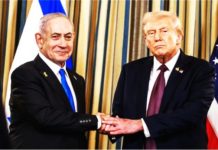
When deterrence ceases to be credible, power retreats without admitting it. This is what Trump and Netanyahu are doing in the face of Khamenei.
 Magnetic Trap (detail), Oil on Canvas, Jean-Pierre Civade, 2025.
January 2026 will be etched in the annals of international relations as a moment of strategic truth for the United States and Israel. After weeks of martial threats, public ultimatums, and carefully orchestrated leaks about imminent strikes against Iran, Washington and Tel Aviv abruptly slowed down, adjusted their posture, and reintroduced a language of caution previously thought to be reserved for periods of weakness. This apparent retreat stems neither from moral restraint nor from a calculated diplomatic effort, but from the confrontation with a geopolitical reality that has spiraled out of control.
What is at stake here transcends Iran and even the Middle East: it is the collision between a power architecture inherited from the 20th century and a world that no longer allows itself to be disciplined by this architecture in the 21st century. The central question is therefore: Did Trump and Netanyahu back down by choice or because the wheels were turning them toward a systemic strategic defeat?
This article seeks to show that the capacity for harm of the US-Israel duo depends on factors internal to Iran, but also on the alignment of the immediate neighbors of the designated adversary.
Indeed, the brutality of the strategic reversal observed during this first month of the year can only be understood by deconstructing the myth upon which the projection of American and Israeli power in the Middle East has rested for decades. Contrary to the official narrative, amplified by the mainstream media, Western military superiority has never been based solely on the quality of weaponry, technological sophistication, or troop training. It has relied above all on a permissive regional environment, on the active or passive complicity of the designated adversary’s neighbors, on the infiltration of local security apparatuses, and on the methodical purchase of internal loyalties. When this ecosystem functions, force becomes almost secondary. When it falters, the war machine reveals its structural vulnerability.
The Venezuelan precedent remains highly illuminating in this regard. American covert operations targeting Caracas never relied on a conventional invasion, but rather on targeted bribery of high-ranking officers, promises of amnesty, economic strangulation, and the internal fragmentation of the military command. Where treachery was achieved, American influence grew. Where it failed, firepower proved ineffective. This model, transposed to the Iranian case, hit a wall. Not only did the Iranian security apparatus demonstrate, downstream, an ideological and institutional resilience greater than anticipated by Western planners, but above all, the regional environment refused to play its traditional role as a sounding board for American strategy.
The categorical refusal of Iran’s Arab neighbors to offer their territory as a rear base, logistical platform, or air projection area marks a historic turning point. This refusal is not merely ideological; it is de facto rational. The Gulf capitals, traumatized by the economic, energy, and security consequences of proxy wars, have understood that an open conflict with Iran would be neither short nor controllable. By keeping their distance, they have deprived Washington and Tel Aviv of what had hitherto been their decisive advantage: regional depth. Without this depth, any strike becomes an isolated, costly, politically risky, and strategically sterile act.
It is within this operational vacuum that the rise of the Moscow-Beijing-Tehran triangle is taking place. This is not an ideological alliance or a formal military pact, but a convergence of fundamental interests. Russia sees the stabilization of Iran as a bulwark against Western encirclement and a lever in its global confrontation with NATO, knowing that this confrontation is also the sole trigger for the conflict in Ukraine. China considers Iran a central energy and logistical hub for its Eurasian project, while de facto seeking to neutralize any major disruption to trade routes, the new Silk Roads, of course. Iran, for its part, has understood that its survival no longer depends on an asymmetrical confrontation with Washington, but on its integration into a system of indirect and multipolar deterrence.
This reconfiguration has profoundly altered the cost-benefit analysis of any American or Israeli military action. A strike against Iran would no longer be a message of dominance, but a trigger for multidimensional systemic instability, immediately entailing asymmetric economic, cyber, and maritime responses, with equally immediate repercussions on global markets and energy balances. Trump, despite his rhetoric of strength, remains an actor hypersensitive to economic signals and the risks of uncontrolled chaos; he is a “dealmaker” who puts “Make America Great Again” (MAGA) and “America First” at the forefront of all his slogans, with “I will make deal ” as his watchwords in closed or open negotiations. Netanyahu, politically weakened and dependent on an already overexposed Israeli deterrent, knows that a prolonged regional war would exceed his own country’s absorption capacity.
The most disturbing truth is that American and Israeli military power, deprived of local support, internal complicity, and organized betrayals, proves far less decisive than it claims. Technology does not replace geopolitics, and military superiority does not compensate for strategic isolation. In January 2026, it wasn’t just Iranian missiles that stopped Washington and Tel Aviv, but the realization that the downward spiral was leading them toward a conflict they could neither control nor win politically. Not only are Trump and Netanyahu each despised by the majority of their own people, but in addition, the entire world is turning against them.
This retreat is therefore neither an accident nor a tactical pause. It constitutes an implicit admission: the unipolar order is over, and any attempt to resurrect it by force now produces the opposite effect. Iran has not triumphed through war, but through the transformation of the battlefield itself. By forcing its adversaries to confront the true cost of escalation, it has shifted the center of gravity of the confrontation.
Clearly, Trump and Netanyahu’s backpedaling about-face in the face of Khamenei is not a sign of wisdom, but a symptom of a world that has become too complex to be governed by old reflexes. It is one of the eloquent proofs that in the new global order, power is no longer proclaimed, but negotiated, disseminated, and protected through the balance of interdependencies. Those who persist in confusing intimidation and deterrence discover at the school of Washington and Tel Aviv, often too late, that the machinery they have set in motion threatens first and foremost to crush them themselves.
In conclusion, let’s say that in this reversed gear, it is no longer the targets who tremble, but those who threaten.
*Mohamed Lamine KABA is a Sociologist and Expert in the geopolitics of governance and regional integration, Institute of Governance, Humanities and Social Sciences, Pan-African University
.
We remind our readers that publication of articles on our site does not mean that we agree with what is written. Our policy is to publish anything which we consider of interest, so as to assist our readers in forming their opinions. Sometimes we even publish articles with which we totally disagree, since we believe it is important for our readers to be informed on as wide a spectrum of views as possible.
 US Surging Military Assets To the Middle East To…
 Iran’s Khamenei Says US Attack Will Lead to ‘Regional War’
 Netanyahu’s Warning Was a Significant Factor in…
 Trump Asks For ‘Decisive’ Military Operations for Iran
 Maduro Calls Netanyahu “21st Century Hitler,”…
 Iran, China and Russia sign trilateral strategic pact