The Electronic Intifada
January 10, 2026
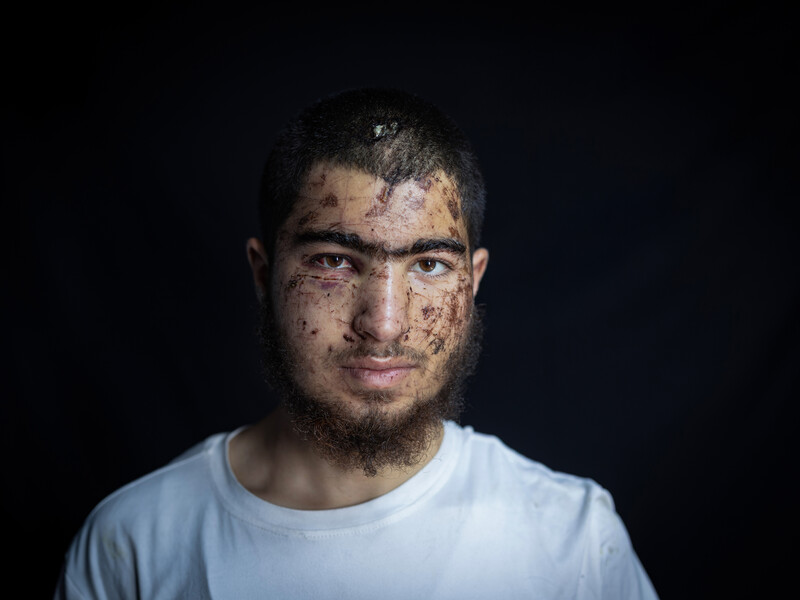
Uwais Hammam, 18, from the village of Khirbet Bani Harith, is treated at the Palestine Medical Complex in the West Bank city of Ramallah after being kidnapped and assaulted by settlers and soldiers, leaving him with serious injuries, 6 December. During the attack, a gun was cocked near his ear and he was told that he would die. ActiveStills
Israeli forces killed 50 people in the occupied Gaza Strip and injured at least 224 others between 3 and 29 December, despite the declaration of a ceasefire in October.
Among them was photojournalist Mahmoud Wadi, 34, killed by a drone-fired missile while he was filming with a drone in Khan Younis on 2 December. Another journalist working for Al Jazeera was injured in the strike, according to the Palestinian Center for Human Rights.
As of 31 December, the cumulative total of people killed in Gaza since 7 October 2023 stood at 71,269, according to the health ministry in the territory. An additional 171, 232 injuries were recorded during that period.
The total number of fatalities includes 569 people who were retroactively added between 5 and 26 December after their identification details were reviewed by a health ministry committee.
The number of fatalities also includes 414 people who were killed and 1,145 injured in Gaza after the ceasefire began on 10 October, as of 29 December. The health ministry reported that 680 bodies were recovered during that same period.

Palestinians look at photos of bodies in the hope of identifying missing family members after 15 bodies were handed over by Israeli authorities, Khan Younis, southern Gaza, 1 December 2025. Most of the returned bodies were unrecognizable. ActiveStills
The Palestinian Civil Defense in Gaza said in early December that it exhumed nearly 50 bodies from temporary graves at Al Ahli Arab Hospital and nearly 100 from makeshift graves at Al-Shifa Hospital, both in Gaza City. Eighty of the exhumed remains were unidentified.
On 15 December, rescue workers recovered the remains of around 20 people from the site where a multi-story building was bombed in December 2023. “Around 60 people, including 30 children, were believed to be sheltering” in the building when it was hit, according to Reuters.
“Gaza authorities are meanwhile still digging to recover around 9,000 bodies they estimate remain buried in rubble from Israeli bombing during the war, but they lack the machinery needed to expedite the work,” Reuters added, citing a Gaza Government Media Office spokesperson.
On 19 December, at least five people were killed in an Israeli strike on a school being used as a shelter for displaced people in al-Tuffah in eastern Gaza City, west of the area where Israeli ground forces remain deployed.
The health ministry in Gaza said that 19 people died during December as a result of damaged buildings collapsing during a low-pressure storm system. Six children in Gaza died in flooding or as a result of cold exposure during the month, according to the UN children’s fund UNICEF.
A child was killed by unexploded ordnance in Nuseirat refugee camp in the central Gaza Strip on 18 December, according to the Palestinian Civil Defense.
Julius Van Der Walt, an official with the UN Mine Action Service in Gaza, said in early December that there was an “absolutely immense” level of contamination in the densely populated territory.
Van Der Walt said that people were being injured “simply by collecting basic necessities on a day-to-day basis.” Lacking safe alternatives, families “have no choice” but to shelter in likely contaminated areas.

Israeli forces were deployed in more than 50 percent of Gaza’s territory and “beyond the ‘yellow line’ which remains largely unmarked on the ground,” the UN Office for the Coordination of Humanitarian Affairs stated in late December.
The Israeli military continued to detonate and bulldoze homes near or east of the yellow line demarcating the presence of its ground forces during December while “access to the sea remains prohibited,” according to OCHA. Four fishers were reportedly detained by Israeli forces off of the coast of Khan Younis on 14 December.
Before October 2023, one million people – nearly half of Gaza’s population – lived in the areas of Gaza that are now under Israeli military control. Satellite imagery shows that the Israeli military has flattened entire districts in the areas it controls as part of an effort to “systematically raze entire neighborhoods all over Gaza,” Haaretz reported during December.
“Access to humanitarian facilities and assets, public infrastructure and agricultural land remain severely restricted or prohibited” in areas beyond the yellow line, OCHA said.
Thirty-five health facilities are located east of the so-called yellow line where Israeli ground forces remain deployed, including eight hospitals. Four out of six formerly functional hospitals in the North Gaza governorate are currently inaccessible.
The UN said during December that humanitarian convoys “require coordination with Israeli authorities to and from crossings and in or near other areas where Israeli forces remain deployed” in Gaza.
Around 150 families living in al-Tuffah were forcibly displaced from the neighborhood “following the intensification of military activities and reported reception of verbal evacuation notices,” OCHA said. “Some families remained in the area due to the lack of alternative shelter options.”
Hundreds of families meanwhile evacuated from shelter sites along the shoreline due to severe storm conditions and flooding during December.
More than 16,400 displacement movements were recorded between 3 and 9 December, according to OCHA. The vast majority of movements were from Gaza’s south to the north, with “overcrowded living conditions in Khan Younis displacement sites and lack of access to adequate shelter materials” driving the trend.

Nearly 1,100 patients in Gaza died while awaiting medical evacuation between July 2024 and 28 November 2025, according to health ministry data, though this figure is based solely on reported deaths and is likely lower than the true number.
More than 18,500 patients, including nearly 4,100 children, are still awaiting medical evacuation in Gaza, Rik Peeperkorn, the World Health Organization’s representative for the West Bank and Gaza Strip, told reporters in December. Only 260 patients along with 800 companions had been evacuated between the beginning of the ceasefire in October and 17 December.
Severe weather flooded an emergency department at Nasser Medical Complex, the largest hospital in southern Gaza, and required the temporary relocation of patients, according to OCHA. Several medical facilities in Gaza were “affected by heavy rainfall and flooding,” disrupting health service delivery, OCHA added.
Since the October ceasefire, 55 health service points have been established or reopened, including an International Medical Corps field hospital in Gaza City, according to OCHA. The Palestine Red Crescent Society repaired and resumed patient care at Al-Quds Hospital, the UN office added.
The Red Crescent opened a rehabilitation hospital in Khan Younis on 2 December while the Hamad rehabilitation hospital reported that it had “provided more than 100 people with prosthetic limbs since March 2025,” OCHA said.
But only half of Gaza’s hospitals – and less than half of primary health care centers – “are currently partially functional and face shortages of essential medical equipment and supplies,” OCHA said.
The World Health Organization has “faced challenges” in bringing laboratory equipment and components into Gaza because Israel classifies many items as “dual use,” according to OCHA.
Gaza’s population of more than 2 million people lacks a single functioning magnetic resonance imaging (MRI) machine. The UN health organization said that medical supplies must be given blanket approval and expedited entry into Gaza.
UNICEF said that it was replacing destroyed “incubators, ventilators and other lifesaving equipment” and had provided supplements to more than 45,000 pregnant and breastfeeding women since the beginning of the ceasefire.
Tess Ingram, a spokesperson for the UN children’s fund, said on 9 December that aid “must be supplemented by commercial goods that restock local markets with enough nutritious foods, so the prices continue to fall.”
“This ceasefire should offer families safety, not more loss,” Ingram added. “More than 70 children have been killed in the eight weeks since the ceasefire began. The ongoing attacks and the killing of children must stop immediately.”

The Israeli military raided and vandalized the offices of the Union of Agricultural Work Committees in the occupied West Bank cities of Ramallah and Hebron on 1 December.
The raid against the Palestinian group was the latest in an escalated Israeli campaign targeting “Palestinian civil society and human rights defenders, most recently in the context of the olive harvest season,” the UN human rights office in the West Bank and Gaza stated.
The UAWC is one of six prominent Palestinian civil society groups branded as “terrorist” organizations by the Israeli government in 2021.
The designations are based on Israeli law “that has vague and broad definitions of terrorism and terrorist organizations, which not only risks but has demonstrably led to unjustifiable restrictions on human rights,” the UN office said. No evidence has been provided to substantiate the accusations.
“The attack on UAWC followed weeks of harassment and public incitement by Israeli settlers and leaders of settler groups, particularly citing UAWC’s work during the olive harvest season,” the UN office added.

On 1 December, three leading Palestinian human rights groups – Al-Haq, Al Mezan and the Palestinian Center for Human Rights – expressed “grave concern regarding the sustained harassment, intimidation, threats and sanctions directed by the US and Israel” against the International Criminal Court and groups and individuals cooperating with the tribunal.
The US sanctioned the three Palestinian groups for engaging with the court’s investigation of Israeli nationals “without Israel’s consent,” thereby safeguarding and entrenching “Israel’s settler-colonial apartheid regime and its unlawful occupation,” the groups said.
The statement from the Palestinian groups was issued at the beginning of the Assembly of States Parties to the Rome Statute – the treaty that founded the ICC – at the Hague during the first week of December.
The Assembly of States Parties to the Rome Statute has made “no reaction” to the sanctions targeting their work, the Palestinian groups added. Meanwhile, the US and Israel have attended the assembly as observer states “despite their continuing efforts to undermine the work of the court,” the groups said.
In a separate statement, Al-Haq said that the US sanctions “have resulted in multiple detrimental effects on our operations, our ability to continue representing victims and document human rights violations.”
The organization’s bank accounts were closed and staff with US citizenship were forced to resign. The sanctions also resulted in a loss of funds and have jeopardized joint advocacy with “US-based partners … ultimately restricting their freedom of speech.”
YouTube, which is owned by Google, shut down Al-Haq’s accounts “without warning, permanently deleting hundreds – if not thousands – of videos, documentaries and testimonies collected from victims of international crimes in Palestine.”
The email newsletter service Mailchimp shut down Al-Haq’s distribution to “thousands of journalists and followers around the world” without warning while Meta disabled the group’s ability “to use ads and promotions.”
“These are attacks on the entire human rights movement globally and an attempt to silence victims of genocide,” Al-Haq stated.
Several International Criminal Court prosecutors and judges have also been sanctioned by the US government, as has Francesca Albanese, the UN special rapporteur on the human rights situation in the West Bank and Gaza Strip.

Some 1.7 million children are among 3.3 million people in need of assistance in the West Bank, including East Jerusalem, and Gaza Strip, the UN children’s fund UNICEF said in December.
“Around 132,000 children remain at risk of malnutrition,” UNICEF added, and more than 1 million children “require psychosocial support, and 765,000 children need access to education.”
In the West Bank, more than 150,000 children “face barriers to accessing education,” according to UNICEF.
Nearly everyone in Gaza is prone to public health risks due to the destruction of water, sanitation and waste management infrastructure.
Meanwhile, “no hospital is fully functional while 39 percent of hospitals are partially functional,” UNICEF added. Only one percent of Gaza’s primary healthcare centers are fully functional, and around a third are partially functional.
Tess Ingram, UNICEF’s communication manager, told reporters on 9 December that “low birth weight is generally caused by poor maternal nutrition, increased maternal stress and limited antenatal care.”
More than a third of pregnant women screened by UNICEF and other organizations between July and September were diagnosed with acute malnutrition.
“Even now, we continue treating them in high numbers,” Ingram added.
“This pattern is a grave warning and will likely result in low birth weight babies being born in Gaza for months to come,” Ingram said, noting that “there was no discernible malnutrition among this group before October 2023.”

Israeli authorities raided the headquarters of UNRWA, the UN agency for Palestine refugees, in East Jerusalem on 8 December.
They replaced the UN flag with an Israel flag, Ramiz Alakbarov, the UN secretary-general’s Middle East envoy, told the Security Council later in the month.
Philippe Lazzarini, the head of UNRWA, warned that the Israeli raid sets “a dangerous precedent anywhere else the UN is present across the world.”
Antonio Guterres, the UN secretary-general, said that the UNRWA compound “remains United Nations premises and is inviolable and immune from any other form of interference.”
Israel claimed that it seized the UNRWA compound due to unpaid property taxes but the UN agency, which has been banned from operating by Israel, denied owing debts.
On 29 December, Israel’s parliament approved an amendment to bills passed previously in October 2024 blacklisting UNRWA. The amended law strips the agency of diplomatic immunity, potentially exposing it “to legal action in Israeli courts,” The New York Times reported.
“It also bars Israeli companies from providing water, electricity or financial services to UNRWA institutions,” the paper added. “The law will also allow the Israeli authorities to expropriate two UNRWA offices in East Jerusalem.”
Guterres condemned the move.

On 11 December, Amnesty International published a nearly 175-page report examining what it described as “abuses by Hamas and other Palestinian armed groups during the attacks of 7 October 2023,” including “war crimes and crimes against humanity.”
According to Amnesty, which said it began its study in the wake of the attacks, “the vast majority of civilians who died were killed by Palestinian fighters and that all held in Gaza were unlawfully detained as hostages.” While Hamas, whose armed wing led the assault, had denied targeting civilians, Amnesty found that attacks on civilians were “both widespread and systematic.”
More than 1,200 people were killed during the attacks, more than 800 of them civilians, including at least 36 children, according to Amnesty. Another 4,000 people were injured.
More than 375 people were killed in an apparently unplanned attack at the Nova music festival – the highest number of fatalities among the sites of attacks.
More than 250 people – both civilians and soldiers – were seized and brought by force into Gaza. That figure includes at least 36 people who were killed on 7 October 2023 and whose bodies were held in Gaza.
At least 35 people who were not Israeli citizens were abducted and taken to Gaza that day, both dead and alive.
All but 36 of the children seized on 7 October 2023 were subsequently released alive, except for 9-month-old Kfir Bibas and 4-year-old Ariel Bibas. Israeli authorities claimed that forensic evidence showed that the brothers were killed by their captors a month after they were seized “but provided no evidence to substantiate their claim,” according to Amnesty.
As of 4 December 2025, 158 living captives and 34 bodies of people seized on 7 October 2023 were released, the majority in exchange deals that secured the release of some of the thousands of Palestinians held by Israel. The body of one captive remains in Gaza as of the end of December.
“Eight living hostages and 50 bodies had been rescued or retrieved through Israeli military operations,” according to Amnesty. Hundreds of Palestinians were killed by the Israeli military during operations to rescue captives held in Gaza.
Of those believed to have been brought into Gaza alive, 48 died during captivity. At least six were killed by their captors “while others died as a result of Israeli military operations,” Amnesty added.

Amnesty said in its report on 7 October 2023 that it “investigated in detail incidents in which around 100 people who were confirmed as civilians or presumed to be civilians died, concluding that they were killed by fighters.”
The rights group acknowledged that some Israeli civilians were killed unintentionally by Israeli forces or as part of the Hannibal Directive. However, Amnesty said “it reviewed and cross-checked evidence that fighters were responsible for killing the vast majority of the remaining civilians who died in the attacks it documented, including the fact that the Israeli military was not present when most killings happened.”
Amnesty said that it “identified a number of patterns” whereby “fighters targeted civilians in their homes, including in safe rooms, sometimes setting houses on fire, either to kill or drive out the inhabitants.” It also found that fighters “fired into areas full of civilians and targeted terrified civilians who were trying to flee” and killed civilians in cars “by firing at them with guns or burning them alive.”
People were also killed while trying to hide or were summarily killed after being abducted, according to Amnesty.
The rights groups said that it “found no evidence that Hamas or other Palestinian armed groups gave orders to their fighters to commit acts of sexual violence during the attacks” but concluded that members of Hamas or its military wing “committed sexual violence against hostages in captivity.”
“Amnesty International did not consider that it had collected enough evidence to definitively conclude that rape, as opposed to sexual assault more broadly, was committed” on 7 October 2023, the group said, noting the lack of crime scene documentation.
The Israeli military estimates that more than 1,600 Palestinian fighters were killed and nearly 150 others captured during the attacks. Israeli authorities claim to be holding at least 200 Palestinians allegedly involved in the 7 October 2023 attacks or holding hostages but have not charged any of them, Amnesty added.
Hundreds of Palestinian detainees from Gaza being held without charge or trial “have been subjected to torture and other ill-treatment, including sexual violence, and are being held incommunicado and subjected to enforced disappearance,” Amnesty said.

Also on 11 December, Agnès Callamard, the secretary general of Amnesty International, said that “there is no greater litmus test” for the international justice system than in Israel and the occupied West Bank and Gaza.
In November, Amnesty stated that Israel’s genocide in Gaza continues unabated despite the ceasefire declared in October.
Callamard called for an international roadmap “to end Israel’s genocide, its system of apartheid and unlawful occupation” complemented by accountability mechanisms, including the International Criminal Court’s investigations.
States should enforce the ICC arrest warrants and ensure the lifting of sanctions imposed on Palestinian human rights groups, Amnesty added. Amnesty faulted Donald Trump’s “peace plan” for seeking to “sideline international law” and overlooking “the root causes of the continuous atrocities Israel inflicts upon Palestinians.”
Amnesty said that “is critical to also ensure accountability for crimes committed by Palestinian armed groups.”

Israel’s attacks and “chronic displacement, siege and starvation have devastated the lives of women in Gaza and eroded whatever control they had over their lives,” the UN human rights office in the West Bank and Gaza stated on 11 December.
Nearly all of Gaza’s hospitals were damaged or destroyed in Israel’s attacks, “denying women access to essential health care, including reproductive healthcare,” the UN office added.
Israel’s blockade, hindering the entry of medical supplies and nutrients, has also contributed to a spike in the rate of women who die from child birth, as well as an increase in miscarriages and newborn deaths.
So has Israel’s apparent deliberate targeting and killing of health care workers, the UN office added.
“Births have dropped by a staggering 41 percent in the first half of 2025 compared to the same period in 2022,” the UN office said, citing health ministry data.
More than 20,000 children have been killed in Israeli attacks since October 2023, compounding “the demographic and emotional toll of the crisis.”
The UN office noted that the International Court of Justice ordered Israel to prevent the commission of acts within the scope of the Genocide Convention, including “measures intended to prevent births within the group.”
Israel’s shelling of Gaza’s largest fertility clinic in December 2023 led to the loss of more than 4,000 embryos and “1,000 specimens of sperm and unfertilized eggs,” the UN office said.
Women are among the thousands of Palestinians arbitrarily detained by the Israeli military “amid documented patterns of torture and ill-treatment, including physical and sexual violence.”
“These include cases of rape of men and boys, sexual assault and harassment of women detainees, and the denial of sexual healthcare services to survivors,” the UN office added.
The UN Population Fund said on 24 December that “some 150 babies are born every day in Gaza, yet essentials like water, soap and electricity are scarce,” while women are forced to give birth without privacy in packed rooms.
Amid Gaza’s “shattered” healthcare system, midwives have served an essential role in stabilizing women who have hemorrhaged after giving birth and in resuscitating newborns “with limited or nonexistent equipment,” the UN Population Fund added.

Al Mezan, a human rights group based in Gaza, said on 14 December that humanitarian conditions in the territory had “deteriorated to an unprecedented level following Storm Byron” that arrived days earlier.
“Relief efforts by emergency crews have been severely hampered because affected areas remain largely inaccessible due to debris and rising water levels,” the human rights group added.
Medical workers were constrained in their treatment of cold-related illnesses due to the total depletion of more than 50 percent of essential medicines in Gaza as well as medical consumables and supplies.
Excessive flooding has engulfed large areas, submerging tents in rainwater mixed with wastewater, and caused homes badly damaged in Israeli attacks to “collapse onto their occupants,” Al Mezan said.
The Palestinian Center for Human Rights, also based in Gaza, warned shortly before the arrival of Storm Byron that “thousands of worn-out tents sheltering more than 1 million displaced persons” were expected to be destroyed by the severe weather.
People in Gaza require “hundreds of thousands of temporary residential units, not merely a few thousand additional tents that offer no protection from rain, wind, or cold,” PCHR said.
The rights group called for weather-resistant prefabricated housing units “equipped with sewage systems, alternative energy sources and infrastructure ensuring a minimum level of privacy and safety.”
PCHR added that Israel’s ongoing restrictions on the entry of shelter materials into Gaza is a continuation its genocide.
Mahmoud Basal, the spokesperson for Gaza’s Civil Defense, called for the provision of mobile homes and caravans for displaced Palestinians after two buildings collapsed, killing at least 12 people, on 12 December.

Israeli forces and settlers killed 13 Palestinians in the West Bank during December, including a man with Israeli citizenship and five children.
In the night between 1 and 2 December, Muhannad Zughair, 17, was shot and killed by Israeli forces in the southern West Bank city of Hebron.
Israeli authorities claimed that the teen had attempted to run over a soldier at a checkpoint, “resulting in a minor hand injury,” according to Defense for Children International-Palestine.
A man identifying himself as Captain Younis called the boy’s family and demanded that he be handed over for involvement in the traffic incident.
“Following the incident at the checkpoint, Israeli forces pursued Muhannad and ultimately shot and killed him, announcing his death at 4 am on 2 December,” DCIP stated. Israeli authorities confiscated the teen’s body.
Palestinian journalists found Muhannad’s smashed and bullet-riddled car on a dirt path off of a highway, Haaretz reported.
“The army most likely has video footage of the whole incident – the checkpoints and the roads there are well surveilled – but it has not made it public,” the paper added.
Muhammad Asmar, 18, was shot and killed by Israeli forces near Umm Safa, a village near the central West Bank city of Ramallah. The Israeli military claimed that the teen had stabbed and lightly wounded two soldiers before he was shot.
Wafa, the official Palestinian news agency, said that soldiers prevented medics from reaching the boy and his body was confiscated by the Israeli military.
On 5 December, Bahaa Rashed, 38, died after he was shot in the head by Israeli forces during a raid on Udala, a village near Nablus in the northern West Bank.
On 8 December, Muamin Abu Riyash, a 19-year-old with Israeli citizenship living in the West Bank, was shot and killed by soldiers while traveling in the northern West Bank. Another man who was shot in the same incident – Baraa Qablan, 21 – died from his injuries while in Israeli custody.
The Israeli military claimed that the young men had thrown stones at vehicles. “A third passenger was arrested,” according to OCHA.

On 10 December, Palestinian authorities announced the death of Abdulrahman al-Sabateen, 21, in Israeli custody. Al-Sabateen, from the town of Husan near the southern West Bank city of Bethlehem, had been detained since late June.
The death of another detainee from Husan – Sakher Zaoul, 26, held since June, was announced on 14 December.
On 4 December, Palestinian authorities announced the names of three Palestinian men from Gaza who were confirmed to have died in Israeli custody: Taysir Sababa, 60, Khamis Ashour, 44 and Khalil Haniyeh, 35.
“According to the responses [given by the Israeli military to a human rights group], Sababa died on 31 December 2024, two months after his arrest; Ashour died on 8 February 2024, one day after his arrest; and Haniyeh died on 25 December 2024, approximately one year after his arrest,” Wafa reported.
At least 84 Palestinians, including a 17-year-old boy, died in Israeli detention between 7 October 2023 and 10 December 2025. Among them were 54 people from Gaza, 28 from the West Bank and two Palestinians with Israeli citizenship, according to UN data.
At least five Palestinians from the West Bank died in Israeli custody “shortly after being shot, injured and arrested by Israeli forces; four in 2024 and one in 2025,” according to OCHA.
As of November 2025, nearly 9,200 Palestinians were being held in Israeli prisons and detention centers. This includes nearly 3,370 people held without charge or trial under administrative detention orders and 1,220 people held as “unlawful combatants,” according to data from Hamoked, an Israeli human rights group.

On 6 December, Israeli forces shot and killed Ahmad Rajabi, 17, while he was driving home after visiting a hospitalized friend in the West Bank city of Hebron.
Israeli authorities claimed that the teen had attempted to run over a soldier.
Defense for Children International-Palestine said that soldiers at a checkpoint ordered Ahmad to stop before opening fire at his vehicle.
“One of the soldiers attempted to open the driver’s door, and as the car skidded, the front driver’s side hit him,” according to DCIP. “The vehicle eventually stopped in the middle of the road, where the soldiers continued to fire at the car, killing Ahmad.”
The soldiers fired at an ambulance that arrived, preventing medics from accessing Ahmad, whose body was confiscated.
A 55-year-old municipality sanitation worker named Ziad Abu Dawood was shot during the barrage of fire and was left to bleed to death before his body was transferred to the Palestine Red Crescent Society, according to Wafa.

Israeli forces shot and killed Muhammad Abahra, 16, in an alleyway in the town of Silat al-Harithya near Jenin in the northern West Bank on 13 December.
The slain teen “allegedly participated in confrontations with Israeli forces alongside other young Palestinians who were throwing explosive devices toward a heavily armored Israeli military vehicle,” according to DCIP.
Muhammad was “targeted by Israeli forces positioned inside a Palestinian home,” DCIP added. Soldiers prevented an ambulance from reaching the boy and placed him in a military vehicle before withdrawing.
His body has not been returned to his family.
On 15 December, Israeli forces shot and killed Ammar Taamrah, 16, in Tuqu, a town near Bethlehem in the southern West Bank.
Defense for Children International-Palestine said that “Ammar was shot in the chest while heading to the bakery in the town center, where his father works and where he often goes to help him.”
The following day, Muhib Jibrin, 18, who had witnessed his friend Ammar’s killing, was shot and killed by a settler after Ammar’s funeral, who fired at stone-throwers from his vehicle.
According to Gideon Levy, reporting for Haaretz, Israeli soldiers in armored vehicles enter Tuqu daily with the apparent sole purpose to “draw youths into the streets and get them to throw stones – and then shoot them.”

Defense for Children International-Palestine said on 16 December that 2025 marked yet another “devastating year in which Palestinian children endured genocide, starvation, torture, mass displacement, enforced disappearance, and relentless violence by Israeli forces and settlers.”
Children have been “systematically stripped” of their rights while world leaders shielded Israel from accountability, “despite overwhelming evidence of mass atrocity crimes,” the rights group added.
“As a result, Palestinian children remained unprotected as Israeli forces used starvation as a weapon of war and continue to escalate torture in detention, disappear children in Gaza and kill and maim children across the occupied territory with impunity.”
As of 16 December, Israeli forces and settlers had killed 54 Palestinian children in the West Bank, according to DCIP’s documentation.
Israeli authorities have withheld the bodies of at least 62 Palestinian children since June 2016. Only the bodies of six of those children have been returned to their families.
The rights group said that Israel’s deliberate use of starvation “constituted torture under international law and forms part of a broader genocidal strategy against Palestinians in Gaza.”
Israel’s detention of children without charge or trial spiked to “all-time high record levels” in 2025, including a 14-year-old boy – the youngest child yet to be placed under administrative detention order since DCIP began monitoring in 2008.
Children are routinely abused and tortured and held in solitary confinement “for days or weeks at a time.”
Meanwhile, “a surge in enforced disappearances marked one of the gravest developments of 2025,” DCIP said, with Israeli forces abducting children while they were seeking aid. Anguished families are left not knowing whether their sons are alive or dead.

On 15 December, the appeals chamber of the International Criminal Court rejected one of multiple challenges made by Israel to the tribunal’s investigation of war crimes in the West Bank and Gaza Strip.
Judges ruled against the procedural challenge that contended Israel was not given due notice of an investigation, a step that allows states to initiate domestic prosecutions or inform the court of an existing domestic judicial process.
The appeals chamber decision maintains the court’s arrest warrants for Benjamin Netanyahu, Israel’s prime minister, and Yoav Gallant, formerly its defense minister.
The Trump administration in Washington announced sanctions against two judges of the appeals chamber who voted in favor of rejecting the Israeli challenge a few days after the panel’s decision was issued.
Kimberly Prost, a Canadian ICC official who was sanctioned previously over her role in investigating US forces in Afghanistan, told the AP news agency during December that “I’ve worked all my life in criminal justice, and now I’m on a list with those implicated in terrorism and organized crime.”
The US is not a signatory to the Rome Statute that founded the ICC and is not among the court’s 125 member states.
On 10 December, the Trump administration threatened to sanction more ICC officials or the court as a whole if it did not amend the Rome Statute to shield the US president from prosecution. The US also demanded that the court end its investigations of Israeli leaders and formally close its probe of US personnel in Afghanistan, which ICC chief prosecutor Karim Khan deprioritized in 2021.
“Sanctions applied to the court as an entity could affect its basic day-to-day operations, from its ability to pay staff to access to bank accounts and routine office software on its computers,” according to Reuters.
The escalated moves against the court came in the wake of a “campaign of deadly strikes against suspected drug vessels in the Caribbean and off the Pacific coasts of Latin America, killing more than 80 people,” as Reuters reported. Weeks later, the US military attacked Venezuela and abducted the oil-rich country’s president and his wife.
On 29 December, the Palestinian human rights group Al-Haq said that France allowing Netanyahu to cross its airspace en route to the US was a breach of its obligations and set “a dangerous precedent for the court’s viability” while “entrenching Israeli impunity.”

On 16 December, the UN human rights office in the West Bank and Gaza said that the “unprecedented assault on civic space” in the territories has severely undermined Palestinian rights, including the “right to freedom of expression, assembly and association.”
Nearly 300 journalists have been killed in Israeli attacks since October 2023 and more than 200 detained, 41 of whom were still detained at the end of October this year.
The UN office said that it interviewed 15 journalists, including five women, who were among those detained.
“They described incommunicado detention, abusive interrogations, degrading treatment, inhumane detention conditions, and the routine use of physical and sexual violence, including two cases of rape,” the UN office stated.
Israel has banned the entry of international journalists to Gaza and has imposed “undue restrictions” on international media outlets in the West Bank, including the military’s forcible closure of Al Jazeera’s offices in Ramallah.
Palestinian groups engaged in human rights work have meanwhile been criminalized under Israel’s 2016 counter-terrorism law and defense regulations that predate the Israeli state. These laws have been used to justify raids on the offices of Palestinian civil society groups, constraints on their funding and the arrest of their staff.
Israeli lawmakers are advancing a bill that would impose a tax of up to 46 percent on foreign donations received by nongovernmental organizations that Israel says engage in “political activities,” the UN office noted.
Israel’s parliament has also introduced a bill that would criminalize the sharing of information with the International Criminal Court. “If passed, the law would compound the chilling effect of the sanctions against Palestinian human rights organizations for cooperating with the ICC,” the UN office said.
The UN office also said that the Palestinian Authority in the West Bank is also “contributing to the tightening chokehold on civic space through its unnecessary or disproportionate use of force, arbitrary detentions, torture and other ill-treatment of journalists, human rights defenders and government critics.”

The Integrated Food Security Phase Classification (IPC) issued its latest analysis for the Gaza Strip on 19 December.
The food security monitor said that famine conditions had been offset since its last report in August due to the October ceasefire and improved access for humanitarian and commercial food deliveries. “However, the situation remains critical,” the IPC warned.
Between 16 October and the end of November, three out of four people in Gaza faced high levels of acute food insecurity. Among them were more than 500,000 people classified as being in an emergency situation and more than 100,000 in a catastrophic situation – the most severe phase of food insecurity.
The IPC said that “the situation is expected to remain severe” in the coming months, though the number of people experiencing catastrophic food insecurity is projected to drop to fewer than 2,000 by mid-April.
Renewed hostilities and a halt in humanitarian and commercial deliveries to Gaza – a “worst-case scenario” – would put the entire population of the territory at risk of famine through mid-April, according to the IPC.
“The situation remains highly fragile and is contingent on sustained, expanded and consistent humanitarian and commercial access,” the IPC stated.
An estimated 101,000 young children were “expected to suffer from acute malnutrition and require treatment, with more than 31,000 severe cases” through mid-October 2026, according to the IPC. Some 37,000 pregnant and breastfeeding women were projected to suffer from acute malnutrition during the same period.
The hunger monitor observed that while nutritious food such as fresh vegetables and fruit are now available in Gaza’s markets, “most families cannot afford to buy them” and so diets remain poor. Meanwhile, “hygiene and sanitation conditions continue to be very poor,” accelerating the spread of disease, especially among children.
“After more than two years of war, households have exhausted their life savings, sold all remaining assets and have no coping strategies left,” the IPC stated.
“Unemployment affects around 80 percent of Gazans, leaving families without income. Efforts to rehabilitate the Gaza Strip are expected to take years.”
Following the publication of the IPC analysis, four principal UN agencies said that in Gaza, “humanitarian needs remain staggering, with current assistance addressing only the most basic survival requirements.”
The UN agencies – the Food and Agriculture Organization, UNICEF, World Food Program and World Health Organization – said they are ready to increase their efforts in Gaza but “import restrictions, access constraints and major funding gaps [were] severely hindering their capacity to operate at the necessary scale.”
“Without decisive action now, the gains made since the ceasefire could unravel quickly,” the agencies warned. “Only access, supplies and funding at scale can prevent famine from returning and help Gaza move from survival to recovery.”

Save the Children said on 19 December that four out of five children are still facing crisis levels of hunger in Gaza.
“Save the Children has repeatedly warned of the long-term damage to children’s physical and cognitive development without regular and nutritious food,” the charity added.
“Needs remain unmet and children are experiencing more severe and prolonged forms of malnutrition,” Save the Children said.
UN Women – a UN entity dedicated to empowering women – said that “women-headed households, which account for one in seven households, are particularly affected” by food insecurity.
“Two thirds of women-headed households depend on humanitarian assistance and community support networks,” UN Women added. Many of these households are “forced to skip meals, take on debt, deplete savings and sell personal belongings to make ends meet.”
The October ceasefire “failed to translate into improved safety and protection,” UN Women said. Since the ceasefire, “dozens of women and girls have been killed and hundreds more injured, with many sustaining life-altering disabilities.”

The World Food Program reported in December that the prices of food commodities had stabilized but remained “beyond the reach of most people” in Gaza, though the cost of wheat decreased to below the price from before October 2023.
“Dietary diversity continues to be low despite modest recovery in food consumption,” the UN food agency said. “Households remain dependent on cereals and pulses, with meat, fruits and vegetables consumed at critically low levels” compared to before October 2023.
More than half of all households were still relying on burning wood to cook food, while some 43 percent rely on burning waste. Only 1.5 percent of families surveyed by the World Food Program were using cooking gas, “while 1 percent have no cooking source at all.”
The agency said that the number of commercial and humanitarian aid trucks improved in November and December but the daily average of trucks entering Gaza was about half the daily average that entered before October 2023. It is also less than half of what is stipulated in the ceasefire agreement that began in October 2025.
The entry of commercial goods into Gaza is being subjected to “exorbitant” coordination fees and service charges, the World Food Program added, reaching “several thousand dollars per truck, varying by urgency and type of goods.”
The fees, damaged infrastructure, feed expenses and supply chain disruptions “are key drivers behind the continued high prices of essential commodities such as eggs, meat, poultry, fruits, vegetables and dairy products,” the UN agency added.

On 30 December, the UN children’s fund UNICEF said it was “deeply saddened by the preventable tragic death” of a 7-year-old boy during severe flooding in a camp for displaced people near Gaza City three days earlier.
In addition to Ata Mai, “at least five other children have lost their lives in December after being exposed to such harsh conditions,” UNICEF said.
Heavy rain, strong winds and freezing temperatures had affected around 100,000 families living in makeshift shelters over the previous week, UNICEF added. “With further rain and colder conditions forecast, the situation is expected to worsen.”
Heavy rains had also driven up “fuel needs for sewage pumping and stormwater drainage,” UNICEF said. The agency called for “the entry at scale of water treatment chemicals, spare parts and other essential supplies needed to repair, maintain and operate water and wastewater systems across Gaza.”
UNICEF also called for “urgent and large-scale entry of a full range of life-saving and life-sustaining supplies … including items that have previously been denied or restricted.”
Increased and sustained entry of fuel was also needed “to avert flooding, sewage exposure and serious public health risks, including disease outbreaks linked to disrupted solid waste collection,” UNICEF said.
An estimated $66 million in damages to Gaza’s solid and medical waste management systems were incurred since October 2023, OCHA stated in December.
“This includes the destruction or damage of more than 200 waste collection trucks, 18 pieces of landfill equipment, five medical waste vehicles, two medical waste microwaves, 90 facilities and approximately 6,000 waste containers,” OCHA said.
Meanwhile, Gaza’s two main landfills have remained inaccessible, “forcing municipalities and partners to rely on temporary dumping sites.”
Waste is primarily collected “using donkey carts and tractors, while secondary collection depends on a limited number of tipper and compactor trucks,” OCHA added.
The UN office said that waste generation “continues to outpace collection capacity in several areas due to lack of access to landfills, insufficient fuel allocations and restrictions on the entry of spare parts, waste collection machinery and other equipment.”
OCHA reported in December that “access to water has improved in Gaza owing to repairs to critical infrastructure and a near-doubling of water trucking by the UN and its partners.”

Israeli forces shot and killed Rayan Abu Mualla, 16, during an incursion in Qabatiya, a town near Jenin in the northern West Bank, on 20 December.
Defense for Children International-Palestine said that the teen was ambushed by soldiers who fired at him from close range. He was left to bleed while soldiers prevented an ambulance approaching and before the military confiscated his body.
The military claimed that Rayan threw a brick at soldiers but security camera footage shows that the boy was walking and unarmed when he was killed without warning.
On 26 December, a Palestinian man killed a man and woman in northern Israel in a ramming and stabbing attack. The alleged assailant, Ahmad al-Rub, from Qabatiya, was “wounded by a civilian before being arrested,” The Times of Israel reported.
The Israeli military raided and besieged Qabatiya for two days following the deadly attack and arrested at least 50 people.

On 23 December, Yousif Aqil, a 33-year-old from Bidya, a town near the central West Bank city of Salfit, succumbed to his injuries after being shot by Israeli forces a week earlier in al-Ram, near Jerusalem.
Wafa, the official Palestinian news agency, said that Aqil was shot while attempting to reach work in Israel.
A Palestinian man from a village near Qalqiliya fell while attempting to cross Israel’s West Bank wall near al-Ram. The man was taken to an Israeli hospital where he was pronounced dead; his body was withheld by Israeli authorities.
OCHA said that it had documented the killing of 16 Palestinians and the injury of 240 more while attempting to cross the Israeli wall since 7 October 2023, “when Israeli authorities revoked or suspended most permits that had allowed Palestinian workers and others to access East Jerusalem and Israel.”
Qais Allan, 20, died after Israeli forces opened fire on a vehicle in which four young men were traveling near Nablus in the northern West Bank on 30 December.
The Israeli military claimed that Allan had tried to run over soldiers, none of whom were injured.
Allan’s death brought to 240 the number of Palestinians killed in the West Bank during 2025.
Israeli forces carried out 225 of those killings, while 15 people were killed by settlers. Around a quarter of those killed were children.
“During the same period, Palestinians killed 17 Israelis, including one child and six members of Israeli forces, in the West Bank,” according to OCHA.
“In Israel, attacks by Palestinians from the West Bank killed three Israelis and one Palestinian perpetrator, in addition to a Palestinian killed in an attack by Israelis in West Jerusalem.”

The Israeli military began razing 25 buildings in Nur Shams refugee camp in Tulkarm on 31 December, affecting some 70 households that had already been displaced, according to OCHA.
One-third of all structures in the camp had been destroyed in May 2025, according to satellite imagery analyzed by the UN.
“Since then, Israeli forces have continued to carry out demolitions in Nur Shams camp, as well as Jenin and Tulkarm camps, but the areas have remained inaccessible for further assessments,” OCHA said.
On 26 December, Israeli settlers “carried out two consecutive attacks against Palestinians and their property” in Deir Dibwan village in the Ramallah area, according to OCHA.
At around 1 am that day, masked settlers, some of them armed, “cut the electricity supply and broke into a Palestinian-owned farm,” where they assaulted two sleeping workers and stole nearly 150 heads of sheep.
At noon the same day, dozens of settlers, some armed, attacked people working their land and who had gathered at the farm that was attacked earlier in the day.
Settlers opened fire and physically assaulted nine people, including four children and a 70-year-old man, “using clubs and metal chains.”
In the northern West Bank, the last six families living in Khirbet Yanun were displaced on 28 December after “a series of settler attacks and intimidation.”
The families had lived in the community for more than 60 years.
OCHA said that it had documented more than 1,800 settler attacks resulting in casualties or property damage in around 280 communities across the West Bank during 2025.
“This is an average of five incidents per day, marking the highest daily average since OCHA began recording such incidents in 2006,” the UN office said.
Around 1,200 people were injured during settler attacks, whether by settlers or soldiers.

In late December, Israel announced that it was suspending the registrations of more than 30 international nongovernmental organizations providing aid to Palestinians in the West Bank and Gaza Strip.
Ahead of the suspensions, UN agencies and nongovernmental organizations called for urgent international action to pressure Israel to “lift all impediments” to the registration process “or risk the collapse of the humanitarian response, particularly in the Gaza Strip.”
International nongovernmental organizations collectively deliver approximately $1 billion in assistance each year, the UN agencies and groups said.
In March, the Israeli authorities began a new regime for registering international nongovernmental organizations.
“The system relies on vague, arbitrary and highly politicized criteria and imposes requirements that humanitarian organizations cannot meet without violating international legal obligations or compromising core humanitarian principles,” the UN agencies and international groups said.
They added that in Gaza, the international nongovernmental organizations “run or support the majority of field hospitals, primary healthcare centers, emergency shelter responses, water and sanitation services, nutrition stabilization centers for children with acute malnutrition and critical mine action activities.”
In October, the International Court of Justice issued an advisory opinion finding that Israel must agree to and facilitate humanitarian aid in Gaza, particularly by UNRWA, the UN agency for Palestine refugees.
That advisory was welcomed by the General Assembly in a vote of 139 in favor, 12 against and 19 abstentions on 12 December.
In January 2024, the same court ruled that Israel must ensure that aid and services reach Palestinians in the besieged Gaza Strip.
The International Criminal Court also cited Israel’s restrictions on life essentials for Palestinians in Gaza when it issued arrest warrants for Benjamin Netanyahu and former defense minister Yoav Gallant.
Al-Haq said that Israel’s aim in sidelining international nongovernmental organizations is to “consolidate its genocidal conduct in Gaza – of which denial access to humanitarian aid remains a central element – to further fragment and isolate the Palestinian people from international support.”
The Palestinian rights group said that it was imperative that the states where the suspended organizations are based “take meaningful concrete actions” to constrain Israel.
Statements of condemnation “remain meaningless without proactive enforcement action, including a comprehensive arms embargo and effective economic, cultural and diplomatic sanctions,” Al-Haq added.

On 30 December, the foreign ministers of 10 countries, including stalwart Israel allies Canada, France and the UK, issued a joint statement expressing “serious concerns about the renewed deterioration of the humanitarian situation in Gaza which remains catastrophic.”
“As winter draws in, civilians in Gaza are facing appalling conditions with heavy rainfall and temperatures dropping,” the foreign ministers stated, while “the majority of the population … face high levels of acute food insecurity.”
The foreign ministers called for “Hamas to disarm and renounce violence” and for the swift transfer of the remains of the last deceased hostage in Gaza.
They called on Israel to ensure that international nongovernmental organizations “are able to operate in Gaza in a sustained and predictable way” as a deadline for conforming with new restrictive registration requirements loomed.
“One in three healthcare facilities in Gaza will close if international nongovernmental operations are stopped,” the foreign ministers stated. “Without them, it will be impossible to meet all urgent needs at the scale required.”
The foreign ministers also called on Israel to allow the UN, including UNRWA, “to continue their vital work” and to lift restrictions on what Israel calls “dual use” items, such as medical and shelter equipment.
“Finally, open crossings and boost the flows of humanitarian aid into Gaza,” the foreign ministers said, including Rafah crossing.
The UN reported that between 10 October and 16 December, Israel rejected the entry of around 9,000 metric tons of aid to Gaza. Most of the requests were submitted by local and international nongovernmental organizations and rejected “on the grounds that the organizations were not authorized to bring relief items into Gaza.”
The UN added that Israel also rejected items that it considers “to fall outside the ‘humanitarian’ category, or items classified as ‘dual use.’”
“In November, such rejected requests included frozen meat, tropical fruit, biscuits, vehicles, power equipment, specialized machinery, multipurpose tents and learning and recreational materials for children,” according to OCHA.
Dozens of international and Palestinian nongovernmental organizations working in the West Bank and Gaza reported that Israel was continuing to block lifesaving aid following the declaration of a ceasefire in October.
The vast majority of organizations reported that Israeli forces or settlers blocked access to people in need and that nearly $50 million in “life-saving aid is being blocked” from entering Gaza.

The second phase of the ceasefire in Gaza, which has nominally held since it was enacted on 10 October, appeared no closer to becoming reality at the end of December than it did at the beginning of the month.
Netanyahu met with Trump outside the US president’s residence in Florida in late December. During Netanyahu’s visit, Trump threatened to “eradicate” new weapons buildups in Iran.
He also warned that there would be “hell to pay” if Hamas did not disarm.
The prime minister of Qatar warned in early December that the situation in Gaza amounts to a “pause” in hostilities rather than a genuine ceasefire, which could only be achieved with “a full withdrawal” of Israeli forces.
The second phase of the ceasefire involves the formation of an International Stabilization Force. Muslim-majority countries who would support sending their troops for peacekeeping have said that Netanyahu opposed their inclusion.
The unclear parameters of the deployment of an international force has also led to uncertainty delaying its formation, as The New York Times reported in December.
The US military branch CENTCOM told military officials from other countries that “troops would be deployed in parts of Gaza currently controlled by Israel, and that a dedicated team would train over 4,000 Palestinian police officers,” according to The New York Times, which saw a copy of the presentation.
“The force’s deployment would begin near the southern city of Rafah and create the conditions for further Israeli military withdrawal,” the paper added. According to CENTCOM’s presentation, some 8,000 soldiers would be deployed and some of them tasked with securing flows of humanitarian aid.
Trump’s peace plan also involves a technocratic Palestinian committee overseen by a “Board of Peace” chaired by the US president, the details of which also remain murky.
Israel’s attempts to undermine Hamas’ reconsolidated authority in Gaza was dealt a blow by the killing of militia leader Yasser Abu Shabab, who made his name by looting aid convoys and cooperating with the Israeli military, in early December.
In an interview with Fox News in late December, Netanyahu said that Hamas’ refusal to disarm was the main obstacle hindering efforts to reach a second phase of Trump’s peace plan for Gaza.
He said that he would give an International Stabilization Force in Gaza a chance and suggested that it would disarm Hamas. “If we disarm Hamas, whether with an international force or by any other means, yes, I see a different future for Gaza,” Netanyahu said.

Data released by the Israeli military at the end of December showed that 151 soldiers were killed during 2025, “including 21 who took their own lives,” the daily newspaper Haaretz reported.
For the second consecutive year, more Israelis left the country than immigrated to it during 2025, according to statistics from Israel’s census bureau.
“More than 69,000 Israelis left the country in 2025 under the shadow of Israel’s war against Hamas in Gaza, leading the country to record a negative migration balance for the second straight year,” The Times of Israel reported, citing the census bureau’s year-end report.
The total population of the country rose by just over 1 percent, the same rate as the previous year, “making it one of Israel’s slowest years of growth ever,” the publication added.
On 24 December, Netanyahu said that Israel would spend $110 billion “to build an independent arms industry … and reduce the dependency on any party, including allies.”
On 29 December, the US Department of War announced that Boeing was awarded a nearly $8.6 billion contract for an additional 25 F-15 fighter jets for the Israeli military.
That same day, Hamas confirmed that Abu Obeida, the pseudonymous spokesperson of its armed wing, as well as its Gaza chief Mohammed Sinwar, were killed earlier in the year.
Israel assassinated Raed Saad, the commander of the military manufacturing unit of Hamas’ armed wing, in a strike near Gaza City on 13 December. Hamas said that a new commander had filled Saad’s place.

Israel repeatedly violated the ceasefire in Lebanon during December.
Israel bombed what it said were Hizballah sites in South Lebanon in early December.
On 23 December, Beirut rejected an Israeli claim that a Lebanese soldier who was among three people killed in an airstrike was a member of Hizballah.
The Israeli military claimed that it killed a member of Iran’s Quds Force in South Lebanon on 25 December.
Text and production by Maureen Clare Murphy.
.
We remind our readers that publication of articles on our site does not mean that we agree with what is written. Our policy is to publish anything which we consider of interest, so as to assist our readers in forming their opinions. Sometimes we even publish articles with which we totally disagree, since we believe it is important for our readers to be informed on as wide a spectrum of views as possible.
 Palestine in Pictures: October 2025
 Palestinians Dig 68 More Bodies Out of Gaza Rubble,…
 Israeli Attacks in Gaza Kill 117 Palestinians Over 24 Hours
 Gaza Health Ministry Says at Least 80 Palestinians…
 Children, Civlians Burned Alive as Israeli Warplanes…
 Palestinians Begin Searching for the 10,000 Bodies…