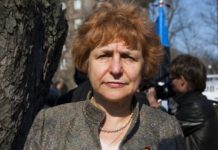
By Tatjana Zdanoka
former MEP (2004-2024)
Brussels, 21 January 2026
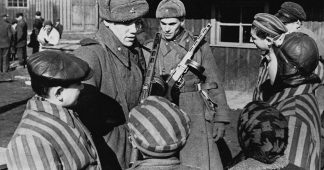
As we approach 27 January, International Holocaust Remembrance Day, I would like to pose a question: eighty-one years after Auschwitz was liberated, do we see the deadly menence of fascism and the danger of its resurgence as important to us now?
Two years ago, in January 2024, the President of the European Parliament Roberta Metsola unilaterally cancelled the EP event that I had organised. The event program included a film “Riga Ghetto: Remembering the Names” exploring the tragedy of the Holocaust in Latvia and further discussions on the emergence of signs of neo-fascism in several EU Member States. Now, in January 2026, President Metsola promises to organise a hard EU response to President Trump’s claims on Greenland.
Did the honourable President finally understand how similar are the old and the new claims for the violent conquest of vital space? Unfortunately, I’m not at all sure about that. It seems to me that double standards in assessing certain people or events continue to prevail. However, I would note that their use is becoming increasingly noticeable. Let me cite one very recent case.
On January 6, 2026, the popular Lithuanian internet platform www.delfi.lt published an article under the attractive title “Migration Department asks security service to assess remarks by Russian opposition figure Volkov”. Since 2020, Leonid Volkov has been living and working in Lithuania. Up to 2023, he was chairman of the board of the “Anti-Corruption Foundation” established by Alexei Navalny.
The story in the Delfi portal went like this: “The request follows comments made by Volkov in late December after reports that Denis Kapustin, a Russian far-right activist who led a volunteer unit that carried out cross-border raids into Russia, had been killed. In a private letter, Volkov described Kapustin as a Nazi and welcomed what he called his “denazification”. Volkov also accused Kapustin of acting on behalf of Kyrylo Budanov, head of Ukraine’s military intelligence, and said Kapustin’s associates, as well as Andriy Yermak, former head of Ukraine’s presidential office, and presidential adviser Mykhailo Podolyak, should be jailed”.
In the wake of the scandal, the prime minister Ruginene was quick to make a categorical statement. Here is her comment to the press: “In my personal opinion, such statements are unacceptable, and such a person has no place in Lithuania”.
So, the Lithuanian prime minister considers it unacceptable to call a true Nazi a Nazi. Actually, this position is not surprising. If, in the case of Volkov, the Lithuanian prime minister did not like his unflattering statement about the commander of the ”Russian Volunteer Corps”, a right-wing militia made up of ethnic Russians fighting on Ukraine’s side, it is not surprising that those who call homegrown Nazis by their name are persecuted in Lithuania.
The best known case here is the conviction of Algirdas Paleckis, journalist and politician, for slander of Laurynas Kasciunas, the chair of the National Security and Defence Committee of the Parliament. In his interview, Paleckis recalled that Mr Kasciunas used to be a member of a nazi party and added: “This Committee, sometimes there I wish to call it a Nazi Security and Defence Committee, wants to ban all independent YouTube channels”. In fact, one can easily find in various open sources that at the age of 18, Kasciunas became the chairman of the Young National Democrats, the youth organization of the far-right National Democratic Party of Lithuania, and joined the party itself in 2000. This party was later banned due to its “neo-Nazi ideology”. Nevertheless, by a court decision on Kasciunas’ appeal, Paleckis was sentenced to no less than a prison term. In another decision, he was sentenced for “belittling the role of Lithuania’s post-Second World War guerilla movement against the Soviet authorities”. In total, in 2025, 1 year and 10 months were added to the six years custodial sentence of 2023 for “intending to spy for Russia”. The “spying” consisted of collecting information on the events of January 1991 in Vilnius.
The case of Paleckis alone shows that in the Baltic states, debates about history have now moved to courtrooms. There are tens of other “politically motivated” persecutions in Estonia, Latvia and Lithuania.
Whether by chance or not, an article has appeared in mid-January in the very same portal Delfi, saying that the “Honorary Chairman of the Lithuanian Social Democratic Party (LSDP) Vytenis Povilas Andriukaitis has called Algirdas Paleckis a “political prisoner”. Such a statement is a sensation since the actual leadership of LSDP distanced themselves from a former member of their party who had represented it earlier in Parliament and in the capital’s government.
But let’s come back to the decision as of January 2024 not to allow me to show the film “Riga Ghetto: Remembering the Names“. The names of my great grandparents are mentioned there alongside with the other names of Riga Ghetto inmates. We will remember them despite all.
I am convinced that the package of disinformation about me, prepared for the European Parliament elections of 2024, was published ahead of schedule in order to disrupt the discussion on the fight against the resurgence of neo-fascism in the EU Member States and in Latvia in particular. The appropriated publication appeared in “The Insider” on January 29, two days before the scheduled event.
Although the European Parliament resolution of February 24, 2024, which was drafted in the heat of the moment and devotes considerable attention to me personally as an alleged “agent of Russian intelligence”, recommends Latvian competent authorities to investigate whether “the MEP concerned is liable for prosecution under national criminal law”, there is not any sign of me being an agent of any intelligence. As I stated in the EP Plenary, “Yes, I am an agent, an agent for peace, an agent for Europe without fascism, an agent for minority rights, an agent for a united Europe from Lisbon to the Urals”.
Nevertheless, the State Security Service of Latvia has officially accused me of committing crimes consisting of:
– consolidation and self-organization of the community of Russian-speakers in Latvia;
– telling the people in Russia about the situation of their compatriots living in Latvia;
– discrediting the image of Latvia at an international level, including by protesting the state-supported tradition of gatherings in Riga on 16 March for Latvian Legion Day to honour those who served in the Waffen-SS.
Altogether my activities may, by the opinion of the Service, “assist Russia in actions directed against the Republic of Latvia”. Procedural issues concerning this accusation are now being examined by Belgian court, i.e. at the place of my actual residence.
I am ready to prove, that during four parliamentary terms, I stood up for the interests of my electorate exclusively.
We remind our readers that publication of articles on our site does not mean that we agree with what is written. Our policy is to publish anything which we consider of interest, so as to assist our readers in forming their opinions. Sometimes we even publish articles with which we totally disagree, since we believe it is important for our readers to be informed on as wide a spectrum of views as possible.