19 February 2026
In January, a post I saw on Twitter/X shocked me.“URGENT: As of now, I have ZERO access to any money,” Hüseyin Dogru wrote. “I can’t provide food for my family, including two newborns, due to EU sanctions.”
Dogru is a journalist, a German citizen living in Berlin.
After reading his post, I sent him a private message offering to order groceries and have them sent to his home.
The reply shocked me even more. “Unfortunately, I’m not allowed to accept any financial or material support,” Dogru wrote.
Dogru is the first European Union citizen known to be living inside the EU to face extrajudicial sanctions imposed by Brussels – robbing him of fundamental civil and humanitarian rights.
He’s also the first person to be sanctioned specifically for his reporting related to Palestine.
“I’m not allowed to exist anymore, I’m not allowed to provide my children with the basic necessities,” he explained on The Electronic Intifada Podcast this week.
“I can’t pay my rent, I can’t pay my lawyers and yes – I’m not even allowed to accept any kind of food, water or medicine whatsoever from third parties.”
Technically, that even includes his own wife.
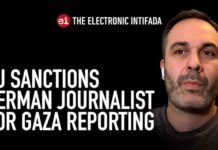
You can watch his interview with this writer in the video above.
Dogru was born in Germany and raised there all his life. He was the founder of Red, an independent publication that extensively covered protests in Germany against Israel’s genocide in Gaza.
He is unlikely to be the last person to face this new form of excommunication – with the German government now openly threatening journalists that they could be next if they stray too far from the official line.
Speaker of germany‘s Ministry of Foreign affairs officially threatens anyone publishing things they don‘t wanna hear with the extra-legal EU sanctions regime. They are happy about this tool.
“By the way, Mr. Warweg, I am also grateful to you for repeatedly making it known that… https://t.co/Yc5wAwvg81
— Pascal Lottaz (@PLottaz) February 18, 2026
The sanctions block all of Dogru’s property and ban him from traveling.
In theory, they do allow him to withdraw $600 a month from his own account, but in practice his bank has repeatedly blocked even this.
In any case, $600 does not go very far in an expensive city like Berlin. Dogru and his family have had to cut back severely to try to survive.
Dogru could face harsh punishment for accepting assistance from anyone.
Draconian EU directives call for up to five years in prison for anyone who violates the sanctions against Dogru and other individuals.
“Socio-economic death sentence”
How could any of this be happening?
In May last year, the European Union adopted its 17th package of sanctions supposedly targeting Russia.
But those sanctions and more that followed were not aimed only at Russian entities and individuals.
Brussels also began targeting – apparently for the first time – EU and other European citizens.
What is particularly shocking is that these individuals were sanctioned simply for speech – journalism or views disagreeing with the foreign policies of their governments, NATO and the European Union.
They include Xavier Moreau – a former French military officer and Moscow-based founder of Stratpol, a website critical of NATO and the French government – and German citizens Alina Lipp and Thomas Röper, sanctioned for their reporting from Russia.
In December, the EU also sanctioned Jacques Baud, a former Swiss army colonel and intelligence analyst, well-known in independent media for analysis of NATO and Western strategy in the context of the war in Ukraine.
Baud lives in Brussels, but because of the sanctions he cannot travel back home to Switzerland – which is not a member of the EU.
According to journalist Patrick Baab, who recently visited him in the Belgian capital, Baud survives off the few hundred dollars he is allowed to withdraw from his bank account under the sanctions, and “the neighbors are cooking for him.”
Baud, like Dogru, is fighting back.
The EU has also sanctioned Nathalie Yamb, a Swiss-Cameroonian anti-colonial scholar.
She has described the devastating impact of the sanctions, even though she does not live in or travel to Europe. Yamb says she is unable to pay for rent or medicine and cannot return to Switzerland because the sanctions ban flying over EU territory.
Yamb calls the sanctions a “socio-economic death sentence,” and she too is fighting back in court.
Pour tous ceux qui veulent savoir ce que ça signifie être placé sous sanctions de l’Union européenne et quels seront les impacts pour Jacques Baud ou Xavier Moreau, je partage d’expérience, puisque je suis la première suissesse sanctionnée (depuis le 26 juin 2025).
Pour Xavier,… pic.twitter.com/nzooxL0WsS
— Nathalie Yamb (@Nath_Yamb) December 16, 2025
Sanctioned for covering Palestine
As well as being the first EU citizen to be sanctioned while living on EU territory, Dogru is unique in another precedent-setting manner.
Like the others, he was sanctioned under blanket accusations of supposedly spreading what the EU considers pro-Russian “disinformation.”
But he is the only person to be sanctioned so far specifically for reporting related to the situation in Palestine as well, particularly Israel’s crimes in the context of the ongoing genocide in Gaza.
URGENT: The @EUCouncil rejected my lawyers’ application to “reconsider” the sanctions imposed on me.
The evidence is shocking and dangerous, which forces me now to publish the entire evidence used to sanction me.
The EU forbids me from publishing their evidence dossier.🧵… pic.twitter.com/2e3gpQGWM7
— Hüseyin Dogru (@hussedogru) September 3, 2025
Dogru’s publication Red was also subjected to EU sanctions.
In order to justify targeting Red, the EU claims that the publication “systematically spread false information on politically controversial subjects with the intent of creating ethnic, political and religious discord amongst its predominantly German target audience, including by disseminating the narratives of radical Islamic terrorist groups such as Hamas.”
It’s not difficult to imagine how such a vague and broad claim – reminiscent of Israel’s accusations that any critic is a Hamas supporter – could be used to muzzle any publication that debunks official narratives.
The sanctions on Red proved to be unnecessary: It was effectively forced to close down before the measures even took effect.
This came after what the publication called a “coordinated campaign” of bogus and even criminal accusations leveled by “an unholy alliance of German media outlets, journalists, union representatives and NGOs, some of which were even founded or directly financed by the German and Israeli state.”
Ominous echo of Germany’s past
These personal sanctions are adopted by EU foreign ministers – without any judicial process or opportunity for those targeted to defend themselves – and are binding on all member states.
Apparently, in order to deprive Dogru of any legal rights he would enjoy as an EU citizen, the EU sanctions decision identifies him only as a Turkish citizen, even though he is, in fact, only a German citizen and not a Turkish national.
Germany and the EU appear to be denying Dogru’s German citizenship purely based on his ethnicity – convenient for them and a horrifying echo of how a past German government treated its Jewish citizens years before it decided to exterminate them.
The message to millions of Europeans with ancestry in former European colonies could not be clearer.
Fighting back
Dogru is challenging the sanctions in European Union courts, a lengthy and expensive process that could take years, offering him and his family no immediate relief.
The fact that Dogru has not been charged with any crime and has not been given any legal due process appears to be precisely the point of the sanctions.
The EU itself asserts that “sanctions are not punitive and instead seek to bring about a change in the policy or conduct of those targeted, with a view to promoting the objectives of the EU’s Common Foreign and Security Policy.”
Brussels also admits that by sanctioning people like Dogru for publishing news and opinions the EU would prefer to suppress, it is targeting them for “non-illegal” behavior.
In other words, the European Union is depriving Dogru’s young children of fundamental rights and needs until their father falls into line with its policies – a personalized version of Western sanctions wars waged on entire populations in Cuba, Venezuela, Gaza, Syria, Iraq or Iran.
Dogru, however, is adamant that this will not succeed.
“The only way to fight is to do exactly the opposite of what they want me to do,” Dogru says. “I’m never going to promote the European security and foreign policy, so therefore I’m going to fight that.”
Despite the closure of Red, Dogru continues to speak out on Twitter/X, Instagram and YouTube. He also still runs the @redstreamnet account on Twitter/X.
His work includes a documentary on Palestinian resistance to Israeli colonization, apartheid and settler terror, filmed in the occupied West Bank in 2022.
For Dogru, it is no coincidence that he – with his particular focus on Palestine and the genocide in Gaza – is the first EU citizen to be sanctioned on EU soil.
“They’re testing it with me because shutting down Palestinian voices or pro-Palestinian voices is right now the most acceptable,” Dogru says. “And once they achieve that and set a precedent, they will come after all non-pro-Palestinian voices as well.”
We remind our readers that publication of articles on our site does not mean that we agree with what is written. Our policy is to publish anything which we consider of interest, so as to assist our readers in forming their opinions. Sometimes we even publish articles with which we totally disagree, since we believe it is important for our readers to be informed on as wide a spectrum of views as possible.