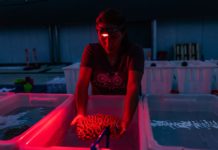
Australia is doing absolutely everything to protect its most iconic ecosystem — except, perhaps, the one thing that really matters.
CAIRNS, Australia — “I just got a whiff,” said Peter Harrison, a marine scientist, as he leaned over the edge of the boat and pointed his flashlight into the dark water. “It’s really coming through now.”
It was shortly after 10 pm on a cloudy December night, and Harrison, a coral researcher at Australia’s Southern Cross University, was about 25 miles off the coast of northern Queensland. He was with a group of scientists, tourism operators, and Indigenous Australians who had spent the last few nights above the Great Barrier Reef — the largest living structure on the planet — looking for coral spawn.
And apparently, it has a smell.
Over a few nights in the Australian summer, shortly after the full moon, millions of corals across the Great Barrier Reef start bubbling out pearly bundles of sperm and eggs, known as spawn. It’s as if the reef is snowing upside down. Those bundles float to the surface and break apart. If all goes to plan, the eggs of one coral will encounter the sperm of another and grow into free-swimming coral larvae. Those larvae make their way to the reef, where they find a spot to “settle,” like a seed taking root, and then morph into what we know of as coral.
Spawning on the Great Barrier Reef has been called the largest reproductive event on Earth, and, in more colorful terms, “the world’s largest orgasm.” Coral spawn can be so abundant in some areas above the reef that it forms large, veiny slicks — as if there had been a chemical spill.
This was what the team was looking for out on the reef, and sniffing is one of the only ways to find it, said Harrison, who was among a small group of scientists who first documented the phenomenon of mass coral spawning in the 1980s. Some people say coral spawn smells like watermelon or fresh cow’s milk. To me it was just vaguely fishy.
“Here we go,” said Mark Gibbs, another scientist onboard and an engineer at the Australian Institute of Marine Science (AIMS), a government agency. All of a sudden the water around us was full of little orbs, as if hundreds of Beanie Babies had been ripped open. “Nets in the water!” Gibbs said to the crew. A few people onboard began skimming the water’s surface with modified pool nets for spawn and then dumping the contents into a large plastic bin.
That night, the team collected hundreds of thousands of coral eggs as part of a Herculean effort to try to keep the Great Barrier Reef alive. Rising global temperatures, together with a raft of other challenges, threaten to destroy this iconic ecosystem — the gem of Australia, a World Heritage site, and one of the main engines of the country’s massive tourism industry. In response to these existential threats, the government launched a project called the Reef Restoration and Adaptation Program (RRAP). The goal is nothing less than to help the world’s greatest coral reef survive climate change. And with nearly $300 million in funding and hundreds of people involved, RRAP is the largest collective effort on Earth ever mounted to protect a reef.
The project involves robots, one of the world’s largest research aquariums, and droves of world-renowned scientists. The scale is unlike anything I’ve ever seen.
But even then, will it be enough?
Continue reading at www.vox.com
We remind our readers that publication of articles on our site does not mean that we agree with what is written. Our policy is to publish anything which we consider of interest, so as to assist our readers in forming their opinions. Sometimes we even publish articles with which we totally disagree, since we believe it is important for our readers to be informed on as wide a spectrum of views as possible.
 Reaching 1.5°C of Global Heating by 2024 Isn’t…
 The 2025 state of the climate report: a planet on the brink
 Global Tipping Points Conference Statement 2025
 Indigenous Australians Mourn Failure of Referendum…
 BBC: The fires in Greece among the extreme weather…
 A Dead World, Plastic-Wrapped to Preserve Freshness