Ships approaching the waterway on Saturday turn back after Iran’s navy tells them it’s ‘shut again’
Apr. 18, 2026
Iran on Saturday denied US claims that it agreed to transfer its enriched uranium abroad and signalled that the Strait of Hormuz has been closed again due to Washington’s ongoing naval blockade.
On Friday, President Donald Trump said the US would maintain a naval blockade on Iranian ports, imposed earlier this week, until a final agreement between the two countries is reached.
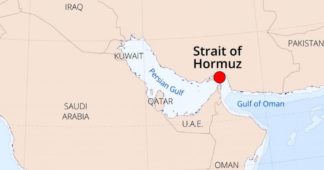
The blockade was imposed in response to Iran’s effective closure of the Strait of Hormuz, which Tehran ended on Thursday following a US-brokered 10-day ceasefire to halt Israel’s war in Lebanon.
However, Iran on Saturday appeared to reverse course after Trump’s comments, saying passage through the waterway would remain restricted as long as the US continued its naval blockade.
“With the continuation of the blockade, the Strait of Hormuz will not remain open,” parliamentary speaker Mohammad Bagher Ghalibaf wrote on X. “What they call a naval blockade will definitely be met with an appropriate response from Iran.”
The US Central Command said overnight it had directed at least 21 ships to turn around since the blockade began this week.
Before Iran signalled it would reassert control of the Strait of Hormuz, more than a dozen mostly non-Western-owned vessels passed through the waterway on Friday and early Saturday, following coordination with Tehran.
However, other ships approaching the strait later on Saturday turned back after Iran announced it was reimposing restrictions. Some vessels reported receiving radio messages from Iranian naval forces informing them that the Strait of Hormuz had been “shut again”, according to Reuters.
The Strait of Hormuz is a key hydrocarbon chokepoint, through which about a fifth of the world’s crude oil and liquefied natural gas flows.
The closure of the waterway has resulted in the largest supply loss in history: more than 10m barrels of oil per day and a 20 percent cut in global liquefied natural gas supply, the International Energy Agency has said.
Enriched uranium
Trump on Friday also claimed that Washington would work with Tehran to bring enriched uranium to the US.
“We’re going to get it together. We’re going to go in with Iran, at a nice leisurely pace, and go down and start excavating with big machinery… We’ll bring it back to the United States,” Trump said.
He referred to “nuclear dust” – a reference to what he believes remains after US-Israeli strikes on Iranian nuclear sites in June last year – and added that it would be retrieved “very soon”.
Iran firmly denied any such transfer.
“Iran’s enriched uranium is not going to be transferred anywhere. Transferring uranium to the United States has not been an option for us,” Esmaeil Baghaei, Iran’s foreign ministry spokesperson, told state television.
Iran is thought to possess more than 900 pounds of uranium enriched up to 60 percent purity.
Trump has repeatedly stated that one of the war aims is to prevent Iran from getting a nuclear weapon.
Iran says its enrichment of uranium is strictly for peaceful civilian use.
A senior Iranian official told Reuters an agreement had been reached on unfreezing billions of dollars in Iranian assets, without giving a timeline.
However, on Friday, Trump told a rally in Arizona that “no money will exchange hands in any way, shape or form”.
During talks last week, Washington proposed a 20-year suspension of all Iranian nuclear activity. Iran suggested a halt of three to five years, according to people familiar with the proposals cited by Reuters.
Two Iranian sources said there were signs of a compromise that could remove part of the stockpile.
The war began on 28 February after the US and Israel launched a barrage of attacks on the Islamic Republic.
Tehran responded by launching strikes on Israel and the Gulf countries, and by closing the Strait of Hormuz. Days later, Israel launched an invasion of Lebanon, and has since killed more than 2,000 people.
End of war talks
Meanwhile, Pakistani leaders concluded high-level visits on Saturday aimed at ending the war.
Asim Munir, the top military chief, met the Iranian leadership during a three-day visit to Tehran, according to a Pakistani military statement.
Munir met with Iran’s president, foreign minister, parliament speaker and the head of the military central command centre.
Pakistani Prime Minister Shehbaz Sharif also concluded a three-day tour of Saudi Arabia, Qatar and Turkey, aimed at securing a peace agreement.
A second round of talks between the US and Iran is expected in Islamabad this coming week.
Ghalibaf and Foreign Minister Abbas Araghchi led the Iranian delegation to Islamabad for talks with Washington last week – the highest-level face-to-face contact between the two countries in decades.
We remind our readers that publication of articles on our site does not mean that we agree with what is written. Our policy is to publish anything which we consider of interest, so as to assist our readers in forming their opinions. Sometimes we even publish articles with which we totally disagree, since we believe it is important for our readers to be informed on as wide a spectrum of views as possible.
 Iran Says It Will Completely Close Strait of Hormuz…
 US President Donald Trump issues 48-hour ultimatum…
 Iran moves to close Strait of Hormuz after strikes
 Strait of Hormuz ‘no longer open’, ships…
 Iran’s Parliament Votes To Close Strait of Hormuz in…
 Iran’s top security body to decide on Hormuz closure…