By Patrick Lawrence*
March 31, 2026
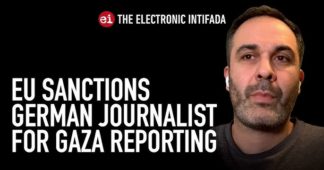
Hüseyin Dogru is the first E.U. citizen to be sanctioned by the union and the first journalist to land on the list because of his work. What is Dogru’s crime? Don’t ask: He has not committed one.
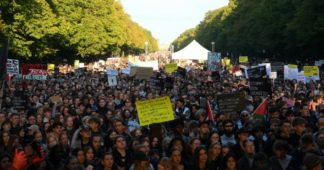
Featured Picture: Pro-Israel protest on the Pariser Platz in Berlin on the day after Oct. 8, 2023. (Leonhard Lenz/Wikimedia Commons)
The following note appeared in the thread of my “X” account at 7:47 Saturday morning. It was posted by Hüseyin Dogru, a German journalist who lives, such as he and his family can, under European Union sanctions:
!!! HUMANITARIAN EMERGENCY CALL !!!
As of yesterday, German authorities seized the bank accounts of my wife.
She is not sanctioned and has committed no crime.
As of now we have only ca. 104 euros left — with two newborn babies and one 7-year-old child!!!@yanisvaroufakis… pic.twitter.com/0e1wrkXKWk
— Hüseyin Dogru (@hussedogru) March 28, 2026
Hüseyin Dogru is not given to histrionics or self-dramatizations, if this is what you’re thinking. He has been on the E.U.’s (increasingly long) sanctions list since May 20 of last year. While Dogru joins others dedicated to the truth of our time and the defense of their own integrity, he is the first E.U. citizen to be sanctioned and the first journalist to land on the list because of his work.
What is Dogru’s crime? Don’t ask: He has not committed one, has not been charged with one, and has not been permitted any opportunity to respond in court to those accusing him of … of practicing his profession and exercising his rights to free expression.
I will get to the particulars of the official documents in a sec. For now, this: Hüseyin Dogru, whose family is of Turkish origin, was born in Berlin and is a German citizen. As a journalist he has been critical of Israel, taken a strong position against the genocide in Gaza and written in support of the Palestinian cause. More later.
With the seizure of his spouse’s bank accounts last Friday, Dogru and his family now face what amounts to a starvation blockade of the kind the Trump regime (not to change the subject) currently imposes on Cuba and Israel imposes on Gaza.
This story reads like something out of Dostoyevsky or Kafka, I have to say. We are talking about a family of five going hungry in the capital of the Federal Republic of Germany as punishment for… what?… for seeing with his eyes open, for thinking about what he sees, then commenting on what he sees?
I would love to suggest various ways readers could support the Dogru family, but there are none. Were someone to donate so much as a loaf of bread to help sustain them the German authorities would count it a criminal offense punishable by a prison term of up to several years.
I discussed this question of assistance with a German friend over the weekend. The only way to come to the aid of Hüseyin Dogru, we determined, would be to hand him, in person, an envelope of euros or a bag of groceries. And this would be to take a risk, of course.
The above quoted social media post was addressed to some names readers will recognize: Yanis Varoufakis, Stella Assange, Alan MacLeod, Clare Daly, Mary Kostakidis, Chris Hedges and on down a long list. The best coverage of the Dogru case I have seen has appeared in Berliner Zeitung, which I have read courtesy of the translations sent me by Eva–Maria Föllmer Müller, a German friend and colleague.
European Media Silence
As to the rest of European media, including Germany’s, there has been a resolute silence these past 11 months. In a series of social media posts over the weekend, Dogru reported that many people have written — your columnist is among them — to offer him and his family some mode of support.
Here are two of his replies: “People ask me what we can do. Legally, I cannot comment, as it could link me to the act and put my family at risk. All I can say is that resisting injustice through civil disobedience is legitimate and morally justified.”
Urge everyone who reads this:
Put pressure on politicians — write protest emails.
Put pressure on my trade union Verdi and DJU.
Put pressure on humanitarian NGOs.
Put pressure on media NGOs.I contacted all of them. They chose to stay silent.
— Hüseyin Dogru (@hussedogru) March 28, 2026
And then this: “Also a call to journalists who know about my case and had access to the files — you chose to stay silent. You are also responsible for the situation of my children.”
People ask me what we can do. Legally, I cannot comment, as it could link me to the act and put my family at risk. All I can say is that resisting injustice through civil disobedience is legitimate and morally justified.
— Hüseyin Dogru (@hussedogru) March 28, 2026
On March 15 Berliner Zeitung published an interview with Alexander Gorski, Dogru’s attorney. Here is a little of what Gorski said when asked how nearly a year’s sanctions has affected Dogru’s life:
“The impact on him and his family is devastating. From one day to the next, his accounts were frozen. He is not permitted to conduct any financial transactions and must have every use of his assets approved by the Bundesbank. Currently, only €506 per month are authorized, with which he must make ends meet…. Furthermore, his bank, Comdirect, repeatedly imposes additional restrictions on the use of these €506…. The risk of committing a criminal offense by having financial contact with my client is very high…. Leading a normal family life under these circumstances is virtually impossible. This situation is often described as “civil death” — and that is exactly what applies here….”
Nine days after this interview appeared, the District Court in Frankfurt am Main rejected an emergency appeal Gorski filed, requiring Dogru’s bank to unblock funds he needs to meet routine obligations — fees to service providers, insurance payments, and the like. The court ruled that Dogru has no “right to an injunction.”
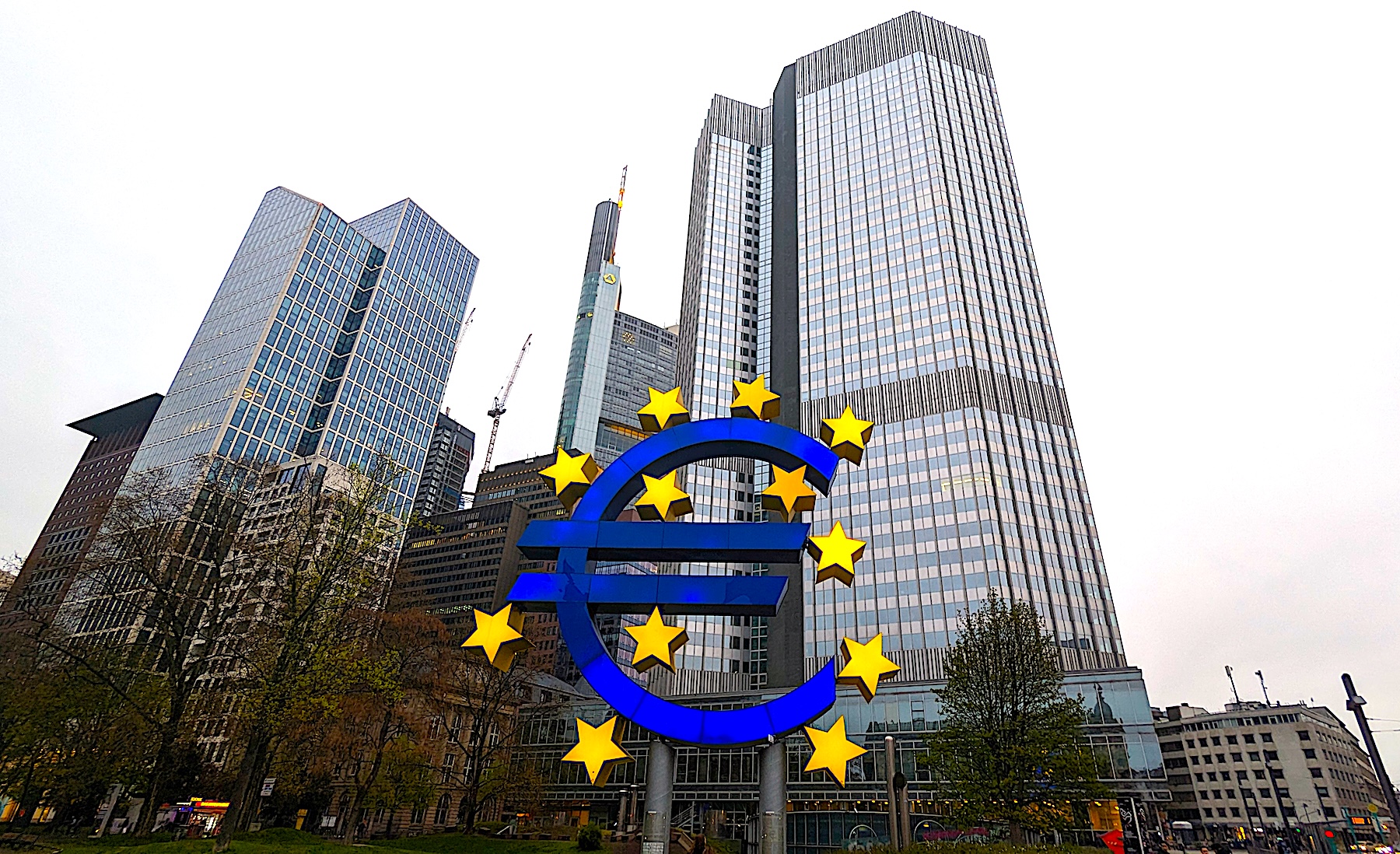 Symbol of the Euro in Frankfurt, 2023. (Sandro Halank, Wikimedia Commons, CC BY-SA 4.0)
It was four more days until, last Saturday, the Central Office of Sanctions Enforcement, a federal authority in Berlin, seized the accounts of Dogru’s spouse.
This is the same treatment accorded others on the E.U. sanctions list. “Civil death” is precisely the term.
Jacques Baud, the noted Swiss commentator, is prominent among these others. The paying-attention population of Europe was shocked when he was sanctioned, last December, a case I wrote of in The Floutist under the headline, “Free Speech and its Enemies.”
Here is Baud’s entry in the E.U. Sanctions Tracker, the list of those the E.U. has summarily blacklisted:
“Jacques Baud, a former Swiss army colonel and strategic analyst, is a regular guest on pro–Russian television and radio programmes. He acts as a mouthpiece for pro–Russian propaganda and makes conspiracy theories, for example accusing Ukraine of orchestrating its own invasion in order to join NATO.”
Hüseyin Dogru’s rap sheet is similarly preposterous. In sum, the E.U. runs miles with his previous association with a now-defunct digital channel called Redfish, which was partly funded by a subsidiary of the Novosti–RT group.
Here is an extract from Dogru’s entry in the E.U. Sanctions Tracker. His case is No. 20 in the document linked here. In it you find a salad of factual inaccuracies along with the beyond-flimsy case it purports to document against him:
“RED [Redfish] has used its media platforms — often publishing under ‘redstreamnet’ or ‘thered.stream’ — to systematically spread false information on politically controversial subjects with the intent of creating ethnic, political and religious discord amongst its predominantly German target audience, including by disseminating the narratives of radical Islamic terrorist groups such as Hamas….
Through AFA Medya [a media company based in Istanbul, the purported sponsor of “RED”], Hüseyin Dogru thus supports actions by the Government of the Russian Federation which undermine or threaten stability and security in the Union and in one or several of its Member States, including by indirectly supporting and facilitating violent demonstrations and engaging in coordinated information manipulation….”
This is a hard bouncing ball to follow, as readers may note. Dogru wrote critically of Israel and the Gaza genocide (among various other topics, including German foreign policy) and this was in the service of spreading Russian disinformation in the cause of destabilizing E.U. member states.
Got it?
When Berliner Zeitung asked Alexander Gorki, Dogru’s attorney, why the E.U. singled out Dogru, he replied, “We don’t know that. What we observe, however, is that the German government, in particular, is cracking down on people who express dissenting opinions on the Russia–Ukraine war or the issue of Palestine.”
Just parenthetically, Dogru opposed the Russian intervention in Ukraine and quit Redfish in protest immediately after it began in February 2022.
“The Commission in Brussels banned him, a European Union citizen, from the European Union,” Yanis Varoufakis remarked in the course of an appearance on The Chris Hedges Report last week. “They turned him into a non-person, ‘an asset of Putin,’ just because they could.”
It is those last four words that rattle me most. They resonate across the Western post-democracies.
—Eva–Maria Föllmer–Müller contributed invaluable research and translations.
*Patrick Lawrence, a correspondent abroad for many years, chiefly for the International Herald Tribune, is a columnist, essayist, lecturer and author, most recently of Journalists and Their Shadows, available from Clarity Press or via Amazon. Other books include Time No Longer: Americans After the American Century. His Twitter account, @thefloutist, has been restored after years of being permanently censored.
.
We remind our readers that publication of articles on our site does not mean that we agree with what is written. Our policy is to publish anything which we consider of interest, so as to assist our readers in forming their opinions. Sometimes we even publish articles with which we totally disagree, since we believe it is important for our readers to be informed on as wide a spectrum of views as possible.