José Manuel Rivero*
February 5, 2026
It is imperative to emphasize that this would not be a lease or a temporary transfer of use, but rather a transfer of ownership and real title, where the occupying power holds full and perpetual ownership of the land, assuming a jurisdiction that effectively nullifies the authority of the transferring State.

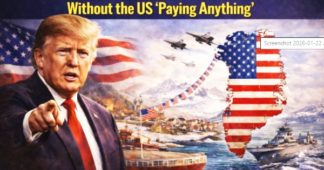
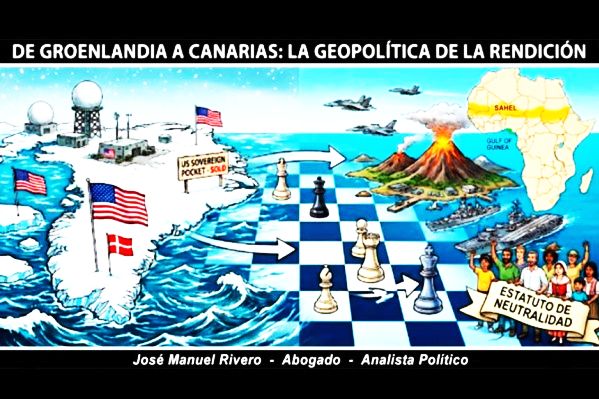
What recently transpired in the halls of Davos between President Donald Trump and the NATO leadership, represented by Secretary General Mark Rutte, should not be interpreted as a mere diplomatic eccentricity or a global real estate transaction. What has been formalized under the euphemism of a “framework agreement” for Arctic security constitutes a breaking point in formally established international law and an existential warning that resonates with alarming force in our Canary Islands. The reality is that Denmark, under the coercion of a trade war and the threat of punitive tariffs, has capitulated. Greenland’s sovereignty has been fragmented to make way for what, in the jargon of negotiations, has been termed “pockets of US sovereignty”—a model that replicates the colonial status of the British bases in Cyprus. It is imperative to emphasize that this would not be a lease or a temporary transfer of use, but rather a transfer of ownership and title, where the occupying power holds full and perpetual ownership of the land, assuming jurisdiction that effectively nullifies the authority of the ceding state. The Greenland agreement announced by President Donald Trump would allow Washington to station US missiles on the island, grant it mining rights, and entail a reinforced NATO presence, according to sources at Bloomberg.
This move reveals the true nature of Atlantic relations in 2026: the formal sovereignty of smaller states is worthless in the face of the hegemon’s strategic needs. While the administrative charade will continue in Copenhagen and Nuuk, and the Danish flag will continue to fly, effective military and strategic control of the territory—especially for the deployment of the Golden Dome missile defense system—passes into the exclusive hands of the Pentagon. A de facto occupation, sanctioned by the Atlantic military alliance, has been carried out, emptying the autonomy of the Greenlandic people of its meaning and reducing Denmark to the status of a mere civilian administrator of a US aircraft carrier.
For those of us who observe geopolitics from the latitude of the Canary Islands, this legal and military precedent is extremely serious. We cannot be so naive as to think that imperial voracity stops at the Arctic Circle. The logic of power is universal and seeks to fill strategic vacuums wherever they arise. If we look to our southern flank, the situation in the Sahel and the Gulf of Guinea presents a scenario of collapse for traditional Western interests, with the expulsion of Western powers from their former territorial strongholds. The United States urgently needs a secure, stable, and “Westernized” platform from which to project its power, control strategic resources, and ensure its hegemony in the Mid- and South Atlantic against global competitors such as China and Russia.
In this plan, the militarization of the archipelago is not only justified offensively by its proximity to the mainland, but is also instrumentalized through “maritime security.” The constant seizures of large drug shipments in the waters surrounding the Canary Islands are integral to this plan, serving as a pretext for permanent surveillance (with increasing involvement of the US DEA in these seizures) and an ever more suffocating foreign naval presence. These operations, often presented under a veneer of international legality, are closely linked to the strategies of legal harassment and financial blockades applied to sovereign nations like Venezuela, where the supposed fight against drug trafficking becomes the preferred tool for political intervention and state destabilization. The use of our waters as the stage for these intelligence and military control “raids” is merely the vanguard of a larger occupation.
Behind these pretexts of security, drug trafficking, or immigration control lies the real objective: absolute control of natural resources. The Canary Islands are at the epicenter of a dispute over the material foundation of the future. The military deployment seeks to secure exclusive access to underwater resources and the rare earth elements of seamounts—such as the Tropic Seamount—essential for the technology and arms industries. Likewise, this projection of power ensures control over fishing grounds, potential oil reserves, and phosphate deposits in the region. From the archipelago, military control extends into the Sahel, guaranteeing the flow of uranium vital for the nuclear infrastructure and energy dominance of the imperialist bloc.
The Canary Islands stand out in this chessboard as the coveted prize. The same dynamics that have brought Denmark to its knees are perfectly applicable to the Spanish state. The structural weakness of our position and Madrid’s historical subservience to Washington’s demands place us in a situation of extreme vulnerability. Just as the excuse of “Arctic security” has been used for the occupation of Greenland, it is foreseeable that “southern flank security” or the stability of the Gulf of Guinea will be invoked to demand a transfer of sovereignty over strategic points in our islands. We are no longer talking about mere authorizations for the use of shared bases, but about the establishment of exclusive sovereign enclaves that guarantee US operations regardless of any Spanish political fluctuations.
The danger is imminent. History does not lie, and the people of the Canary Islands must remember the precedent of Western Sahara. In 1975, the Spanish State did not hesitate to hand over the territory and its population to safeguard the interests of the metropolis, but in doing so, it also achieved a higher strategic objective for Washington: to strengthen Morocco as an unconditional ally and a battering ram against Algeria’s regional role. Today, the imperial need to control trade and energy routes to Africa constitutes an irresistible incentive that places us squarely in the same crosshairs.
Faced with this horizon of submission, the only possible response lies in the conscious and organized mobilization of the Canarian people. We cannot allow our land to become the chessboard for war games that only benefit transnational capital. It is imperative to reclaim and safeguard the historical demand for the Statute of Neutrality for the Canary Islands ; a legal and political framework that removes us from the imperialist military structure and transforms us into a genuine bridge of peace between continents, not the spearhead of an occupation. Sovereignty is not granted; it is defended in the streets and in the collective consciousness, building a historical bloc capable of saying no to ignominy and yes to a future of self-determination and peace.
*José Manuel Rivero is a lawyer in Spain (Canary Islands), writing for elDiario.es on political and social issues. Recently (September 2025) he has spearheaded legal actions against political leaders on human rights issues.
.
We remind our readers that publication of articles on our site does not mean that we agree with what is written. Our policy is to publish anything which we consider of interest, so as to assist our readers in forming their opinions. Sometimes we even publish articles with which we totally disagree, since we believe it is important for our readers to be informed on as wide a spectrum of views as possible.