Jeremy Scahill and Murtaza Hussain
Mar 02, 2026
Iran is intensifying strikes across the region after Supreme Leader Khamenei’s assassination, as Trump floats new talks and more bombing.
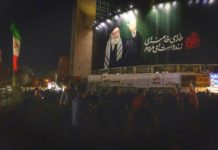
On Saturday, President Donald Trump went to TruthSocial to announce the U.S. and Israel had been successful in assassinating Iran’s Supreme Leader, Ayatollah Ali Khamenei. “Khamenei, one of the most evil people in History, is dead,” Trump wrote. “He was unable to avoid our Intelligence and Highly Sophisticated Tracking Systems and, working closely with Israel, there was not a thing he, or the other leaders that have been killed along with him, could do.”
The New York Times followed with a breathless account published Sunday purporting to tell the secret story of how the CIA and Israel hunted down Khamenei, “tracking him for months” and “gaining more confidence about his locations and his patterns,” before pinpointing his location so he could be killed. “People briefed on the operation described it as a product of good intelligence and months of preparations,” the report claimed.
Khamenei’s secret location, it turned out, was simply his office.
The U.S. and Israel have consistently claimed Khamenei was in hiding. “This is basically just fabricated drama to make Trump look bigger and more dramatic than he really is,” a senior Iranian official told Drop Site. He spoke on the condition of anonymity because he was not authorized to speak about internal matters.
Iran’s Supreme National Security Council “personally recommended to [Khamenei] that he relocate, change his workplace, and even adjust his living arrangements for safety reasons,” the Iranian official said. “But [Khamenei] had a completely different perspective on moving—he insisted on keeping things as normal and ordinary as possible, without seeking extra security measures or standing out in any way.”
Ali Larijani, the chair of Iran’s Supreme National Security Council said Iranian officials anticipated that the U.S. and Israel would target Khamenei. “They decided to strike him first. This analysis was also circulating among military circles—that they were pursuing exactly this objective,” he told Iranian state TV after Iran confirmed Khamenei was killed.
“This event is an extraordinarily bitter one for us,” Larijani added. “America and the Zionists, through this act, have effectively created a situation for Iran—for the Iranian people—that we must say: You have burned the heart of the Iranian people. We will burn your hearts in return.”
As of Sunday morning, the Iranian Red Crescent and state-linked media have reported preliminary casualty figures of over 200 people killed and more than 740 injured across Iran, though the actual toll is expected to be significantly higher. One strike on a girls’ elementary school in Minab killed 165, according to the state-run IRNA news agency.
Within hours of the U.S.-Israeli bombing, Iran began launching barrages of ballistic missiles at Israel in attacks that have so far killed at least 11 people and injured several hundred. On Sunday morning, an Iranian missile struck a building near Jerusalem, in an attack that is estimated to have killed at least nine people in a bomb shelter.
“The Islamic Republic of Iran considers bloodshed and revenge against the perpetrators and commanders of this crime as its legitimate duty and right, and will fulfill this great responsibility and duty with all its might,” Pezeshkian said Sunday in a statement carried on state TV.
Iran has also unleashed a series of sustained missile and drone attacks against U.S. military facilities across the Persian Gulf, striking the United Arab Emirates, Bahrain, Saudi Arabia, and Qatar, as well as targets in Jordan. The UAE reported three deaths and 58 minor injuries in Iranian strikes, with most of those impacted believed to be foreign workers. Dubai International Airport, the world’s busiest airline hub, was also damaged and partially shut down after an unidentified projectile struck one of its concourses. Two were also killed in Iraq and one in Kuwait.
The attacks have also drawn the first acknowledged U.S. military casualties of the war. In a statement early Sunday, U.S. Central Command announced that three American service members had been killed and five others seriously wounded during “Operation Epic Fury,” adding that several other additional personnel had sustained minor shrapnel injuries. The soldiers killed had been deployed to a base in Kuwait supporting the operation, U.S. officials told NBC News.
Iranian officials have said their initial response to the U.S.-Israeli bombing, while unprecedented in scope, did not represent the full force of Tehran’s potential retaliatory strikes.
Is a Diplomatic Solution Still Possible?
The Saturday strikes on Khamenei’s office wiped out the top echelon of Iran’s political and military structure and killed several of the late Supreme Leader’s family members. Iran, which has spent decades investing in a horizontal leadership structure to defend against this type of attack, announced a new leadership structure. Along with President Masoud Pezeshkian, Iran’s new interim leadership council includes Gholam-Hossein Mohseni-Ejei, the head of Iran’s judiciary, and Ayatollah Ali Arafi, a prominent member of Iran’s Guardian Council and Assembly of Experts—the body that is ultimately responsible for choosing the country’s Supreme Leader.
The White House said President Trump intends to speak with what a U.S. official called the “new potential leadership” of Iran in the coming days and Trump has suggested the war may be shorter in duration than he initially projected. “They want to talk, and I have agreed to talk, so I will be talking to them. They should have done it sooner. They should have given what was very practical and easy to do sooner. They waited too long,” Trump told The Atlantic. “They could have made a deal. They should’ve done it sooner. They played too cute.”
For now, Trump said in a post on Truth Social, “heavy” bombing would continue “uninterrupted throughout the week or, as long as necessary.”
In a pre-recorded message on Sunday afternoon, Trump said, “I once again urge the Revolutionary Guard, the Iranian military, police to lay down your arms and receive full immunity or face certain death. It will be certain death. Won’t be pretty. I call upon all Iranian patriots who yearn for freedom to seize this moment.”
Likewise, Israeli Prime Minister Benjamin Netanyahu said Israel would expand its strikes. “In the coming days, we will strike thousands of targets of the terrorist regime,” Netanyahu said in a video posted on social media. “We will create the conditions for the brave people of Iran to free themselves from the chains of tyranny.”
Trump said he still believes there will be an uprising in Iran spurred by the U.S.-Israeli bombings and assassinations. “I think it’s gonna happen,” Trump told the Atlantic.
“Everyone said that if Ali Khamenei is killed the people will come into the streets to overthrow the regime, and so far that has not happened. Some people have cheered, but overall the system is quite resilient,” said Sina Azodi, director of Middle East studies at Georgetown University. “One thing the Israelis have tried for the past two years is decapitating the top echelon of their enemy and expecting them to implode tomorrow. That works well against non-state actors, but not against a state actor that is quite resilient, has a constitution and other structures in place, and that in its early years already had to go through the experience of total war and leadership assassinations.”
Hooman Majd, an Iranian-American political analyst who served as an advisor to former Iranian President Mohammed Katami, said Iran has been preparing for major U.S.-Israeli attacks since the 12-day war last June, during which more than 1,000 Iranians were killed, including senior military commanders. “Their military leadership is quite deep in terms of both the regular army, the IRGC, and the Navy. They have an ability to sustain a war, perhaps even longer than the U.S. wants to,” Majd told Drop Site. “There will come a point at which Trump may decide Trump is the one who wants the off-ramp, not Iran.”
Majd said that if Iran decided to start targeting oil infrastructure in the Persian Gulf or completely shut off access to the Strait of Hormuz, the economic consequences would be significant. “A financial hit on America and Western Europe is something that nobody wants for a long period of time, certainly not Trump,” he said. “So there’s going to be an advantage for Trump to have [an off ramp]. But if he really believes that Iran is then going to come in and say, ‘Enough, we give up, whatever you want, we’ll do,’ that’s very unlikely.”
Iran, meanwhile, has said it remains open to diplomacy and has denounced the U.S. “deception” in the purported negotiations that preceded the bombings that began Saturday morning. Technical talks were scheduled for Monday in Vienna. Oman’s Foreign Minister, Badr Al Busaidi, the chief mediator of the talks between Iran and the U.S., said Sunday he had spoken with Iran’s Foreign Minister Abbas Araghchi. In a statement, Al Busaidi called for a ceasefire and said that Araghchi told him Iran was open “to any serious efforts that contribute to stopping the escalation and returning to stability.”
In an appearance Sunday on ABC’s This Week, Araghchi was asked by host George Stephanopoulos if a diplomatic resolution was still possible. “You answer this question,” Araghchi shot back. “We negotiated with the United States twice in the past 12 months. And in both cases, they attacked us in the middle of negotiation. And that has become a very bitter experience for us.”
Dr. Foad Izadi, a professor at the University of Tehran, said that Iranian forces still have not used their most powerful weapons systems, including its hypersonic and long-range ballistic missiles, in retaliatory strikes against Israel and U.S. bases and vessels in the region. If meaningful steps toward a ceasefire or a return to diplomatic talks do not emerge soon, he said, Iran is likely to intensify its military responses.
“[Iranian leaders] are getting this idea that you either use it or lose it. Iran has some capabilities and the other side is hitting these capabilities, so the sense is that Iran should use these capabilities as long as they remain available,” said Izadi, a prominent supporter of the Iranian government, in an interview with Drop Site. “They have to basically measure how much they can use, when they can use it, keeping in mind that they may not be able to access these stockpiles if they wait too long. But when you lose senior commanders, then sometimes making decisions on these issues becomes more difficult.”
Iran’s Strikes in the Gulf
The Gulf states have issued strong denunciations of “Iranian aggression” against them, while avoiding explicit demands for an end to the U.S. attacks that are being launched with the use of military and intelligence facilities on their soil.
“To the countries of the region: We are not seeking to attack you,” said Larijani, one of the central figures directing Iran’s current strategy. “When the bases located in your country are used against us, and when the United States carries out operations in the region relying on these forces, then we will target those bases. For these bases are not part of the land of those countries; rather, they are American soil,” he wrote on X.
But Iran has not only struck U.S. military facilities. It has also hit civilian airports in Kuwait, Bahrain, Abu Dhabi, and Dubai, as well as hotels and other buildings in the UAE and Bahrain. “We have begun targeting their military bases. They evacuated their bases and moved into hotels, turning civilians into human shields,” Araghchi charged in an interview with Al Jazeera. “We are trying to target only military personnel and facilities assisting U.S. operations against Iran.”
On Sunday, an Iranian strike also hit a port in Oman, the central mediator in the recent negotiations between Iran and the US. Araghchi said the strike was not intended as an attack on Oman and indicated that it was the result of pre-selected targets developed before the war began. “We have already told our Armed Forces to be careful about the targets that they choose,” he told Al Jazeera. “Our military units are now, in fact, independent and somehow isolated, and they are acting based on general instructions given to them in advance.”
The Kingdom of Saudi Arabia summoned the Iranian ambassador on Saturday and issued a statement condemning what it described as “cowardly Iranian attacks” targeting its territory. In a Sunday interview with CNN, United Arab Emirates Minister of State for International Cooperation Reem Al-Hashimy conveyed a similar combative stance, saying that the UAE won’t “sit idly by.” The UAE also said it had closed its embassy in Tehran and withdrawn its ambassador and diplomatic mission.
In an extraordinary meeting held via video conference on Sunday, the Gulf Cooperation Council (GCC) condemned “treacherous Iranian attacks” on GCC countries and Jordan and stated that it will take “all necessary measures to defend its security and stability,” including the option to “respond to the aggression.” The GCC said that attacks happened despite “repeated assurances that their territories would not be used to launch any attack” on Iran and urged for decisive action from the UN Security Council, “noting that the stability of the Gulf region is not only a regional concern but also a cornerstone of global economic stability and maritime navigation.”
Araghchi said that Iran’s Arab neighbors “should be angry at the United States and Israel,” adding, “They should not pressure us to stop this war; they should pressure the other side.”
Analysts have suggested that some of the targets hit by Iran in the opening phase of the war were selected because Iranian intelligence believed they housed Israeli intelligence and defense companies or personnel. The U.S. embassy in Bahrain evacuated government personnel from hotels and issued a warning for citizens to avoid hotels in the country after an Iranian strike on the Crowne Plaza Hotel in Manama.
“Right after the 12-day war, with the threat of a new regional conflict looming, Iran’s security and military agencies jointly put together a target bank that included potential strikes on American and Israeli personnel and forces if things escalated into a full-blown regional war,” the senior Iranian official told Drop Site. “The fact that they’ve now pinpointed the residences/locations of some of these forces has really caught the Americans and Israelis off guard. And yeah, the precision and targeting of these attacks are getting sharper and more focused by the day.” There has been no independent confirmation that any of the sites hit by Iran housed Israeli intelligence facilities or personnel.
“The UAE is host to a lot of Israeli intelligence companies, arms companies, and Iran considers those offices legitimate targets because they’re Israeli targets,” Izadi said. “The UAE government has allowed Israelis to basically have an unofficial base in different parts of UAE. Part of the Israeli operation against Iran is run out of the UAE. So Iran has been monitoring these places.”
On Sunday, the Israeli Broadcasting Authority reported that an Iranian drone struck an apartment inhabited by Israelis in Abu Dhabi near the Israeli embassy. The UAE is one of the only Muslim countries in the world to have normalized relations with Israel and officials from both countries often publicly celebrate their close ties.
Amid a wave of attacks on targets in the UAE including iconic buildings like the Burj al-Arab hotel, which was reportedly struck by a drone, multiple fires visible from satellite imagery also broke out at one of the berths at Jebel Ali Port after debris from what local authorities claimed was as an “aerial interception” struck the area. Jebel Ali is the largest container shipping port in the Middle East and a critical node in the Emirati economy. DP World, which operates the facility, announced that it was suspending operations at the port temporarily in response to the attack.
The leaders of France, Germany and the UK issued a joint statement Sunday that appeared to indicate they may get involved directly with the U.S.-Israeli war. “We will take steps to defend our interests and those of our allies in the region, potentially through enabling necessary and proportionate defensive action to destroy Iran’s capability to fire missiles and drones at their source,” they wrote. “We have agreed to work together with the US and allies in the region on this matter.“
Faced with an existential war, Iran has long signaled it could retaliate by striking the global economy—including by hitting oil facilities around the Persian Gulf. In addition to the attacks on Jebel Ali, at least two ships, including an oil tanker, in the strategically vital Strait of Hormuz were also hit by projectiles over the past 24 hours. The Iranian government has warned ships not to attempt to cross the strait, through which roughly 20% of global oil and gas production flows. As of Sunday, over 200 ships, including at least 150 oil and gas tankers, are estimated to have dropped anchor outside the waterway, while commercial traffic has plunged 70%. Oil prices have already risen by over 10% to over $80 a barrel and could rise above $100 in the event of further escalation.
“Iran’s strategy and only real option is to continue attacking and increase the costs on the Americans and U.S. allies. Part of that strategy of increasing costs means attacking the GCC countries but also hitting U.S. bases in the region. We have now seen the three Americans killed and the Iranians know that Americans are sensitive to casualties including in a midterm election year,” said Azodi. “For Iran, an ideal scenario might be to fight for three to four weeks after which there is no clear winner at the end—they are trying to increase pressure in every way. They cannot win the war but they can absorb a lot of punishment and can force it to stop.”
Jawa Ahmad, Drop Site’s Middle East research fellow, contributed to this report.
Read also:
Jeffrey Sachs: US & Israel Attack Iran – War Is Spreading Across the Region
.
We remind our readers that publication of articles on our site does not mean that we agree with what is written. Our policy is to publish anything which we consider of interest, so as to assist our readers in forming their opinions. Sometimes we even publish articles with which we totally disagree, since we believe it is important for our readers to be informed on as wide a spectrum of views as possible.