Jan 09, 2026
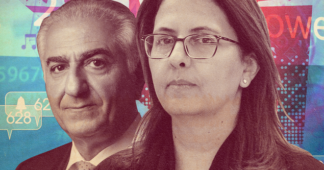
Leveraging public anger toward the Khamenei regime, Israel is attempting to restore the monarchy in Iran. According to information published by the Israeli newspapers Haaretz and The Marker, Israel has orchestrated digital campaigns in recent months in favor of the Pahlavi dynasty.
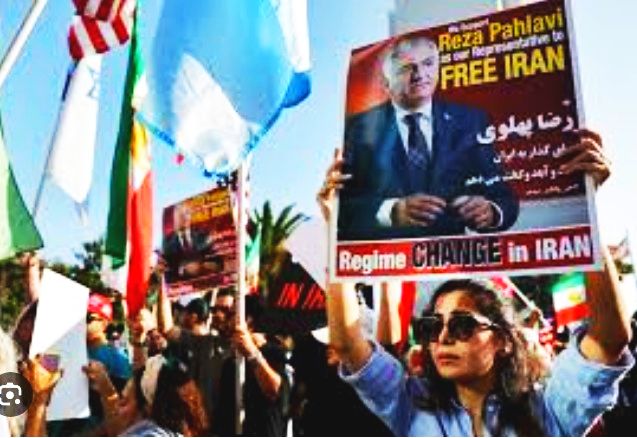 Reza Pahlavi is the son of Iran’s last Shah, who was imposed following the 1953 coup organized by U.S. and British intelligence agencies, which overthrew the progressive government of Mohammad Mosaddegh. The Shah was toppled during the 1979 Islamic Revolution and replaced by the regime of the Ayatollahs. Pahlavi, who has lived abroad for decades, is often presented in the West as the most liberal, democratic alternative to the Ayatollahs’ regime.
His official visit to Israel in early 2023, hosted by Gila Gamliel—then Minister of Intelligence and now Minister of Science—was, according to Haaretz, a pivotal moment for his public image. Israeli media portrayed the visit as proof that the Israel–Iran conflict concerns the Iranian regime and not its people, reinforcing the narrative of a natural alliance between Israeli and Iranian citizens against Tehran.
However, analysts and experts speaking to Haaretz emphasize that while Pahlavi retains supporters abroad, the idea of restoring the monarchy is by no means a dominant demand in Iranian society. Instead, many Iranians desire a “normal life,” with less repression, economic stability, and social rights, without returning to the past of the Shah’s regime, which in collective memory is associated with corruption, political oppression, and torture.
In this context, Haaretz and The Marker revealed in their October 2025 reports Israel’s digital operations to influence Iranian public opinion. The newspapers’ sources describe a multi-layered system in which private entities—some receiving state support—funded campaigns serving Israel’s geopolitical interests.
According to the same sources, Persian-language speakers were recruited to manage accounts on platforms such as X (formerly Twitter), Instagram, and Telegram. These accounts posed as Iranian citizens, often with detailed “personal” profiles, while many of their photos were generated using artificial intelligence tools. The goal was to create the impression of a spontaneous, internal Iranian dynamic in favor of overthrowing the regime and promoting specific political solutions.
The sources also mention internal friction. Two individuals who spoke to the newspaper stated they felt uncomfortable when asked to use the same networks not only to promote anti-regime messages but also to bolster the public image of Gila Gamliel, a close political ally of Netanyahu. This reinforced the perception, according to the sources, that the operations had an internal political dimension beyond their international role.
The report links these new revelations to previous investigations by Haaretz. Journalist Bar Peled, as well as independent social media researchers such as Nitzan Yasur and Gil Feldman, had already identified hundreds of suspicious accounts promoting pro-Pahlavi content and using hashtags like #KingRezaPahlavi. While not all accounts were attributed to a single operation, the overall picture, as described in the article, points to a broad and persistent ecosystem of digital influence.
A key role in documenting these findings was played by Citizen Lab, a research center at the University of Toronto with an international reputation for studying digital threats, surveillance, and disinformation. The lab identified a second, separate but related network of over 50 Persian-language accounts, which it characterized with a high degree of certainty as inauthentic.
According to Citizen Lab, these accounts were created in 2023 but remained inactive for months until they were activated almost simultaneously in early 2025. This timing, combined with the intensity of their activity during the 12-day war, is considered strong evidence of a coordinated operation. Additionally, researchers recorded extensive use of AI-generated content, including videos depicting Iran’s Supreme Leader, Ali Khamenei, in a satirical or offensive manner, based on familiar cultural patterns.
The most serious revelation concerns the Evin Prison case in Tehran. According to Citizen Lab’s findings, accounts in the network began posting reports of “explosions” in the prison area before such news appeared in Iranian media. Shortly afterward, a video purportedly showing an explosion at the site was disseminated. This video was widely circulated internationally before being exposed as inauthentic in a New York Times investigation.
Citizen Lab believes that the timing of the posts with the military operations of the Israeli Defense Forces makes it highly unlikely that the accounts were acting without prior knowledge of the events. Based on this evidence, the researchers attribute the campaign either directly to the Israeli state or to contractors acting on its behalf.
The report also documents how the digital campaigns attempted to “ride” existing social tensions in Iran. Network accounts amplified calls for protests, economic unrest, or even attacks on banks, while simultaneously adopting real slogans and demands already circulating in Iranian society. The goal, according to Citizen Lab, was to create chaos and destabilize the regime by exploiting existing social fissures.
Haaretz quotes the head of the Citizen Lab investigation, Alberto Fittarelli, who notes that while such practices are common in authoritarian regimes, attributing responsibility remains extremely difficult without the cooperation of the social media platforms themselves, which hold crucial data.
Translated from Greek info-war.gr
.
We remind our readers that publication of articles on our site does not mean that we agree with what is written. Our policy is to publish anything which we consider of interest, so as to assist our readers in forming their opinions. Sometimes we even publish articles with which we totally disagree, since we believe it is important for our readers to be informed on as wide a spectrum of views as possible.