January 4, 2026
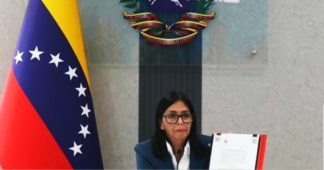
On Saturday, in keeping with the line of succession specified in Venezuela’s Constitution, the Constitutional Chamber of Venezuela’s Supreme Court of Justice (TSJ) directed Vice President Delcy Rodríguez to “assume and exercise as acting president” all the powers, duties, and authorities inherent to the office of president of the Bolivarian Republic of Venezuela in order to ensure administrative continuity and the comprehensive defense of the nation.

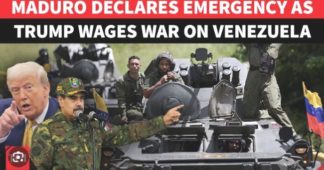
In reading the Constitutional Chamber’s decision, the president of the chamber, Tania D’Amelio Cardiet, listed the objective and legal arguments that led to the decision following the US military attack that took place on January 3, 2026, which culminated in the abduction of Constitutional President Nicolás Maduro.
D’Amelio stated the following: “the Constitutional Chamber of the Supreme Court of Justice, in exercising the interpretative power conferred upon it by Article 335 of the Constitution of the Bolivarian Republic of Venezuela, considers it necessary to carry out a systematic and teleological interpretation of Articles 234 and 239 of the Constitution” in order to “determine the regulation applicable to guarantee the administrative continuity of the State and the defense of the nation.”
The forced absence of the president of the republic, as a result of his abduction, “constitutes a case of material and temporary impossibility for the exercise of his functions,” noted D’Amelio.
By virtue of this circumstance and in compliance with the power conferred by Article 335 of the Constitution, as the highest and final interpreter of the Constitution, as well as Article 5 of the Organic Law of the Supreme Court of Justice—added D’Amelio—“this chamber bases its jurisdiction and proceeds ex officio to interpret the applicable Constitutional provisions in order to clarify and dispel any legal uncertainty, with the aim of establishing a roadmap for the preservation of Constitutional order at this momentous time for the country.”
Exceptional situation
She specified that the US attack and presidential abduction that occurred on January 3, 2026, “constitutes an exceptional, atypical situation of force majeure not literally provided for in the Constitution,” which creates a situation that requires “Constitutional certainty due to the extreme gravity that threatens the stability of the State, the security of the nation, and the effectiveness of the legal system.”
For this reason, she continued, the Constitional Chamber considered it “indispensable” to issue its decision within the framework of an “urgent and preventive precautionary measure”—a protective measure to ensure “the administrative continuity of the State and the defense of the nation.”
It did so, she clarified, “without this implying a decision on the merits of the definitive legal classification of the temporary or absolute presidential offense nor replacing the powers of other State bodies to make such a classification in subsequent proceedings.”
The document, signed by the president, the vice president, the magistrates, and the secretary of the Constitutional Chamber of the TSJ, indicates that in the “current state of manifest urgency and certain threat,” it is “imperative, necessary, and proportionate to cautiously provide that said function be exercised immediately” in order to facilitate the “preservation of the interests of the nation in the face of the foreign aggression it currently faces.”
A brief biography of Delcy Rodríguez
Delcy Rodríguez joined the Venezuelan government in 2003, during the first presidency of Hugo Chávez. In this administration, she served in the office of the vice presidency, as director of international affairs at the Ministry of Energy and Mines, as vice-minister for European affairs and minister for presidential affairs, and as general coordinator to the vice president who, at that time, was her brother, Jorge Rodríguez.
Delcy and Jorge are the children of Jorge Antonio Rodríguez, a leader of Venezuela’s Revolutionary Left Movement and founder of the Socialist League. In 1976, he was tortured and killed by Venezuela’s former intelligence service, the Directorate of Intelligence and Prevention Services (DISIP). Due to its links with United States intelligence agencies and because of numerous human rights abuses, DISIP was disbanded by President Chávez in 2009 and replaced by the current intelligence agency of Venezuela, the Bolivarian National Intelligence Service (SEBIN).
More recently, Delcy Rodríguez has served as the president of the Constituent Assembly of Venezuela from 2017 to 2018 and the minister of petroleum from 2024 to 2025. She had served as vice president in the Maduro administration since 2018.
As president of the republic, Rodríguez will thus continue the Constitutional path followed by the Bolivarian Revolution since the election of Chávez in late 1998.
(Telesur) Translation: Orinoco Tribune
.
We remind our readers that publication of articles on our site does not mean that we agree with what is written. Our policy is to publish anything which we consider of interest, so as to assist our readers in forming their opinions. Sometimes we even publish articles with which we totally disagree, since we believe it is important for our readers to be informed on as wide a spectrum of views as possible.