By Al Mayadeen English
Feb 27, 2026
US intelligence and international monitors challenge Trump’s Iran nuclear claims, saying Tehran is years away from hitting the United States.
As President Donald Trump and senior aides publicly argue for potential military action against Iran, they have claimed that Tehran has restarted its nuclear program, could build a bomb within days, and is developing missiles capable of striking the United States.
The narrative has been the same for decades, alleging that Iran, despite having constantly reasserted that it does not aim to build a nuclear weapon based on a national law and religious edict, intends to build an atomic bomb.
However, American and European officials, international weapons monitors, and US intelligence assessments present a significantly different picture.
Several of the administration’s claims remain either unproven or contradicted by available intelligence.
US intelligence on Iran’s nuclear program
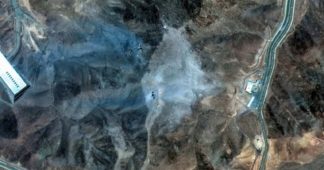
While Iran has taken steps to excavate facilities struck last June by the United States and “Israel”, officials say there is no evidence that Tehran has resumed uranium enrichment or initiated efforts to construct a nuclear detonation mechanism.
The stockpiles of previously enriched uranium remain buried following last year’s strikes, making it nearly impossible for Iran to assemble a nuclear weapon “within days,” according to officials familiar with intelligence assessments.
Steve Witkoff, the White House’s lead negotiator in talks with Iran, stated on Fox News that Iran is “probably a week away from having industrial-grade bomb making material.”
Yet US officials and international inspectors dispute that assertion, noting that strikes on Natanz, Fordow, and Isfahan severely damaged Iran’s primary nuclear infrastructure.
According to the International Atomic Energy Agency, most of Iran’s nearly 1,000 pounds of uranium enriched to 60 percent remains buried at Isfahan. Without access to that stockpile and without enrichment to 90 percent purity, constructing a nuclear weapon would likely take many months or longer.
Even some congressional Republicans have questioned the immediacy of the threat.
“I can’t speak for Steve. I haven’t got those reports, and I’ve been read in on some of those programs,” Senator Markwayne Mullin said on CNN. “I’m not saying he’s wrong or he’s right, I just haven’t seen those reports.”
Secretary of State Marco Rubio acknowledged there is no evidence Iran is currently enriching nuclear fuel.
Iran ballistic missile range and US threat claims
In his State of the Union speech, Trump claimed Iran is “working to build missiles that will soon reach the United States of America.”
Rubio echoed the concern but suggested a longer timeline, saying Iran could “one day” develop such capabilities.
However, three American officials with access to current intelligence assessments said the president exaggerated the immediacy of the threat.
A Defense Intelligence Agency report last year concluded that Iran does not currently possess ballistic missiles capable of striking the United States and could require up to a decade to develop a limited intercontinental ballistic missile capability, and only with sustained effort.
Iran currently maintains an estimated arsenal of 2,000 short- and medium-range ballistic missiles, capable of targeting “Israel” and US bases in the region. Its most advanced systems can reach Central and Eastern Europe, but intelligence agencies assess that Tehran is years away from threatening the US mainland.
Pentagon military buildup in West Asia
The Pentagon has deployed ships, aircraft, and air defense units to the region in the largest US military buildup in more than two decades.
Critics argue the administration has not publicly justified the urgency of a second military confrontation with Iran in less than a year.
Representative Jim Himes, the top Democrat on the House Intelligence Committee, voiced concern following a closed-door briefing.
“I’m very concerned,” he said. “Wars in the Middle East don’t go well for presidents, for the country, and we have not heard articulated a single good reason for why now is the moment to launch yet another war in the Middle East.”
Contradictions within the administration
During his State of the Union Iran speech, Trump reiterated that last year’s strikes “wiped out” Iran’s nuclear program while simultaneously asserting that Tehran had restarted it.
“They want to start it all over again and are at this moment again pursuing their sinister ambitions,” he said.
US intelligence officials indicate that Iran has not constructed new nuclear facilities since the strikes. However, activity has been detected at two incomplete sites near Natanz and Isfahan that were not targeted.
Fordow, one of the most fortified facilities struck last year, remains inoperable, according to US officials.
Intelligence assessments suggest Iran may be exploring deeper underground construction to shield future facilities from conventional US weapons such as the Massive Ordnance Penetrator.
Historical echoes
Some lawmakers have drawn parallels between current rhetoric and the 2003 State of the Union address by former President George W. Bush, in which claims about Iraq’s weapons programs were later proven false.
The debate over Trump’s nuclear claims continues as talks over Tehran’s nuclear program proceed, while tensions rise amid an expanding US military presence in the region.
In his State of the Union address, US President Donald #Trump made extensive allegations about Iran’s nuclear program, defended #US military strikes on #Iran‘s nuclear facilities, repeated debunked accusations about the armed riots in Iran, while simultaneously confirming ongoing… pic.twitter.com/jrfZluNu3C
— Al Mayadeen English (@MayadeenEnglish) February 25, 2026
Read also: Trump Iranian missile claim unsupported by US intelligence
.
We remind our readers that publication of articles on our site does not mean that we agree with what is written. Our policy is to publish anything which we consider of interest, so as to assist our readers in forming their opinions. Sometimes we even publish articles with which we totally disagree, since we believe it is important for our readers to be informed on as wide a spectrum of views as possible.