By Rayhan Uddin
March 5, 2026
Bahraini authorities are cracking down violently on protesters angry at US role in the state, and detaining people for posting videos of Iranian attacks
The US and Israel have suggested their war could bring about regime change in Iran. Some are now joking that they might have sparked it in Bahrain, a close western ally, instead.
While revolutionary fervour may be far off, tensions in Bahrain are palpable.
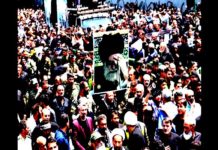
Hours after the US and Israeli assassination of Ayatollah Ali Khamenei was confirmed, protests against the killing of a man who was a Shia spiritual leader as well as Iran’s supreme leader spread across the Gulf island.
“There were demonstrations in many cities and villages. These were angry marches but they were peaceful,” a source in Bahrain familiar with the matter told Middle East Eye, speaking on condition of anonymity.
Protests are rare in Bahrain, due to severe restrictions on dissent and freedom of expression. Much of the population is Shia, from the Baharna ethnic group. The group was one of the earliest adopters of Shia Islam, dating back to the 7th century.
Bahrain’s ruling Al Khalifa family, who are Sunni, arrived on the island in the 17th century.
“Khamenei is also a religious leader. If the US understood anything about Iran and Shiism, they would’ve recognised that killing Khamenei in Ramadan, in old age, is the greatest gift they could have given him,” Maryam al-Khawaja, a Bahraini-Danish activist, told MEE.
“For all of his followers, he is considered a martyr.”
Footage shared on social media showed large crowds in Bahrain marching through narrow streets on Sunday and chanting Shia religious slogans, such as “for the sake of Hussein”.
Bahraini security forces responded aggressively, firing teargas directly at crowds. There was also footage of a handful of demonstrators throwing Molotov cocktails.
At least 65 people were arrested in connection to protests, according to the Bahrain Institute for Rights and Democracy, or Bird.
Two of those detained were young men, Husain Naji Fateel and Ali Mahdi. They marched peacefully towards the US embassy, and shared footage of it online.
Sayed Alwadaei, director of Bird, spoke to Fateel’s father following the arrest.
“He confirmed to me that his son was interviewed by a public prosecutor. The charges given to him are extremely serious. He was accused of inciting hatred against the monarchy, assisting an enemy state, undermining public security and misuse of social media,” Alwadaei told MEE.
His father, Naji Ali Hassan Fateel, has himself faced multiple arrests over human rights activism. “Now his 21-year-old son is facing his father’s fate,” said Alwadaei.
US bases a ‘threat to Bahrain’s security’
Over the past five days, Iranian drones and missiles have targeted US military bases across the Gulf region, including Bahrain.
There have been explosions and fires in the capital, Manama, from direct impacts, as well as falling debris from air defence interceptions. A Bangladeshi man was killed by debris in the Salman industrial area.
An Iranian drone strike on the Crowne Plaza Hotel in Manama reportedly wounded two employees of the US Department of War.
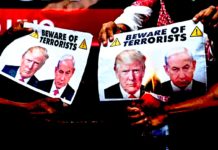
The anger of protesters in Bahrain has been largely directed towards the US role in the war.
Bahrain hosts the headquarters of the US Navy’s Fifth Fleet, where over 9,000 American troops are stationed. It’s the second-largest US base, in terms of personnel, in the region.
Many Bahrainis see that as inviting conflict into the country. They also believe that the US, as well as the UK, have long propped up Bahrain’s royal family.
“The bases in Bahrain have always been seen as a problem and as a threat to the security and safety of the people,” said Khawaja. “In the past week we’ve seen how the GCC [Gulf Cooperation Council] has become cannon fodder.”
‘What the Bahraini government does best is oppression – especially in times of crisis’
– Maryam al-Khawaja, activist
The presence of American troops in Bahrain has been a point of contention for decades.
Bahrain’s legislative assembly was disbanded in 1975, just two years after it was created, partly due to the fact it opposed the presence of the US Navy on the island.
The permanent dissolution of parliament prompted a period of 25 years’ emergency rule by decree.
Opposition to the navy hasn’t ended: in 2024 there was a sizeable march against the Fifth Fleet and Bahrain’s establishment of open relations with Israel.
Khawaja noted that every few years there were anti-government protests in Bahrain, including mass uprisings in the early 1990s and in 2011. Both were violently brought to an end by authorities.
“If history has taught us anything, it’s that what the Bahraini government does best is oppression – especially in times of crisis,” she said.
In 2011, other Gulf states, led by Saudi Arabia, helped to suppress protests in Bahrain using the joint Peninsula Shield Force.
Rumours spread online this week that Saudi police had once again entered its neighbouring state to suppress protests. However, the source in Bahrain told MEE they were not aware of any such action.
Arrests for social media posts
Separate to the protests, at least 11 people have been arrested for posting footage of Iranian attacks online. They have been accused of misleading public opinion and “spreading fear in the hearts of citizens and residents”.
One of those arrested, Alwadaei confirmed, was social media influencer Sayed Baqer al-Kamel. He is a well-known social media influencer and photojournalist.
Kamel posted a video of a high-rise building on fire in the Seef district and called on people to pray for Bahrain. It has since been deleted from his profiles.
“He didn’t post footage of a military facility. He happened to be in a nearby area and documented the moment,” said Alwadaei. “Hours after the post, he was summoned.
“Bahrain is imposing a terrorising campaign to stop anyone sharing footage of what is happening.”
The public prosecutor’s office said that those arrested for creating “fabricated visual content” were being held in pretrial detention. It added that it could lead to prison sentences of up to two years, as well as a fine.
It also said that those accused of “glorification and promotion” of Iranian attacks would face urgent trials.
MEE has asked the Bahraini embassy in the UK for comment.
Khawaja, whose father, Abdul-Hadi al-Khawaja, was sentenced to life in prison in 2011 after leading peaceful protests, is all too familiar with the Bahraini legal and prison system.
Her father went on hunger strike for several weeks in 2023, over the conditions in Jau Prison, where many prisoners of conscience are held. In 2011, he was convicted in what Amnesty International described as a “grossly unfair military trial”. Khawaja herself has been detained too.
“From personal experience, there is no due process in Bahrain,” she said.
.
We remind our readers that publication of articles on our site does not mean that we agree with what is written. Our policy is to publish anything which we consider of interest, so as to assist our readers in forming their opinions. Sometimes we even publish articles with which we totally disagree, since we believe it is important for our readers to be informed on as wide a spectrum of views as possible.
 Iran’s Khamenei Says US Attack Will Lead to ‘Regional War’
 Before Khamenei Killing, CIA Assessed He Would…
 UK will allow US to use its military bases to…
 Anti-war protests held in US, UK, and Greece after…
 Austin Pledges the US Will Defend Israel If It Faces…
 Trump Threatens To Hit Iran ‘Very Hard’ Over Protests