February 13, 2020
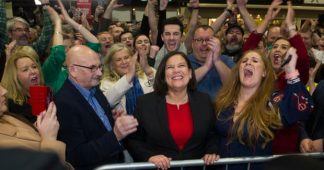
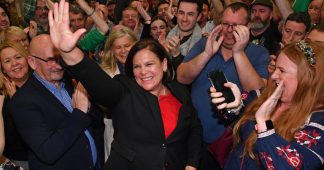
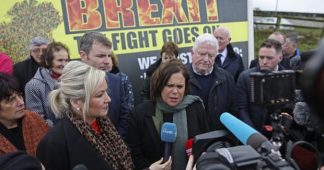
Sinn Féin, a nationalist party that sits with the left/far-left group in the European parliament and from the 1970s to ’90s was attached to an armed insurgency in Northern Ireland, won the most first-preference votes in this month’s general election in the Republic of Ireland. It now has about the same number of parliamentary seats as each of the state’s traditional centrist “big parties”, Fine Gael and Fianna Fáil.
This is an extraordinary development by any measure. However, with the party’s vote and seat share sitting just below one quarter, and with “the Left” in total, generously measured, stuck at not much more than 40% in votes and seats, it is not at all clear that it will lead to extraordinary changes in politics and economics here. Protracted negotiations, and perhaps another election, lie ahead.
Beyond the sensational fact that Sinn Féin, with its dangerous past and radical present, is the main beneficiary of the anti-establishment surge in this election, there is an unmistakable trend. The two big parties that have traded power in Ireland since 1932 have been seeing their combined vote shrinking, especially since the devastating crisis of 2008. In 2011, it was a dramatic historic low of 53%. Then in 2016 it dropped just below 50%. This time around, it is a mere 43%.
In 2011, Ireland’s Labour Party – a watery organisation even by the weak standards of European social democracy – was at the forefront of this resistance, gaining almost as many votes and seats as Sinn Féin earned this time. Then Labour went into a governing coalition with Fine Gael, and in the last two elections it has been virtually wiped out. If it had stayed in opposition, perhaps it would have blocked at least some of the rise of Sinn Féin, and benefitted from this year’s bigger wave.
Instead, Labour sits sullenly near the bottom of the new, uncoalesced Left bloc in Ireland, consisting otherwise of Sinn Féin; the Green Party, which has shared government with the centre-right in the past and is, by European-Green standards, relatively corporate in its politics and presentation; a loose historically-trotskyist alliance called “Solidarity – People Before Profit” (S-PBP), some affiliated to the Committee for a Workers International’s successor International Socialist Alternative, and others to the Cliffite International Socialist Tendency; various left independents (some formerly attached to those trotskyist groups); and the Social Democrats, a soft-left grouping that owes its 2012 formation in part to Labour renegades who left that party for reasons no one can remember.
All these groups owe their current relative success in large part to the fact that Sinn Féin, not anticipating this year’s surge, ran too few candidates, and their “surplus” transfers went very much to the Left, in Ireland’s complex voting system. These are disparate and often mutually hostile groups – the simmering tensions even within S-PBP, from the outside a remarkably stable alliance that delivers electoral fruits largely unknown on the “revolutionary” Left elsewhere in Europe, are eased only slightly by victory. It is unlikely that all this Left will get it together to govern, especially since they would probably need the acquiescence of a motley assortment of mostly rural “non-ideological” independent members of parliament.
Meanwhile, the media in Ireland, almost uniformly hostile to Sinn Féin, have suggested the party’s victory came from the successful hiding of its “terrorist” past and radical/nationalist present – despite the same media “uncovering” these allegedly concealed things, repeatedly. In this formulation, the party’s push for pragmatic solutions to crises in housing and healthcare was the source of its new success. There is clearly some truth in this, after an election campaign that focussed heavily on dissatisfaction with public services.
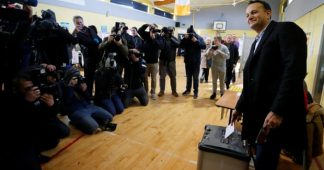
However, Sinn Féin’s “pragmatism” cannot and should not be read outside a larger ideological frame. Both of the old “big parties” had been successfully remodelled in the neoliberal style in recent decades: Fianna Fáil, the party of the Celtic Tiger, drove an economic boom and bubble on a combination of financial speculation and multinational tech and pharmaceutical investment. Fine Gael decorated its post-crisis austerity policies in the rainbow colours of progressive change, adopting itself to popular referendum campaigns for marriage equality and reproductive rights; its outgoing prime minister, Leo Varadkar, is the gay son of a doctor from Mumbai.
By contrast to such models of neoliberal orthodoxy, and just as an example, Sinn Féin’s spokesperson on housing, Eoin Ó Broin, is a long-time activist who has written books about “left republicanism” and about the role of neoliberalism and financialisation in the housing crisis. Like most in his party, he stands proudly outside the consensus view of what constitutes “pragmatic” solutions to such crises. One shouldn’t exaggerate their revolutionary socialism; in the European parliament, they sit on the right side within the left GUE/NGL group. Nonetheless Sinn Féin, unlike the Irish Labour Party, are far from Blairite barely-social democrats.
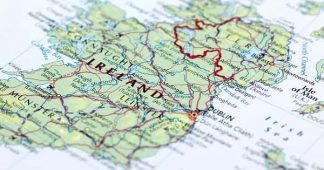
Similarly, the Sinn Féin party’s stance outside the Irish state’s consensual accommodation with British imperialism, including the party’s insistence on a move toward referenda on Irish unity north and south of the Border, has almost certainly been less of an impediment than conventional punditry would insist. In fact, the Border-poll proposal is supported by the electorate far beyond the party’s supporters. The outgoing government began the election having just been forced by popular outrage to abandon plans for a commemoration of the police and auxiliary forces who stood with the British against the Irish struggle for independence a century ago. Anti-imperialism is a force to be reckoned with in Ireland, where campaigns against US and British wars and Israeli settler colonialism are widespread and well supported.
Where, then, does “nationalism” fit into the equation when we calculate the causes and consequences of political change in Ireland? And how do we discuss it without treating nationalist sentiment in a post and anti-colonial country as though it mirrored the nationalism of, say, Britain’s Brexit campaign?
We can begin to address these questions precisely by looking at Brexit in this election. A lot of the conventional wisdom from international pundits has suggested that Brexit was central to the result in Ireland. Within Ireland, the conventional wisdom goes the opposite way, supported by an exit poll that showed only 1% of the electorate saw it as the most important issue. Irish media generally say Brexit was irrelevant to voters, and that the outgoing government badly miscalculated by campaigning on it, with its focus on the competent handling of the negotiations leading up to Britain’s official exit from the EU on January 31st.
Both sets of conventional wisdom are probably wrong. Brexit played little part in the successful electoral drive of the Sinn Féin and the Left, but the spectre of Brexit should not be entirely discounted as a factor in the election.
The old government counted on the simplistic hope that Irish voters like to see their politicians “holding their own” and “punching above their weight”, especially vis-a-vis the British. Insofar as Varadkar and his team ensured that EU negotiators “stood up for Ireland” to insist that there should not be a “hard border” between Northern Ireland and the Republic, the pre-Brexit talks could and should be counted as this sort of success, by their reckoning.
The trouble with this victory-lap approach was not simply voter “ingratitude” for the government’s efforts – “Eaten bread is soon forgotten” was an oft-cited cliché of the election coverage – but rather the inescapable fact that Brexit remains unresolved. The UK, including Northern Ireland, left the EU at the end of January, but apart from British officials losing their seats at Brussels confabs, nothing has changed – yet. In the week between nominal Brexit on January 31st and the election on February 8th, Irish news bulletins often featured an ebullient Boris Johnson vowing defiance of one EU demand or another for a future trade agreement, undercutting any sense of successful “completion”.
Certainly the Irish government tried, in the election campaign, to have its Brexit cake and eat it too, crowing about its Brexit success but also warning that “it is only halftime” in negotiations, as an argument for continuity. Like most contradictory electoral messages, this was not a formula for success. It is arguable that continuing unease and even anger about Brexit and its as-yet-unknown Irish consequences were quiet influences on voters considering casting their ballot for Sinn Féin.
In any case, “change” was an easy message for Sinn Féin to sell in a country that both badly needs it – in its appalling public services, particularly – and has also successfully delivered it in recent years. The party, like most other parties in the state, was actively involved on the winning side in the referenda that have marked the Irish people out as a particularly liberal and inclusive electorate. If we can vote for gay marriage – the first jurisdiction in the world to introduce it by referendum – and for legal abortion in an overwhelmingly Catholic state, then surely we can also vote for someone other than Fine Gael or Fianna Fáil.
However, it is clear that the electorate does not wish “change” to take an anti-EU or anti-immigrant colouring, as it did in Britain in 2016. A number of new small parties and some high-profile independent candidates ran in this election on platforms rejecting immigration and calling, more or less explicitly, for “Irexit”. They were roundly defeated, gaining no more than a few hundred votes for the most part, and “immigration” was selected as the most important issue in the election by only 1% of people who answered the main exit poll. A Sinn Féin candidate in the rural west of Ireland who had been targeted by anti-immigrant forces last year because of his support for asylum-seekers nonetheless topped the poll in his constituency.
In the continuing and complete rejection of any racist or neo-fascist Right, and in its turn to Sinn Féin and politicians further to the Left, the Irish electorate have offered powerful and unusual reasons to be cheerful about the politics of the new decade.
* Harry Browne lectures at Technological University Dublin, where he jointly coordinates the Centre for Critical Media Literacy.
Published at https://www.criticatac.ro/lefteast/irish-voters-reject-the-right-a-new-opportunity-for-the-left/