DANIA AKKAD*
10 March 2026
Keir Starmer’s complicity in the illegal US-Israeli war started in January when British and American assets started moving to the Middle East
Keir Starmer has said that the UK “does not believe in regime change from the skies” and that lessons from the Iraq war have been learned.
Yet 11 days into the US-Israeli war on Iran, the prime minister is letting the UK become increasingly involved in a conflict which has been roundly criticised for violating international law.
In fact, Britain’s involvement began back in January when both UK and American weaponry started moving east in preparation.
Here’s a break down of Britain’s involvement:
Safe passage for US planes
American planes have been transiting through British military bases on their way to the Middle East since early January after Trump said the US was “locked and loaded” and ready to help Iranian protesters.
Planes have been tracked passing through RAF Lakenheath and RAF Mildenhall, both in Suffolk, and have also moved through Prestwick Airport, a civilian airport in Scotland.
Over 100 fighter jets have left RAF Lakenheath for the region since January, according to the Lakenheath Alliance for Peace, an activist group focused on US activity at the base.
Additionally, the group says more than 25 C-17 transport planes, which can carry troops and cargo and are typically deployed before an operation, have transited through during that period.
Activists tracking the activity argue that the quantity of American planes passing through British military bases show how important they have been for the US strategically.
At least one of the jets from Lakenheath, an F-15, was reportedly among those which crashed in Kuwait during the war, confirming their involvement in the conflict.
Use of bomber base
Before the US and Israel attacked Iran, Starmer refused to allow the US to use RAF Fairford and the British base at Diego Garcia to bomb Iran directly, reportedly over concerns that such strikes would violate international law.
Unlike the bases being used for transiting aircraft, these bases are important specifically for bombing missions.
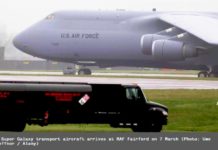
RAF Fairford in Gloucestershire has a 10,000-foot runway and is the US Air Force’s only European airfield for heavy bombers. Diego Garcia has a runway long enough for US B-2 stealth bombers to bomb deep inside Iran.
After the US and Israel campaign began, Starmer announced on 1 March that the US had requested – and the UK had approved – the use of British bases to launch “defensive” operations against Iran.
On Monday, three American B-52s arrived at RAF Fairford, joining other American aircraft (B-1s) that have turned up since Starmer’s announcement.
The deployments come as the US and Israel repeatedly attack civilian targets and oil infrastructure across Iran, plunging the capital Tehran into a black cloud of toxic smoke.
It remains unclear how the UK can ensure the US only strikes targets in Iran that pose a threat to “British interests” on these bombing runs.
Defensive assets
Britain moved “defensive assets” to Cyprus and Qatar in January and February “to ensure we were in a heightened state of readiness of any conflict beginning”, Starmer said last week.
The assets included fighter jets, air defence missiles, advanced radar and systems to take down drones.
Since the start of the war, British forces have shot down Iranian drones over Jordan, Qatar and Iraq.
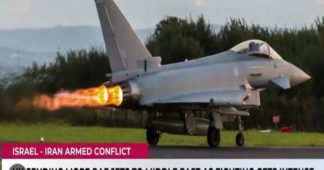
The UK is also flying air patrols with Eurofighter Typhoons and F-35 fighter jets to strengthen its air presence and support allied Gulf monarchies.
Further assets have been moved out or are on their way. Four more Typhoon jets have been sent to Qatar to support air defences to protect Gulf countries.
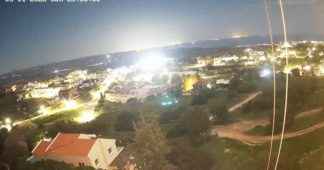
The UK is also deploying the destroyer HMS Dragon and “drone-busting” Wildcat helicopters to the Eastern Mediterranean after drone strikes on RAF Akrotiri in Cyprus.
Dragon has Sea Viper missiles that can shoot down drones at approximately £1 million a shot.
*Dania Akkad is an investigative journalist. She has won awards for her reporting on women’s rights in the Middle East, Saudi Arabian dissidents and California’s lettuce industry. She started her career covering crime and agribusiness at daily newspapers in California, and then reported from Syria as a freelance journalist before the war, including investigating the 2005 suicide bombing in Amman that killed members of her family. She served most recently as senior investigations editor at Middle East Eye.
.
We remind our readers that publication of articles on our site does not mean that we agree with what is written. Our policy is to publish anything which we consider of interest, so as to assist our readers in forming their opinions. Sometimes we even publish articles with which we totally disagree, since we believe it is important for our readers to be informed on as wide a spectrum of views as possible.