By Ahmed Ahmed*
January 22, 2026
Palestinians report a dire lack of healthy food, medicine, and winter shelter, while a new ban on humanitarian groups will push the enclave to the brink.
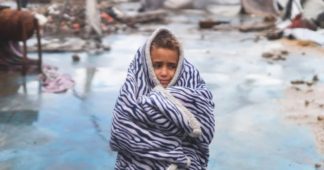
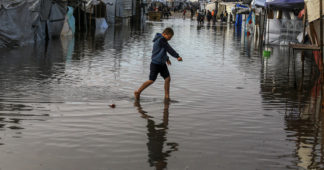
At the beginning of the new year, Saber Dawas stood inside Gaza City’s Yarmouk Stadium, where he and his family had been displaced since Israel bombed their home in Beit Lahiya in December 2023. Now, he had to start from scratch yet again: Heavy rain and strong winds destroyed his family’s makeshift tent and flooded their belongings.
“My wife and six daughters were crying while freezing,” Dawas told +972 Magazine. “I was helpless, trying to hold the tent with a wooden stick to keep it standing, but it was blown away.”
Dawas’ family is among more than a million Gazans in need of emergency shelter, and almost 800,000 living in areas prone to flooding during the recent winter storms. Yet in spite of the terms of the October ceasefire, Israel has continued to enforce severe restrictions on the entry of goods — including prefabricated homes, or caravans, and other shelter materials — and Palestinians like Dawas are left struggling to find basic resources.
“My family and I have been waiting for the entry of caravans so we can live with dignity instead of being humiliated in tents,” Dawas added. “If this is a real ceasefire, why is Israel still closing the borders and restricting the entry of life-saving necessities, including caravans, humanitarian aid, commercial products, and even my daughter’s medicine and milk?”
Dawas’ youngest daughter, Hoor, who is two years old, suffers from stomach cancer and severe malnutrition. She can only safely consume specialized medical formulas known as F100 and F75, prescribed by doctors for critically ill and malnourished children.
But Dawas has been unable to find them in pharmacies, medical clinics, or from humanitarian organizations operating in Gaza, as Israel has continued to prevent UNICEF from bringing nearly a million bottles of baby formula into the Strip.
 Two-year-old Hoor Dawas, who suffers from malnutrition and stomach cancer, and her older sister, in Gaza City, November 28, 2025. (Courtesy)
“Since the ceasefire, whenever we ask NGOs or pharmacies about the milk, they tell us Israel is not allowing it into Gaza,” Dawas’ wife and Hoor’s mother, Sanabel, said.
Hoor also urgently needs to leave Gaza to get medical attention; with the healthcare sector largely destroyed by Israel’s campaign, doctors lack the imaging equipment necessary to determine the severity and progression of her cancer.
“A severe shortage of cancer medications, the denial of essential diagnostic services, and the continued closure of crossings preventing patients from traveling abroad for treatment have created a deadly reality, placing patients’ lives at constant risk,” explained Talha A. Balousha, a supervisor at the Gaza Cancer Center in the Health Ministry.
Even cancer medications that have entered Gaza through the ministry following the ceasefire remain far below what is needed to meet patient demand who require continuous and specialized treatment.
“The ceasefire has made no difference and has not led to any meaningful improvement in medical services, neither in specialized equipment nor in essential medicines,” he continued. “Patients are unable to receive chemotherapy, and with acute shortages of painkillers, they are forced to endure extreme suffering. Some die without any access to pain relief.”
Indeed, doctors recently reported that cancer-related deaths have tripled since October 2023. Hoor was issued a high-priority medical referral last July, after doctors with the International Medical Corps in southern Gaza diagnosed her stomach cancer. But like 18,500 other Gazans, she is still waiting for Israel to facilitate her evacuation — and Dawas knows that time is running out.
“We are still waiting for Israel to open the borders so we can treat our daughter before she dies in front of us,” he said.
 A four-day-old Palestinian baby is treated in the neonatal intensive care unit at Nasser Hospital in Khan Younis, southern Gaza Strip, as doctors call for her urgent transfer abroad for surgery, January 17, 2026. (Abed Rahim Khatib/Flash90)
‘I walk past fruits and vegetables, feeling helpless’
Although Israel agreed to allow 600 trucks of aid into the Strip every day as part of the ceasefire agreement, local authorities say that only 200 enter on the best days. European diplomats are now reportedly reconsidering their participation in the U.S.-led Civil-Military Coordination Center in southern Israel, in part due to the fact that many of the trucks entering Gaza since October have only carried commercial goods, and citing the absence of any notable increase in humanitarian aid.
Meanwhile, Gazan economic researcher Ahmed Abu Qamr estimates Gaza actually needs at least 1,000 trucks daily to meet basic needs, or five times what Israel is currently allowing. Israel has only approved a small number of vetted Gazan importers to bring goods into the Strip, who have reported paying millions of dollars in “coordination fees” to the Israeli military — and with a monopoly on imports, they can pass on the fees to other traders who lack Israeli approval and raise the cost of goods in local markets.
“These fees drive prices up to eight times higher than before the war,” Abu Qamr said. “Less than 5 percent of Gaza’s population can afford basic goods, while the vast majority live in poverty and rely on charities.”
Israel further restricts essential food items such as chicken, meat, and eggs, leaving them to spoil in the trucks, or demanding higher coordination fees that leads to a spike in their prices. Meanwhile, unhealthy processed snacks enter with fewer restrictions. “These products cannot replace nutritious food,” Abu Qamr said. “Thousands of families in Gaza have not eaten vegetables or fruit for months.”
Ayman Madoukh, a Palestinian in his 50s who used to work in construction, had desperately awaited the ceasefire to be able to return to work and feed his family. But while local shops are once again selling fresh food, he cannot afford them.
“I frequently visit the market to buy basic necessities, but my money runs out before I can buy everything my family needs,” Madoukh said. “I walk past fruits and vegetables and return home feeling helpless and deeply saddened.”
 Palestinians shop at a market in Khan Younis, in the southern Gaza Strip, November 21, 2025. (Abed Rahim Khatib/Flash90)
A father of six, Madoukh’s family relied on savings until they ran out last summer. He now depends on one of his sons’ income working at a small mall in central Gaza City and occasional support from his brother in Turkey.
Without stable earnings, Madoukh’s family relies largely on humanitarian food parcels distributed by organizations like UNICEF. But he says distributions are insufficient and similarly nutritionally inadequate, especially after months of starvation. While the Strip is no longer under famine conditions, hunger levels are still at a critical point.
“Instead of chicken, meat, eggs, or vegetables, I have only received bags of flour and beans since the ceasefire,” Madoukh said. “It is neither healthy nor enough.”
“People have been flooded with aid limited to a single category of food — mainly white flour and cheap canned goods,” Abu Qamr also noted. Often, the cost of transportation to collect aid exceeds the low value of what they collect, so some families skip distribution.
“Israel has pushed people in Gaza into near-total dependence on humanitarian aid,” he continued. “Before the war in October 2023, around 55 percent of Gaza’s population depended on humanitarian assistance; today, that number has risen to 95 percent.”

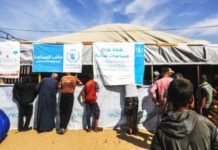
Palestinians line up outside of a World Food Programme aid distribution site, in Khan Younis, in the southern Gaza Strip, November 2, 2025. (Abed Rahim Khatib/Flash90)
‘Allowing humanitarian aid in Gaza is not a favor’
Now, an already dire humanitarian situation will be pushed to the brink after Israel revoked the operating licenses of some of the international organizations that deliver assistance in the occupied Palestinian territories. 37 international organizations — including the International Rescue Committee and Doctors Without Borders — had their licenses suspended on Jan. 1 and were given 60 days to cease operating within Gaza and the West Bank.
The Israeli Ministry of Diaspora Affairs and Combating Antisemitism said the 37 organizations on the list failed to meet what it described as “security” and “transparency” requirements. But UN human rights chief Volker Türk described the suspensions as “arbitrary,” warning that they make “an already intolerable situation even worse for the people of Gaza.”
“Denying medical assistance to civilians is unacceptable under any circumstance, and it is appalling to use humanitarian aid as a tool of policy or collective punishment,” Doctors Without Borders wrote in response to Israel’s suspensions. “Allowing humanitarian aid in Gaza is not a favor — it is an obligation under international law.”
In response to a request for comment, a spokesperson for Israel’s Coordinator of Government Activities in the Territories (COGAT) — the civilian branch of Israel’s military government in the occupied West Bank and Gaza — emphasized that “Israel does not restrict essential food items, and their entry is facilitated in accordance with requests from international aid organizations.”
The spokesperson also claimed that “between 600 and 800 aid trucks enter the Gaza Strip every day,” 70 percent of which carry food, and that COGAT has “carried out extensive preparations for the winter period” in Gaza by facilitating the entry of “more than 490,000 family tents, sheets, and tarpaulins.” The spokesperson similarly denied that Israel restricts the entry of medicine, and insisted that “Israel acts to allow and facilitate the entry of all required medical equipment and continues to facilitate the entry into the Gaza Strip of trucks carrying medical supplies, without quantitative limitation.”
Nor does Israel, according to the COGAT spokesperson, “restrict the exit of Gaza Strip residents for the purpose of receiving medical treatment in a third country. On the contrary, Israel encourages countries around the world to submit requests to evacuate patients from the Gaza Strip, with an emphasis on children and their caregivers, and is prepared to assist in the evacuation process subject to receipt of an official request from a receiving country.” The spokesperson claimed that 42,000 residents have been evacuated from Gaza since the start of the war, and “dozens and even hundreds” each week in recent months.
Regarding the recent suspension of operating licenses for international organizations operating in Gaza and the West Bank, the spokesperson noted that “due to credible information received regarding Hamas exploitation of humanitarian aid, the defense establishment formulated a new mechanism for the entry, control, and supervision of humanitarian aid.
“As part of this mechanism, organizations are required to complete an orderly registration process with Israel’s Ministry of Diaspora Affairs, which includes, among other things, the submission of a list of organization employees operating in Gaza for prior security screening.
“The volume of aid entering Gaza each day does not depend on these organizations, and there will be no future harm to the volume of humanitarian aid as a result of the implementation of the law.”