Timo Al-Farooq – Source: Al Mayadeen English
Mar 17, 2026
Germany’s crackdown on pro-Palestinian activism is driving a broader erosion of civil liberties and democratic standards. According to Timo Al-Farooq, measures targeting Palestine solidarity are expanding into wider repression of dissent across society.
In terms of civic freedoms, last year ended on yet another low note for Germany.
As the criminal Israeli regime’s most loyal fixer in Europe throughout the ongoing genocide in Palestine, the Federal Republic remains hellbent on sacrificing its liberal democracy on the altar of what Columbia University professor Joseph Massad has described as the “genocidal cult of Zionism.”
In December, the Johannesburg-based CIVICUS Monitor downgraded Germany’s civic space from “narrowed” to “obstructed,” citing state repression against Palestine solidarity as the core reason.
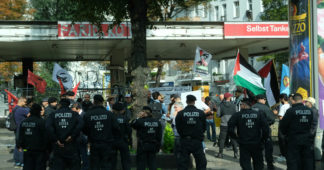
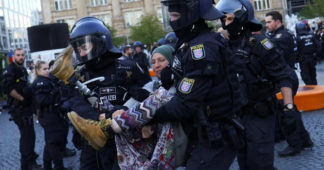
The authors decry that “German authorities have continued to severely restrict the right to protest in solidarity with the Palestinian people” and that they react to any “perceived breach of overly broad protest restrictions” with “severe police brutality, including kettling, pepper spraying, punching and choking.”
The report also identifies the weaponisation of antisemitism as a key strategy to silence anti-genocide voices.
“Instead of supporting those advocating for human rights, Germany has conflated anti-Israel criticism with antisemitism, chilling speech nationwide, emboldening the right, and silencing civil society voices,” the group’s Europe researcher said.
This is the second downgrade in two years after CIVICUS changed Germany’s status from “open” to “narrowed” in 2023 as a result of its crackdowns on pro-Palestine protests in the first three months of Israel’s genocidal war on Gaza.
A case for the UN
In 2026, state repression against Palestine solidarity (which includes opposition to the US-Israeli war of choice against Iran and Israel’s application of its genocidal Gaza doctrine to Lebanon) remains the driving force behind Germany’s inexorable democratic decline.
Police brutality against protesters proliferates unchecked, as does the absurd political policing of protest-related speech, such as the arbitrary criminalisation of the liberation slogan “From the river to the sea, Palestine will be free,” even though there is no legal certainty over the phrase’s illegality.
The Zionist shtick of crying wolf about alleged Jew-hatred is becoming ever more grotesque, with the non-Jewish antisemitism commissioner of the state of Hesse recently accusing the anti-Zionist civil society group Jüdische Stimme (Jewish Voice) of “spreading antisemitism” and calling for a national ban on the organisation.
In fact, the civil liberties situation in Germany has deteriorated so much that it has attracted the attention of the United Nations.
On February 6, the UN Special Rapporteur on the right to freedom of opinion and expression, Irene Khan, wrapped up her official country visit to Germany during which she met with state officials and members of civil society in order to examine “the situation of the rights to freedom of opinion and expression in the country.”
In a statement given at the end of what was the first-ever observer mission to Germany by a UN independent expert on freedom of opinion and expression since the mandate was created in 1993, Khan warned that the space for freedom of expression was shrinking in the country.
She chastised the German government for its “security-oriented approaches” against Palestine solidarity, such as the “surveillance of organizations on vague, undefined grounds of ‘extremism’” and “the use of anti-terrorism laws to broadly restrict or prohibit the content of Palestinian advocacy.”
Reminding officials that these approaches were “inconsistent with international human rights standards,” Khan also lamented Germany’s failure to distinguish between antisemitism and the protected right to boycott I”srael”.
With regard to the much maligned “From the river to the sea.” she criticised the disproportionate nature of “a general ban or criminalization for merely uttering a slogan.”
Canary in the coal mine
A new study published by the Amsterdam-based Transnational Institute (TNI) at the end of last year will inarguably prove helpful to the Special Rapporteur in evaluating the severity of the situation in Germany as she prepares her own report for the UN Human Rights Council’s 62nd session in June.
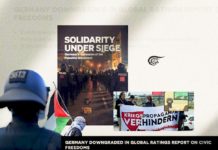
Entitled “Solidarity under Siege,” the TNI report makes the key argument that Germany’s crackdown on Palestine solidarity “has served to test a broader transformation towards authoritarianism.”
“Measures tested on the Palestinian solidarity movement may well be extended to other dissenting groups, from environmentalists to anti-militarists,” writes Josephine Solanki, the author of the report.
This is what many analysts and activists mean when they say that the issue of Palestine is the canary in the coal mine of international human rights, the “guinea pig” on which increasingly autocratic western governments are testing their tolerance for political opposition.
In fact, the extension of German state repression to other social justice movements is no longer a matter of speculation.
In January, a district court in the state of Brandenburg allowed charges against members of the now defunct climate action group Letzte Generation, including the charge of “forming a criminal organisation,” to proceed to trial in what is the first indictment of its kind nationwide.
A statement by the group described the decision as revealing of “how criminal prosecution is increasingly becoming a tool for dealing with undesirable political protest.”
In December, a German court in the city of Freiburg sentenced a 19-year-old former high school student to 15 hours of community service for posting memes on social media in protest of US-style army recruitment drives at schools.
Mocking a PowerPoint presentation given by a Bundeswehr officer, one meme simply said “So kids, who among you would like to die on the Eastern front?”
In her closing remarks, Special Rapporteur Khan warned that the criminalization of speech should only be applied “to the most egregious situations.”
Clearly, the German state has a different definition of what constitutes “egregious” as it continues to eviscerate basic democratic freedoms in support of a colonial genocide in Palestine, remilitarisation at home, and the global destruction of the climate.
.
We remind our readers that publication of articles on our site does not mean that we agree with what is written. Our policy is to publish anything which we consider of interest, so as to assist our readers in forming their opinions. Sometimes we even publish articles with which we totally disagree, since we believe it is important for our readers to be informed on as wide a spectrum of views as possible.