Trump threats cause dilemma for US officers: disobey orders or commit war crimes
Julian Borger, Senior international correspondent
Mon 6 Apr 2026
Legal experts say attacking Iran’s infrastructure would constitute a war crime – but would military officers be held responsible?
Donald Trump’s threats to carry out mass bombing of civilian infrastructure in Iran present US military officers with a dilemma: disobey orders or help commit war crimes.
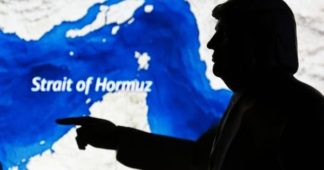
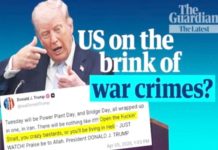
It is an urgent matter for the US chain of command. In an expletive-laden threat, Trump set a Tuesday 8pm Washington time deadline for the Iranian government to open the strait of Hormuz or face “Power Plant Day, and Bridge Day, all wrapped up in one”.
He wrote on his Truth Social platform on Sunday: “There will be nothing like it!!! Open the Fuckin’ Strait, you crazy bastards, or you’ll be living in Hell.”
Three days earlier, the president had made clear what he meant by “Power Day”.
There is little debate among legal experts that such an attack on the life-supporting infrastructure for 93 million Iranians would constitute a war crime.
“Such rhetorical statements – if followed through – would amount to the most serious war crimes – and thus the president’s statements place service members in a profoundly challenging situation,” two former judge advocate general (JAG) officers, Margaret Donovan and Rachel VanLandingham wrote on the website Just Security on Monday.
“As former uniformed military lawyers who advised targeting operations, we know the president’s words run counter to decades of legal training of military personnel and risk placing our warfighters on a path of no return.”
They noted that Trump’s boast that he would bomb Iran “back to the Stone Ages”, and the order by his defence secretary, Pete Hegseth, to show “no quarter, no mercy” were not just “plainly illegal” but they also represented a rupture from the moral and legal principles that US military personnel had been “trained to follow their entire careers”.
She cited as an example US soldiers who refused to take part in the 1968 My Lai massacre in Vietnam, including a helicopter pilot who threatened to shoot the perpetrators.
In his court martial, the officer who ordered his men to gun down hundreds of Vietnamese villagers, 2nd Lt William Calley, argued that he was only obeying orders, but the court ruled that was no defence as such orders were “palpably illegal”.
The question is whether officers who carried out orders to bomb Iranian power stations and bridges could argue that they did not know it was “palpably illegal”.
When Democratic members of Congress published a video message in November telling US service members “you can refuse illegal orders, you must refuse illegal orders”, Trump went on Truth Social to accuse them of “SEDITIOUS BEHAVIOR, punishable by DEATH”.
“There are many factors that make it hard to say ‘no’ or stand up to stop war crimes, especially where there are grey areas in the law,” Carpenter said.
“What the law requires of enlisted troops is to disobey only ‘manifestly unlawful’ orders – orders so egregiously unlawful that a person of ordinary understanding would know they were wrong.
“However, this skill and moral judgment is not drilled into troops in the same way as they are taught to follow the chain of command and go along with their small units, and troops can also be court-martialled for insubordination if they guess wrong.”
Since taking office last year, Hegseth has made it harder for officers in the chain of command to find legal advice by firing the Pentagon’s top JAGs, and dissolving the Civilian Harm Mitigation and Response unit set up by the Biden administration.
Ordinary soldiers have the last-resort option of calling a “GI rights hotline” and calls have reportedly risen sharply under the Trump administration.
A survey led by Carpenter last year found that most service members can distinguish between legal and illegal orders.
“A majority of them understand their duty to disobey, and can give concrete examples of situations where they should,” she said.
“Recognising those situations in real time and acting appropriately is harder than in a survey experiment, but one thing we know is that when one person stands up, it’s easier for others to do so.”
Asked if anything was off limits, he replied: “Very little.”
Pressing the threat on Monday, Trump said: “The entire country can be taken out in one night, and that night might be tomorrow night.”
The extremity of Trump’s threats, coupled with his growing desperation to find a way out of the conflict, has increased fears that a volatile president could try to use a nuclear weapon.
Under the US system, a US president has sole authority to order a nuclear launch. To do so he would summon a security conference call of the National Military Command Center, which would typically involve top officials such as the defence secretary, the armed forces commander, but it would depend who was available at short notice.
A military aide who is always close to the president would open the “nuclear football”, a briefcase containing nuclear strike options as well as the codes to confirm his presidential authority.
The only way to stop the order would be for those in the chain of command to deem it illegal.
In January 2021, the then chair of the joint chiefs of staff, Gen Mark Milley, was so concerned about Trump’s volatility that he reportedly told his senior officers to make sure he was involved in any nuclear decision.
Jeffrey Lewis, a nuclear weapons expert and professor at the Middlebury Institute of International Studies at Monterey, said Trump had previously shown respect for the devastating consequences of nuclear use, but he added: “I don’t know how strong that respect is when he is losing the war and his mind at the same time.”
In a 2018 book, The 2020 Commission Report on the North Korean Nuclear Attacks Against the United States, Lewis sketched out a scenario in which Trump started a war through misjudgment.
At one point in the book, the military aide carrying the “nuclear football” tries to stop the president getting his hands on it and is disciplined for his actions.
Asked what confidence he had that someone in the chain of command now would intervene to stop Trump, Lewis simply replied: “None.”
“He has consistently purged the military of anybody who he thinks would stand up to him or resist him,” he said
.
We remind our readers that publication of articles on our site does not mean that we agree with what is written. Our policy is to publish anything which we consider of interest, so as to assist our readers in forming their opinions. Sometimes we even publish articles with which we totally disagree, since we believe it is important for our readers to be informed on as wide a spectrum of views as possible.