In the last 24 hours, the Revolutionary Guards have stepped up their attacks, resorting to the most dangerous stock of their arsenal. “As the quantity decreases, the quality of the attacks increases,” a senior Israeli military official told “K.” From last Saturday’s retaliation with double-digit launches every few minutes, we have reached sporadic attacks with a few missiles, usually no more than two or three in each barrage.
From an article in the pro-Israeli Greek daily Kathimerini, The regime attacks with new weapons – Operations with no end in sight
English Translation:
Stavros Ioannidis
March 9, 2026
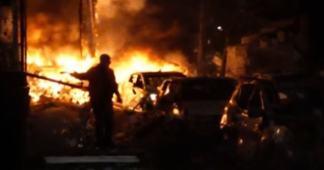
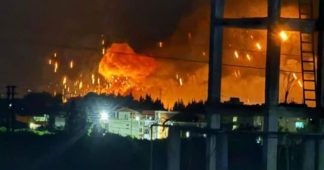
Minutes after the inauguration of Iran ‘s new supreme leader , Mojtaba Khamenei, the regime launched a broad wave of attacks, successively targeting Israel ‘s four major urban centers , Jerusalem and Tel Aviv, Haifa in the north and Beersheba in the south. A common feature of the attacks is the use of cluster munitions from sophisticated missiles that can penetrate air defenses.
Ιρανικά πλήγματα σε αστικά κέντρα του Ισραήλ. pic.twitter.com/z9GutXCDM5
— Kathimerini_Web (@KathimeriniWeb) March 9, 2026
In the last 24 hours, the Revolutionary Guards have stepped up their attacks, resorting to the most dangerous stock of their arsenal. “As the quantity decreases, the quality of the attacks increases,” a senior Israeli military official told “K.” From last Saturday’s retaliation with double-digit launches every few minutes, we have reached sporadic attacks with a few missiles, usually no more than two or three in each barrage.
Ιρανικά πλήγματα σε αστικά κέντρα του Ισραήλ. pic.twitter.com/z9GutXCDM5
— Kathimerini_Web (@KathimeriniWeb) March 9, 2026
Cluster munitions
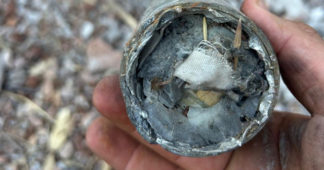
However, the regime has revealed that it has deployed the advanced Khorramshahr 4 medium-range missiles in its attacks against Israel. These are hypersonic ballistic missiles that were presented in 2023 and are being used for the first time in war . Their range is said to reach 2,000 kilometers and can carry an explosive warhead of more than 1.5 tons. They are made of materials that reduce their radar signature, while information indicates that they have the ability to micromaneuver to avoid interceptor fire. It is also established that the Revolutionary Guards (IRGC) equip these missiles with dispersion warheads.
During the descent of the missile, the warhead breaks up into many submunitions which are dispersed over a large radius. Each bomb contains 2.5 kilograms of explosive material and, combined with the kinetic speed of the projectile, causes significant damage and often injuries and casualties. During Sunday’s attacks in Tel Aviv alone, two Israelis were seriously injured by this type of munitions.
Το Ιράν έκανε χρήση πυρομαχικών διασποράς στις επιθέσεις του σε τέσσερις πόλεις του Ισραήλ. pic.twitter.com/mKJl0vwBal
— Kathimerini_Web (@KathimeriniWeb) March 9, 2026
“They want to terrorize the citizens of Israel,” IDF spokesman Lieutenant Colonel Nadav Shoshani told “K.” “There are international treaties that prohibit the use of these weapons against civilians,” he added, adding that “the army is operating with the aim of destroying the launchers and the stockpile of missiles that the regime has.”
Everything on the table
But as we enter the 10th day of the war and despite the hammering that Tehran and the theocratic regime are receiving, no one can come to a safe assessment of the outcome of the war. Speaking to the Times of Israel, Donald Trump revealed that the duration of the operations will be determined jointly with Benjamin Netanyahu , essentially leaving all possibilities open. It is recalled that 2026 is an election year in Israel, with the process being extended until December if there is a security issue in the country.

In his message on Sunday morning, the Israeli prime minister revealed that the airstrikes are going to intensify even more with the aim of destabilizing the Iranian theocratic regime. It is now clear that in parallel with the military operation, Israel and the US want to bring the protesters back onto the streets, aiming to overthrow the regime from within. Moreover, each airstrike targets the camps and infrastructure of the Basij militia, Iran’s internal security, which played a leading role in dealing with the recent uprisings and is allegedly responsible for the deaths of thousands of protesters.
However, if one looks at the big picture and the battle formation of the forces in the Middle East, one is led to the conclusion that we may still be in the early stages of the war. The US has mobilized its fleet of strategic bombers (B-2 Spirit, B-1 Lancer and B-52 Stratofortress) and in a few days will have three aircraft carriers in the region, with the USS Gerald Ford, as everything seems to indicate, taking over the protection of navigation in the Straits of Hormuz and the Red Sea. In addition, leaks about the possible deployment of ground forces in Iran make the situation on the ground even more complicated and the duration of the military operations even more uncertain.
.
We remind our readers that publication of articles on our site does not mean that we agree with what is written. Our policy is to publish anything which we consider of interest, so as to assist our readers in forming their opinions. Sometimes we even publish articles with which we totally disagree, since we believe it is important for our readers to be informed on as wide a spectrum of views as possible.