by Massimiliano Ay, general secretary of the Communist Party (Switzerland)
Mar 8, 2026
The Islamic Republic of Iran is not a theocratic regime where power is exercised by the clergy as a religious class indistinguishable from political authority and where religious norms coincide with State laws.
The political regime that emerged from the 1979 Revolution is rather theocentric in nature: power is in fact mediated by legal and political institutions and is not automatically exercised by the clergy as a unified body. On the contrary, there are elected bodies, a Constitution and a republican state apparatus, as well as a complex set of institutional checks and balances. The most widespread first mistake in the West is therefore to believe superficially that the Islamic Republic of Iran is a kind of medieval and obscurantist absolutism: alongside undeniable backward-looking legacies contrary to a liberal-democratic conception of the State, forms of modernity are emerging that must be recognised in order to understand the persistence of this forty-year experience. Suffice it to say that it was the Islamic Revolution that universalised the right to education for Iranian women, which, at the time of the Shah, was granted only to a few representatives of the wealthy classes: today, 60% of university students in Iran are women, and over 40% of companies are run by female entrepreneurs. Even on the civil rights for transgender people, it was Ayatollah Khomeini who signed a law in 1980 that not only authorises gender transition but also places the costs entirely on the State.
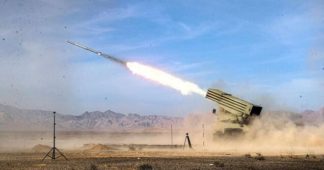
The second mistake is to underestimate the enormous responsibility that Atlantic imperialism has (in history and still today) due to its systematic interference in Iranian political dynamics. It was only with the 1979 Revolution, where religious leaders and communists initially worked together, that the Iranian people regained political, economic and cultural sovereignty, freeing themselves from Western capitalist diktats and the bloody tyranny of Shah Reza Pahlavi. Since then, the country has been constantly demonised, if not directly attacked militarily or through terrorism, by the US, the EU and Israel. However, if Iran is now ruled by a theocentric regime, which was consolidated by the subsequent tragic repression of the communists in the 1980s, it is also because Atlantic imperialism overthrew the secular and socialist government of Mossadeq, imposing an absolute monarchy that allowed the West to plunder its resources and against which popular anger erupted in 1979. Even today, there is no shortage of external attempts at destabilisation: from the declaration of readiness for a US military attack with the aim of turning Iran into a new Syria and the infiltration of Zionist Mossad into popular and youth movements: the violent degeneration of recent street demonstrations, initially peaceful and based almost exclusively on the difficult economic conditions and not on civil rights or the political-institutional system, is there to prove it.
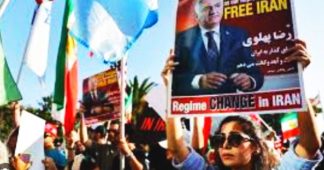
The third mistake is that made by the Western left, which has given up on anti-imperialism as the central axis of its identity, thereby lending support to the narrative of the right and to structural racism towards all peoples who do not obey our liberal and Atlanticist value system. After Russophobia and Sinophobia, as we stated during the 25th Congress of the Communist Party of Switzerland, we are now moving on to Islamophobia, which ‘more typically confined to right-wing circles, has been fomented not only by Zionists but also, unwittingly, by that part of the left which, after supporting movements hostile to the Iranian Islamic Revolution, has agreed to repeat as an “act of faith” the condemnation of the actions of the Palestinian or Lebanese resistance in response to Israeli crimes’. From this perspective, communists distance themselves from the Swiss left, which took to the streets with nostalgic monarchists waving the tricolour flag bearing the image of the lion of the former “Imperial State of Iran” ruled by the tyrannical Pahlavi dynasty. A correct class-based and anti-imperialist approach, instead, grasps another decisive political fact, namely that the Iranian reality operates in a new global context, constituting today a bulwark of primary importance in hindering Atlanticism and Zionism. Without it, the Palestinian resistance could be compromised, but even the new Silk Road promoted by China would be weakened.
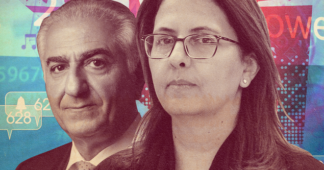
Among the Iranian diaspora there are numerous organisations that historically looked to Marxism, but which today openly operate as fifth columns of imperialism and Zionism, even though they still declare their ideal adherence to socialism. It is important, as serious Marxists, not to make a fourth mistake, namely, to analyse not the material reality of today but to be under the illusion that everything has remained unchanged since 1953 (the coup against Mossadeq) or 1979 (Khomeini revolution) and thus limiting ourselves to taking for granted the sometimes even rambling public statements of this or that organisation of the left-wing diaspora, which is completely irrelevant in the Iranian national reality. Entrusting, for example, the communists of “Tudeh” or “Toufan” (who have less support in their homeland than the monarchists) with a utopian messianic task of – as we red in some public statements of leftwing comrades – “building an alternative hegemony starting from the bottom, from the bazaar and the universities, to prevent the fall of the mullahs from leading to a new colonial subjugation” is not Marxism, but pure fantasy that does not help to develop a credible movement for peace and against imperialism. The “Tudeh” itself, moreover, admits to “the absence of a coherent progressive national leadership”. In Iran today, the unrest is primarily economic, due to Western sanctions that affect wages, fuel inflation and worsen the quality of life. However, it seems rather unrealistic to believe that popular support for political and religious institutions has waned, as Atlanticist war propaganda would have us believe, and that the definitive disintegration of the “historic clerical-conservative bloc” is underway and that “the regime no longer has hegemony (moral and intellectual consensus) but only domination (repressive apparatus)”. Even more illusory is the belief that the Zionist and American puppet of the Pahlavi dynasty, which sold out the country, can enjoy mass support: he will be able to return to the throne not through a popular uprising, but solely and exclusively through military force and foreign military action, following the model of what recently happened in Venezuela.
At the same time, and this is the fifth mistake we must avoid making, it is important not to believe the information provided by the Western media, which is almost entirely biased, without any real pluralism, by American and Israeli press agencies that are building mass consensus for the next war! The demonstrations staged by the opposition are numerous, but they are much less well attended than those of the patriotic masses who express hostility to US interference and defend the institutional structure of the Islamic Republic. Furthermore, the opposition is able to mobilise almost exclusively in large urban centres among the upper-middle class, who demand liberal, Western lifestyles and consumption models, but who clash with the feeling of loyalty to the government in the suburbs.
.
We remind our readers that publication of articles on our site does not mean that we agree with what is written. Our policy is to publish anything which we consider of interest, so as to assist our readers in forming their opinions. Sometimes we even publish articles with which we totally disagree, since we believe it is important for our readers to be informed on as wide a spectrum of views as possible.