


President Donald Trump said he could shoot someone on Fifth Avenue and not lose a single voter. The press called it hyperbole. His opponents called it proof of insanity. His supporters called it Tuesday.
Everyone missed the point.
Trump was not boasting. He was explaining his theory of power. The theory is simple: The rules do not apply to him because he has convinced everyone — allies and enemies alike — that he does not play by any rules at all.
He is not crazy. He is strategic. And the strategy is working.
The absurdity as armor
Trump says things that no normal politician would say because he understands something that normal politicians do not. Normal politicians are constrained by the fear of looking ridiculous. Trump is not. He has weaponized absurdity.
When he called for banning all Muslims from entering the country, the press was outraged. His opponents were horrified. His supporters shrugged. The policy was never implemented. It did not need to be. The goal was not to ban Muslims, but to demonstrate that he was willing to say what no one else would say. That demonstration was the message.
The message is always the same: I am not afraid. I do not care what you think. I will say anything. And you cannot stop me.
That is not craziness. That is a calculated display of fearlessness.
The contradiction as confusion
Trump contradicts himself constantly, sometimes in the same sentence. His opponents collect these contradictions like trophies and present them as evidence of incompetence. They are wrong.
When Trump says one thing on Monday and the opposite on Wednesday, his opponents spend Tuesday and Thursday trying to figure out what he “really” believes. They write think pieces, they hold strategy sessions, they tie themselves in knots trying to reconcile the irreconcilable.
Trump does nothing. He waits. He moves on to the next contradiction. He lets his opponents exhaust themselves chasing a consistency that does not exist.
This is the firehose strategy at its purest: flood the zone with so much contradictory noise that the opposition cannot focus on any single threat.
Why he likes being called crazy
Trump calls himself crazy, embracing the label and wearing it like a medal.
This is strategic positioning. When your opponents have spent years calling you crazy, you have two options. You can defend yourself, which legitimizes the frame and forces you to play defense. Or you can own the label, which disarms the attack and puts you back on offense.
Trump owns it, the attack bounces off, and the weapon is useless.
The trap Democrats keep falling into
Democrats have spent nearly a decade trying to prove that Trump is crazy, unfit, dangerous, and unworthy of office. They have compiled evidence, made legal arguments, and appealed to decency, to norms, to the rule of law.
None of it has worked. Not because the evidence is weak, but because the strategy misunderstands the game.
Trump is not running for president of a civics class. He is running for president of a country where half the population has stopped believing in institutions, stopped trusting the media, and started treating politics as a team sport where winning is the only thing that matters.
Democrats keep trying to appeal to a shared reality that no longer exists. Trump understood this before anyone else.
The cold hard truth
Trump is not crazy. He is not stupid. He is not a chaos agent with no plan. He has a plan, and it has been working for nearly a decade. And his opponents still do not understand it.
The plan is simple:
1. Say things that shock the conscience and dominate the news cycle.
2. Contradict yourself constantly to keep the opposition confused.
3. Embrace every attack, turning your opponents’ weapons into decorations.
4. Repeat until the opposition exhausts itself.
5. Win.
Until Democrats figure out what game Trump is actually playing, they will keep losing and Trump will keep winning.
*Craig Anderson is an independent journalist and author under pen name Will Hart.
We remind our readers that publication of articles on our site does not mean that we agree with what is written. Our policy is to publish anything which we consider of interest, so as to assist our readers in forming their opinions. Sometimes we even publish articles with which we totally disagree, since we believe it is important for our readers to be informed on as wide a spectrum of views as possible.
Former detainees detail systematic torture and sexual violence, including rape, while in Israeli custody.
Warning: This story contains descriptions of sexual assault that some readers may find disturbing.
Muhammad al-Bakri specifically remembers the date of his rape.
It was April 10, 2024, during the Eid al-Fitr holiday, at the end of the holy month of Ramadan. The Gaza civil servant had been beaten, tortured, bound and forced to soil himself since his arrest by Israeli soldiers a month earlier.
The soldiers and their guard dogs surrounded him that day. “There were six soldiers on the right and six on the left,” he recalled. “They would ask your name. If you said ‘Muhammad’, they would say, ‘No, say your name is b****.’”
Al-Bakri said he was held with seven other prisoners. They were all stripped, blindfolded and handcuffed.
“We were raped after being stripped of our clothes,” he said. “We were shouting, ‘Oh Lord, oh God’, but they were just laughing and filming us.” Al-Bakri then echoed what several rights agencies have also reported – that guards also used dogs during the sexual abuse of prisoners. “The dogs were following commands from the officers to [attack] us,” he said.
“There was no mercy. We stayed in that state of sexual abuse and beatings for about 20 minutes to half an hour. Then they told us to get dressed and took us back to the prison.”
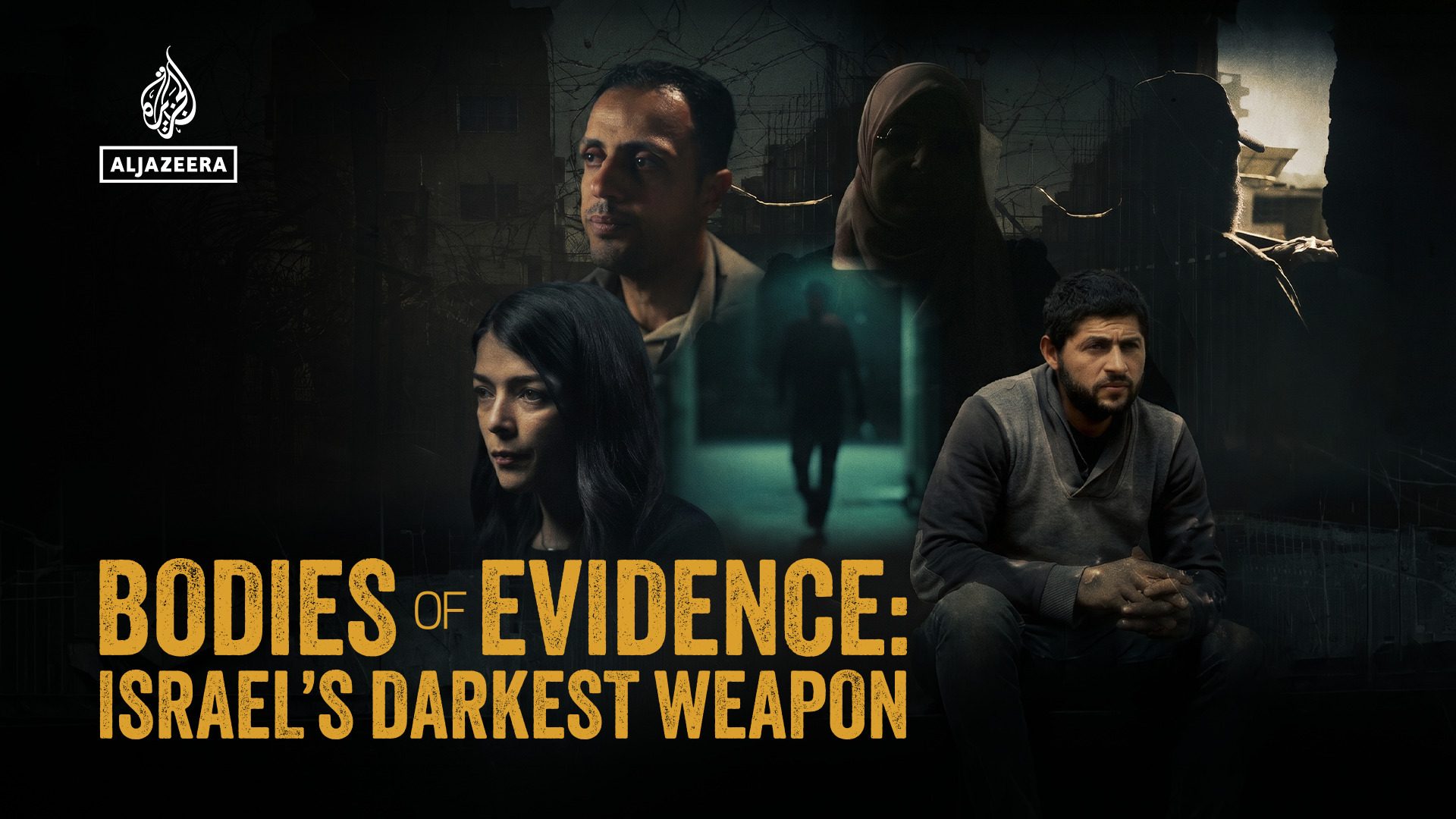
Al-Bakri is among multiple former prisoners who have given detailed testimonies to Al Jazeera for Bodies of Evidence: Israel’s Darkest Weapon, a documentary investigation into what International Criminal Court (ICC) judges, the United Nations and its special rapporteur on the occupied territories, Francesca Albanese, say amounts to the widespread and systematic use of rape and sexual torture by the Israeli army against Palestinians. Rights groups such as the Palestinian Centre for Human Rights (PCHR) and Euro-Med Human Rights Monitor have also documented testimonies of prisoners recounting how Israeli soldiers used dogs to rape them.
Allegations of the sexual abuse of Palestinians in Israeli prisons are not new – they date back decades. But launching its genocidal war on Gaza following the Hamas-led attack of October 2023, Israel appears to have increased the use of rape as a weapon of war, according to the Al Jazeera investigation and various reports by the UN and leading rights groups.
A UN report published in March 2025 found evidence of the “systematic” use of sexual, reproductive and other forms of gender-based violence by Israel since October 7, 2023. In May, Israel was added to the UN “blacklist of sexual violence in conflict zones”. Human Rights Watch, Amnesty International, Israeli rights group B’Tselem and the PCHR have described the pervasive culture of sexual violence within Israeli forces, especially among those charged with overseeing Palestinian prisoners. Many were arrested and held without charge under Israel’s system of administrative detention.

No soldiers or guards have been convicted of sexual abuse of Palestinians. Israel detained 10 security officers after a video of the rape of a prisoner was leaked from the Sde Teiman detention camp in the Negev desert in July 2024. But gangs of right-wing protesters, including legislators, attempted to storm the facility where the guards were being held in a bid to free them.
Last July, Israel dropped all charges against the guards. The female officer who allegedly leaked the video of the attack, Major-General Yifat Tomer-Yerushalmi, was subsequently arrested. Israeli Prime Minister Benjamin Netanyahu termed her “crime” – sharing footage of the rape by Israeli soldiers – as the “most severe public relations attack” on the country since its founding.
![Right-wing protesters wave Israeli flags outside Sde Teiman detention facility, after Israeli Military Police arrived at the site as part of an investigation into suspected abuse of a Palestinian detainee, near Beersheba in southern Israel, July 29, 2024. [Jill Gralow/Reuters]](https://www.aljazeera.com/wp-content/uploads/2024/08/2024-07-29T140941Z_1302201514_RC2159ATGNAF_RTRMADP_3_ISRAEL-PALESTINIANS-MILITARY-INVESTIGATION-1722644321.jpg?w=770&resize=770%2C578&quality=80)
UN rapporteur Albanese said the intention behind the sexual abuse of Palestinian prisoners was clear: not simply to inflict pain, but to destroy the victim and their sense of self-worth.
“There is something deeper in the sense that torture, especially rape and other forms of sexual torture, destroys the mind of the person, especially in the capacity to rebuild or enjoy his or her intimacy,” she told Al Jazeera, recounting interviews with two survivors of rape.
Asked in the Knesset, Israel’s parliament, in July 2024 whether it was ever legitimate to rape a prisoner, Hanoch Milwidsky, a member of Netanyahu’s Likud party, shouted: “Yes.”
“If he is a Nukhba [Hamas fighter], everything is legitimate to do, everything.”

Surviving genocide and rape
Casual labourer Job, which is how Al Jazeera has chosen to credit him, never thought there was anything particularly noteworthy about his life.
Like al-Bakri, Job thought he was an everyday middle-aged family man from Gaza. Both placed their children’s future above their own. Both prioritised their families’ safety since Israel launched its genocidal war in October 2023. Both had become accustomed to shepherding their families through the checkpoints, bombings and forced displacements that defined daily life in the besieged enclave.
That changed when both were taken prisoner, tortured and repeatedly raped by Israeli soldiers and guard dogs.
As with al-Bakri, Job’s memory of his rape is equally clear. “Female soldiers entered my room,” he told Al Jazeera. “They put iron handcuffs on my hands behind me. They untied the handcuffs from my legs and put on more handcuffs. Then they stripped me of my clothes.”
He was pinned to the ground with boots on his back and neck, while the female soldiers raped him using artificial objects.
“The soldiers around them were applauding and filming the scene. They were filming the rape scene.”
Job’s rape and sexual torture continued, all while being questioned for any knowledge of the Hamas-led attack of which he knew nothing.

Rage
The attack of October 7, 2023, during which 1,139 people were killed and about 250 abducted, ruptured much of Israeli society and assumptions about the relationship with Palestinians in the occupied territory.
Through endless loops on rolling news, the trauma of the attacks echoed throughout Israeli society, as the political class sought to amplify the harm inflicted upon Israel that day.
Recalling the events of his capture, Job recalled being blindfolded, tortured, trampled upon and beaten, all the while being questioned on the events of October 7, despite having no connection to what unfolded that day.
“They were telling us: ‘You know God and the Quranic verse, an eye for an eye, a tooth for a tooth. As you sow, so shall you reap,’” he recalled. Israeli soldiers told him: “You entered our lands, the Israeli lands, and invaded them. You raped and you did this and you did that”.
Al-Bakri was given a number for a name and described being beaten when he attempted to identify himself in any other way. “You are here as a prisoner of war,” he recalled being told. “You came here because of the destruction you caused.”
In addition to rape, al-Bakri said, he and other prisoners were attacked with dogs, and what he described as sound bombs intended to cause disorientation.
“You had to sleep on your stomach, hands tied and eyes blindfolded, while they walked dogs over you and kicked you,” he said.
Albanese told Al Jazeera that similar accounts of mistreatment and torture in the wake of the October 7 attack are common. “Brutality has escalated to an unprecedented level,” she said. “It became vindictive.”
“Regular practices have been severe beating, slapping, burning, broken bones, broken teeth, sexual violence, and rape,” she said. “Sexual penetration through objects, both bodily and other objects, like something that is recurrent, is the use of metal rods, cutting metal that might be knives, metal detectors, bottles.”

Dehumanisation
Many of the Israeli soldiers accused of taking part in the torture, sexual abuse and rape of Palestinian prisoners were raised in societies described by observers within Israel as having been conditioned to see Palestinians as somehow undeserving of human respect.
Organisations such as B’Tselem and Physicians for Human Rights Israel have described how many Israelis spend their entire lives without ever encountering Palestinians, a people destined by state policy to attend separate education systems.
Notions of Palestinians as being somehow outside the category of a recognisable people run deep in Israeli political culture, said sociologist Yehouda Shenhav-Shahrabani. That reaches back from the present to even the British Mandate for Palestine, when officials described it as a “land without a people” to the present, where they can be killed, raped and tortured with apparent impunity.
“By depicting the entire population as human animals and terrorists, and invoking the notion of human shields to justify massacres, Israel has effectively painted a target on the back of an entire civilian population as such,” Albanese told Al Jazeera. “Even children portrayed as terrorists in the making describe an overwhelming fear of imminent death.”
Israeli President Isaac Herzog had no issue with “unequivocally” blaming all Palestinians for the Hamas-led attack on October 7, telling reporters: “It is an entire nation out there that is responsible. It’s not true [that] this rhetoric about civilians not [being] aware, not involved. It’s absolutely not true.”
In the wake of the attack, former Defence Minister Yoav Gallant said Israel was fighting what he called “human animals” and ordered a “complete siege” on the men, women and children there. Others, such as Finance Minister Bezalel Smotrich and National Security Minister Itamar Ben-Gvir, have been consistent offenders, routinely referring to Palestinians as terrorists or framing large segments of Palestinian society in broadly criminal or extremist terms, particularly in relation to Gaza and the occupied West Bank.
“Dehumanising language plays a key role in enterprises like a genocide or other forms of collective punishment and abuse,” Albanese said, “because, in order to treat the other as a subhuman, you need to see him or her as a subhuman.”

Impunity
Despite what analysts have described as an established pattern of rape and sexual abuse against Palestinians, Israel has yet to receive legal censure from any multinational body or face sanctions for its actions in Gaza or the occupied West Bank. Attempts by international bodies, including the UN’s bid to investigate the allegations of sexual abuse in January 2025, were actively blocked by Israel.
Specific abuses – from forced nudity and threats of rape to assaults targeting genitals – have become standard practice for the Israeli forces, the UN has found, carried out with explicit or implicit approval from senior officials. Ben-Gvir, for instance, has decried investigations into the rape at Sde Teiman as “shameful”, while Defence Minister Israel Katz has described attempts to hold soldiers accountable for rape as a “blood libel”.
The torture of Palestinians has been glorified in Israel, Albanese remarked. “You have had not only Israeli officials and leaders boasting about how badly Palestinians were treated … Settlers and citizens alike have been taken to detention centres to observe, to watch, or to even [take part] in the humiliation inflicted on Palestinians.”
Triestino Mariniello, a professor at Liverpool John Moores University and part of the legal team representing Gaza’s victims at the ICC, pointed out what he described as a “very important difference under international criminal law between isolated acts of sexual violence and acts that are part of a systematic pattern against civilians”.
“The former may constitute war crimes. When the same acts are organised and widespread, they amount to crimes against humanity,” he said.
“These crimes take place in state detention centres and military detention centres. The fact that perpetrators are not tried, prosecuted, or convicted shows an institutional policy behind their commission,” Mariniello added.
To be sure, Palestinians continue to resist, Albanese said. “The Palestinians are still fighting not to be erased, not to be made extinct as a people with a capacity to determine themselves.”
But in the eyes of most observers, Israel’s genocide in Gaza is continuing in defiance of the paper ceasefire imposed upon Israel by United States President Donald Trump in October 2025. Israel is pursuing the forcible displacement of Palestinians across the occupied West Bank at a rapid pace, with any resistance from the landowners and farmers to Israeli settlers and security forces typically met with violence, imprisonment, and often torture and rape.
“Surviving sexual violence and torture in general, and rape is brutal,” Albanese said. “Imagine when it’s done on a large-scale systemically to a population. It means to destroy the people as such.”
We remind our readers that publication of articles on our site does not mean that we agree with what is written. Our policy is to publish anything which we consider of interest, so as to assist our readers in forming their opinions. Sometimes we even publish articles with which we totally disagree, since we believe it is important for our readers to be informed on as wide a spectrum of views as possible.