


By Meghan Bartels* | May 14, 2026
How the war in Iran could endanger one of Earth’s most unique ecosystems
Despite decades of damage, the Persian Gulf’s ecological marvels remain—for now
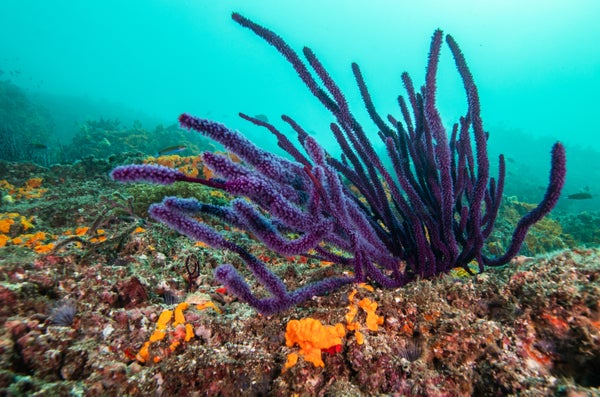
Coral seen near the Strait of Hormuz in the Persian Gulf. Mahmut Serdar Alakus/Anadolu via Getty Images
The Middle East—and the Persian Gulf at its heart—have been battered by the Iran war since late February. Mines have been deployed across the Strait of Hormuz, the entrance to the Gulf, countless spills have leaked oil into its waters, and missiles have fallen perilously close to Iran’s sole nuclear power plant, risking radiation seepage from the coastal facility. Even before this current chaos began, the underappreciated treasure troves of the Gulf’s ecosystems were under stark pressure, scientists say. Now they worry that remarkable examples of evolution in action and potential genetic secrets to surviving climate change may be lost.
“These environments are on the edge,” says Kaveh Samimi-Namin, a marine biologist at Naturalis Biodiversity Center in the Netherlands, who grew up in Iran. “Anything that happens that impacts the environment can really push those animals, that biodiversity, off the cliff.”
“A sea of contrasts”
The Gulf’s ecosystems are shaped by remarkable geology and geography, says Bernhard Riegl, a marine biologist at Nova Southeastern University in Florida, who has worked in the Persian Gulf for more than 30 years.
Sandwiched between Iran and the Arabian Peninsula, the Gulf is geologically young; the shallowest areas have been under water for only around 6,000 years and the body of water overall is only a result of glaciers melting at the end of the last ice age. That means its marine life are all new arrivals in the grand scheme of things—in fact, the corals are so young they haven’t had time to build extensive reefs.
The Gulf is also an extreme place to live: its summers are broiling, its winters are chilly, and its waters are remarkably salty. Yet it is bursting with life. “The Gulf is often misunderstood as biologically poor due to its harsh environment,” says Mohammad Reza Shokri, a marine biologist at Shahid Beheshti University in Iran.
With most tropical reefs expected to face conditions like the Gulf’s by 2100—and already faltering under increasingly frequent marine heat waves—that makes the Gulf’s coral a source of valuable genetic information about resilience that could have implications for the rest of the world’s reefs. “It’s like somebody built a little laboratory out there for how tropical biota should behave in really extreme climate,” Riegl says. “We’re left with the evolutionary gold.”
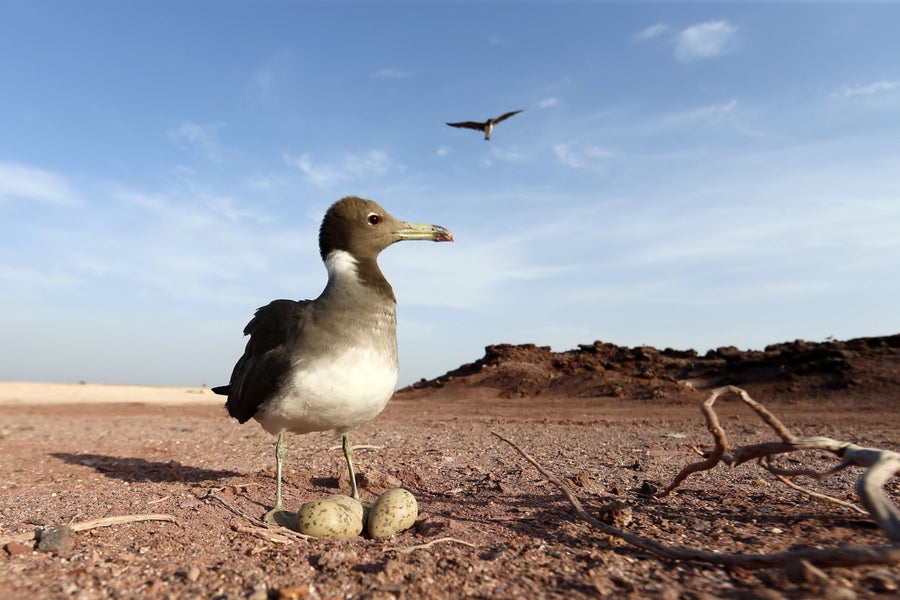
A Sooty Gull nesting on an island within the Persian Gulf. Karim Sahib/AFP via Getty Images
Of course, there’s more than just corals in the Gulf’s waters. Patches of seagrass meadows and mangrove forests line the coasts, as do mudflats that serve as crucial feeding sites for migratory birds. The Gulf also boasts some of the most charismatic species on Earth: hundreds of massive whale sharks were discovered in a seasonal aggregation amid an oil field off the coast of Qatar in 2011, and surveys in 2019 and 2020 revealed the largest known herd of manateelike dugongs.
The ecology of the Strait of Hormuz, where salt water enters the Gulf, is particularly stunning, Riegl says. Its biodiversity, he says, is “just absolutely epic.” From there, water flows north and west along the steep shores of Iran, then south and east along the shallower coast of the Arabian Peninsula. That slow counterclockwise flow, combined with the way the water increases in temperature and salinity as it flows through the Gulf, means that the Iranian side hosts the milder conditions and higher biodiversity.
Although the Gulf’s species have endured incredible conditions, stress has already taken a toll. “It is a sea of contrasts,” Shokri says. “This duality—resilience alongside fragility—is what makes the Gulf both scientifically important and conservation-critical.”
Feeling the heat
The Gulf’s vulnerability has become increasingly evident over the three decades Riegl has studied it, because of three key factors, he says. Most damaging has been a series of heat waves that began in the late 1990s. These successive events have gradually overcome even sturdy Gulf corals; he estimates that 90 percent have bleached, which occurs when stressed corals eject the symbiotic algae living within them, turning the corals white.
Next most devastating to marine ecosystems has been the region’s building frenzy. Along the Gulf’s southern coast in particular, natural shorelines have nearly disappeared beneath infrastructure such as ports and sewage plants, massive artificial island developments, and more since he began visiting the region, Riegl says.
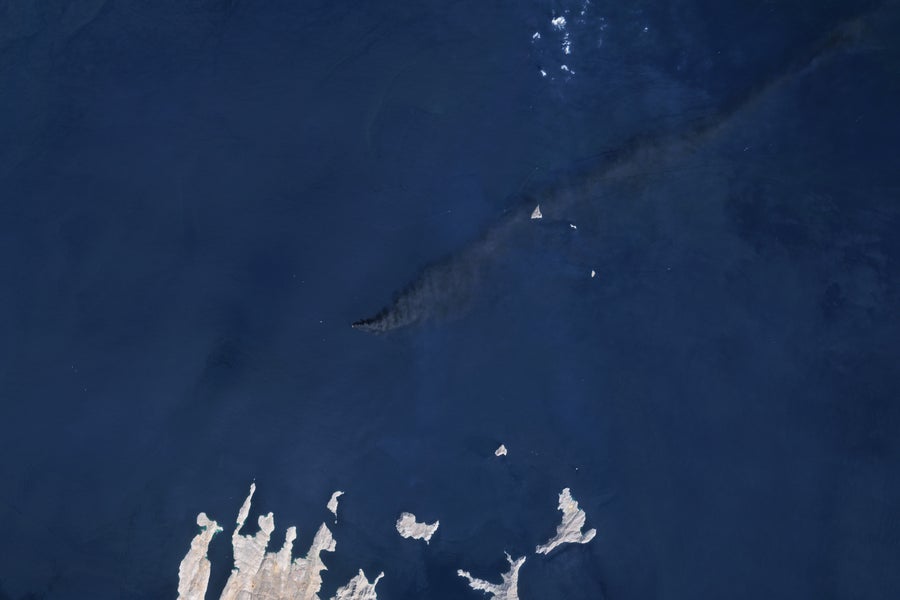
A satellite view of an oil tanker ablaze in the Strait of Hormuz on March 18, 2026. Gallo Images/Orbital Horizon/Copernicus Sentinel Data 2026
Then there’s pollution, some of which has come from previous conflicts. For example, the first Gulf War saw crude oil spills tallying millions of barrels, much of which hardened into a substance called bitumen. “In some areas you’ve got basically bitumen shorelines with sand on top of them,” Riegl says. “That pollution still isn’t gone.”
Worse still, the heat makes spilled oil more toxic, with some scientists estimating that the Gulf is the most polluted marine basin in the world. Among other damage, the oil can essentially suffocate mangrove trees, interfere with hawksbill turtles’ and green sea turtles’ sense of smell that guides their navigation, and prevent fish from reproducing.
More recently, massive desalination plants, which often double as electric power plants, have been dumping hot brine that rapidly sinks, smothering life at the Gulf’s bottom, Riegl says. “It just sterilizes the seafloor; nothing really lives there.”
Right now, no one knows precisely how the Gulf’s ecosystems are faring amid the new conflict, Shokri says, although satellite imagery has shown several oil spills since attacks began earlier this year. Experts know that even if attacks are primarily targeting Iran, the consequences won’t be limited there. Oil follows the same counterclockwise current as everything else in the Gulf. “It’s just such a little puddle; it’s all connected,” Riegl says.
All three experts emphasize that there’s still time to safeguard the remarkable ecosystems. As a coral expert, Riegl notes that even with the massive die-offs, corals remain. “We have had now a decade of devastation, but there’s still something there,” he says. “They’re small, they’re beaten up, they’ve been through hell, but they’re still there.”