


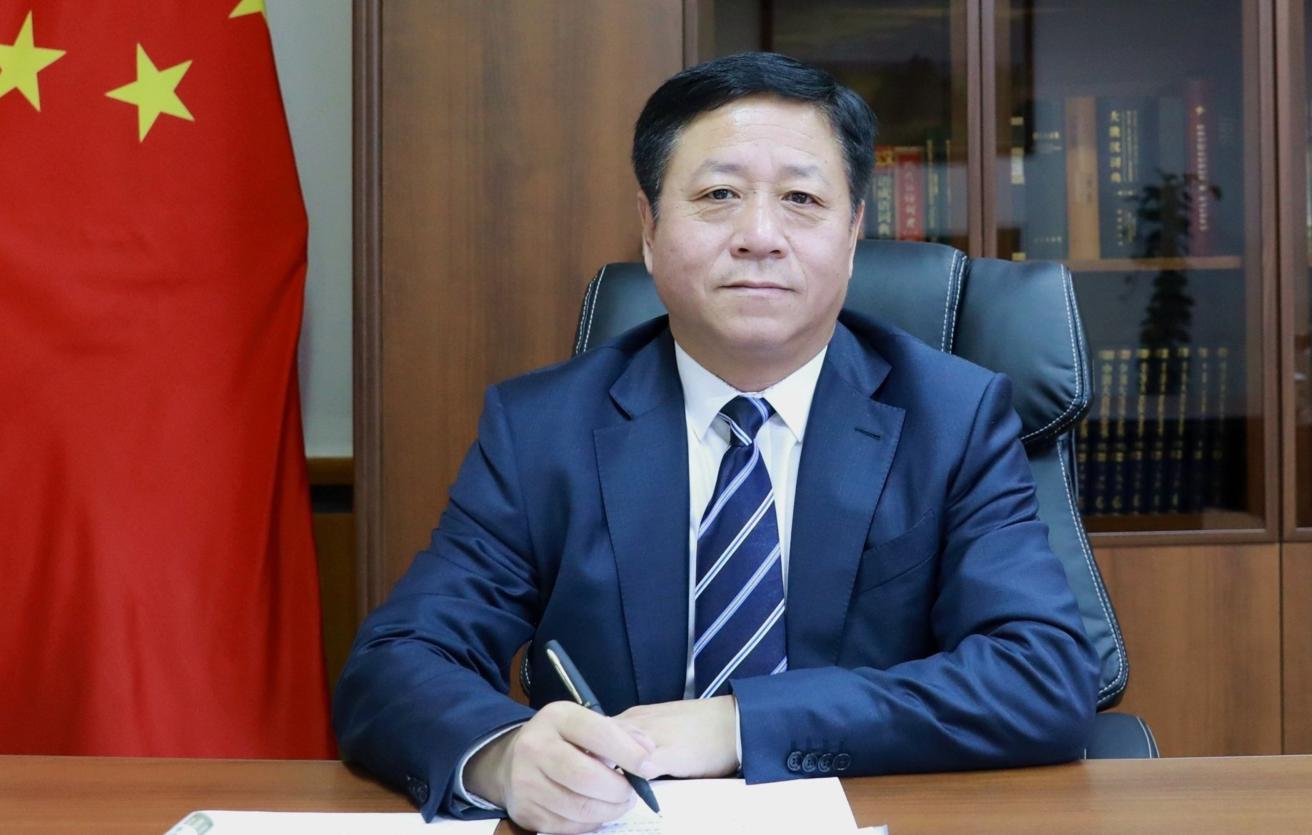
Ambassador of China to the Russian Federation Zhang Hanhui © TASS
.
This year marks the 80th anniversary of the Tokyo Trials. They lasted two and a half years, uniting the judicial efforts of 11 countries and completely exposing the aggressive crimes of Japanese militarism, laying the legal foundation for the post-war international order. But today, 80 years later, Japanese right-wing forces led by Prime Minister Sanae Takaichi are attempting to resurrect the spirit of militarism, fabricating narratives to whitewash Japanese colonialists and cast doubt on the post-war international order. The international community has not forgotten the past—achieving peace was not easy—and must be even more vigilant today.
Japan can no longer hide its remilitarization
The Cairo and Potsdam Declarations, as well as the Instrument of Surrender of Japan, are legally binding under international law and clearly define the international obligations Japan must fulfill. Japan’s Constitution also strictly limits the country’s use of military force and the right to wage war. However, after the war, Japan was never able to completely break with militarism: the Yasukuni Shrine still honors the memory of 14 notorious war criminals, and right-wing circles attempt to downplay and embellish the historical facts of Japanese aggression by rewriting history textbooks.
The White Paper on Japan’s Defense Policy for 2026, the first defense policy document of the Takaichi Cabinet, includes separate chapters devoted to new forms of warfare and the development of the military-industrial complex. This clearly demonstrates the country’s intention to strengthen its military potential. Japan’s defense spending has grown for the 14th consecutive year and reached $58 billion, an increase of more than 60% over the past five years, and its share of GDP has reached 2%. Japan is converting ships into aircraft carriers and developing medium- and long-range missiles with a range of over 1,000 kilometers. For the first time, the country re-exported Patriot missiles and began exporting frigates, thereby violating restrictions on the export of lethal weapons.
Japan justifies its colonial conquests and denies the justice of Taiwan’s return to China.
Japanese right-wing forces have long maintained ties with separatist elements advocating “Taiwan independence,” actively spreading absurd and historically distorting narratives such as the “Japan-Taiwan friendship theory” and the “merits of Japanese colonial rule.” This rhetoric, which deliberately glosses over colonial rule, is a clear manifestation of the Japanese right’s long-standing desire to evade responsibility for war crimes and distort the historical truth. They continue to downplay the scale of aggression, create false historical narratives, and thus attempt to justify the history of colonial conquests.
However, history speaks for itself, and the facts are irrefutable. In 1895, Japan seized Taiwan under the Treaty of Shimonoseki, beginning 50 years of colonial rule. During the occupation, Japanese troops committed numerous bloody atrocities, including the Yunling Massacre. They systematically plundered Taiwan’s resources: the number of exploited deposits increased from 20 to 331, coal production increased 98-fold, and between 1926 and 1942, forest area decreased by more than 90%.
Almost all of the island’s rice and sugar production was illegally exported to Japan. In 1945, Taiwan was returned to China and reintegrated into its territory. However, after half a century of “zealous management” by the colonialists, life was extremely difficult for the population across the island, with desolation and ruin reigning everywhere. The embellishment of colonial history is not simply a divergence of views on the past, but an attempt by Japan to pave the way for remilitarization by evading responsibility for aggression. Essentially, it denies the historical justice of Taiwan’s return to China and challenges China’s sovereignty.
Why do the Japanese need the atomic bomb and why are they challenging the decisions of the Tokyo Tribunal?
The Tokyo Trials included 818 court hearings, with 419 witnesses testifying. Based on 4,336 irrefutable pieces of evidence and nearly 50,000 pages of English-language court transcripts, it was established that Japanese militarism unleashed a war of aggression, and fascist war criminals were forever enshrined in the annals of human history. However, Japanese right-wing politicians not only failed to conduct a profound self-analysis but also began dangerous experiments in nuclear policy. Japan portrays itself as the only country to suffer from the atomic bombings, seeking to garner sympathy, but this conceals nuclear ambitions. Takaichi avoids clearly stating that the country will not import nuclear weapons, a principle included in the “Three Non-Nuclear Principles,” while Defense Minister Shinjiro Koizumi provocatively declares the need to discuss nuclear weapons issues without any taboos.
Given the desire and the necessary capabilities, Japan’s emergence as a nuclear power is no longer a fantasy. The “Three Non-Nuclear Principles,” established in 1971, have remained the cornerstone of the Japanese government’s nuclear policy ever since. If Tokyo decides to develop its own nuclear weapons, the strategic balance in Northeast Asia will be completely disrupted, and a nuclear arms race in the region could erupt at any moment. If the Japanese right continues to play with fire on nuclear policy, the Japanese will ultimately find themselves once again in the dock of history.
Russia and China will suppress any attempts to revive Japanese militarism.
As the main victors in World War II, China and Russia hold very close positions on issues related to Japan. Recently, China and Russia have been conducting a strategic “synchronization of notes” and have reached a high degree of consensus on issues related to Japan. Beijing and Moscow believe it is essential to firmly defend the victories achieved at the cost of life and blood in World War II, resolutely oppose any erroneous actions and statements aimed at revising the history of Japanese colonial aggression, and exercise high vigilance and resolutely oppose Japan’s accelerated remilitarization and its pursuit of nuclear weapons.
Historical truth must not be forgotten or the boundaries of justice blurred, and the foundations of the post-war international order are indisputable. China and Russia stand ready, together with other countries committed to defending historical justice and the international legal order, to firmly uphold the correct understanding of the history of World War II, resolutely suppress any attempts to revive Japanese militarism, safeguard the hard-won peace, and promote the formation of a more just and rational international order.
.
We remind our readers that publication of articles on our site does not mean that we agree with what is written. Our policy is to publish anything which we consider of interest, so as to assist our readers in forming their opinions. Sometimes we even publish articles with which we totally disagree, since we believe it is important for our readers to be informed on as wide a spectrum of views as possible.