


After the first world war, the Bolshevik revolution of 1917 was the next great event of the 20th century to capture the literary imagination. Russia, for so long an enigma, became the focus of every kind of fantastic speculation that, in the long term, would morph into many shelves of biography and history, novels of espionage, and finally, George Orwell’s Animal Farm.
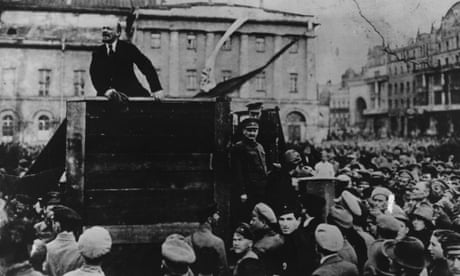
At first, however, the Russian Revolution was simply a sensational item of world news. What could be more thrilling than the fall of the tsar, or more arresting than the triumph of the proletariat (a word now fallen into disuse)? The revolution was all the more intoxicating, because its leaders, especially Lenin and Trotsky, were brilliant newspaper copy – passionate intellectuals and articulate middle-class revolutionaries who seemed to be men of action committed to translating communist theory into their vision of a new society.
Reed later wrote that Harvard had made him, and many others, “realise that there was something going on in the dull outside world more thrilling than college activities”, whereupon he and his fellows turned their attention to the writings of innovative minds such as HG Wells.
From Harvard, Reed had moved to New York to try his luck as a journalist. In 1913, he joined the staff of the Masses, edited by Max Eastman, becoming part of a journalistic milieu that included Lincoln Steffens, Ida Tarbell, John Dos Passos, Emma Goldman, and the radical playwright Eugene O’Neill, as well as the feminist and journalist Louise Bryant, whom he married in 1916.
On the Masses, Reed’s modus operandi, as a reporter, was to get arrested, which he regularly did, while looking for trouble. Soon, weary of provoking the US authorities, he broadened his horizons to take in the ferment in the old world as well as the new. In 1917, appalled by Woodrow Wilson’s declaration of war against Germany, the newlyweds set off for Europe, and wound up in St Petersburg at the beginning of the revolution. Reed saw at once that this was his great opportunity. Where previously he had written and published poetry and flirted with the Mexican revolution, now his prose caught fire at the prospect of a worldwide socialist catharsis. Reed was exhilarated by what he was witnessing:
After this first, thrilling encounter with revolution (Reed also met both Lenin and Trotsky), Reed and Bryant returned to the US, and became trapped in a succession of bruising lawsuits inspired by the American authorities’ fear of Bolshevism. Reed’s life at this time was every bit as dramatic as the world from which he had just returned. All his papers from his Russian trip were confiscated, and would not be returned for seven months. At this juncture, Reed seized his moment, not least because his wife (Louise Bryant) was about to publish her own version, Six Red Months in Russia. His editor, Max Eastman, recalls a meeting with his correspondent during the period of time when Reed shut himself away to write his account of the revolution in, he claimed, 10 days:
“He was gaunt, unshaven, greasy skinned, a stark, sleepless, half-crazy look on his slightly potato-like face. He had come down after a night’s work for a cup of coffee.
“‘Max, don’t tell anybody where I am. I’m writing the Russian revolution in a book. I’ve got all the placards and papers up there in a little room and a Russian dictionary, and I’m working all day and all night. I haven’t shut my eyes for 36 hours. I’ll finish the whole thing in two weeks. And I’ve got a name for it too – Ten Days That Shook the World. Good-bye, I’ve got to go get some coffee. Don’t, for God’s sake, tell anybody where I am!’
“Do you wonder why I emphasise his brains? Not so many feats can be found in American literature to surpass what he did there in those two or three weeks in that little room with those piled-up papers in a half-known tongue, piled clear up to the ceiling, and a small dog-eared dictionary, and a memory, and a determination to get it right, and a gorgeous imagination to paint it when he got it. But what I want to comment on now was the unqualified, concentrated joy in his mad eyes that morning. He was doing what he was made to do, writing a great book. And he had a name for it too—Ten Days That Shook the World.”
Eastman was right. From its opening page, Ten Days has a tempo and a voice that sets it apart, in an era when reportage as a genre was still in its infancy.
Since March 1917, when the roaring torrents of workmen and soldiers beating upon the Tauride Palace compelled the reluctant imperial duma to assume the supreme power in Russia, it was the masses of the people, workers, soldiers and peasants that forced every change in the course of the revolution. They hurled the Miliukov ministry down; it was their soviet that proclaimed to the world the Russian peace terms–“No annexations, no indemnities, and the right of self-determination of peoples”; and again, in July, it was the spontaneous rising of the unorganised proletariat who once more stormed the Tauride Palace, to demand that the soviets take over the government of Russia.
“The Bolsheviks, then a small political sect, put themselves at the head of the movement. As a result of the disastrous failure of the rising, public opinion turned against them, and their leaderless hordes slunk back into the Viborg Quarter, which is Petrograd’s St Antoine. Then followed a savage hunt of the Bolsheviks; hundreds were imprisoned, among them Trotsky, Madame Kollontai and Kamenev; Lenin and Zinoviev went into hiding, fugitives from justice; the Bolshevik papers were suppressed.
“Provocateurs and reactionaries raised the cry that the Bolsheviki were German agents, until people all over the world believed it. But the provisional government found itself unable to substantiate its accusations; the documents proving pro-German conspiracy were discovered to be forgeries; and one by one, the Bolsheviki were released from prison without trial, on nominal or no bail, until only six remained. The impotence and indecision of the ever-changing provisional government was an argument nobody could refute. The Bolsheviks raised again the slogan so dear to the masses, ‘All power to the soviets!’– and they were not merely self-seeking, for at that time the majority of the soviets was ‘moderate’ socialist, their bitter enemy.”
Reed’s account of what he saw continues to shape many subsequent versions of the Russian Revolution. The great film director Sergei Eisenstein based his film October (Ten Days That Shook the World) on the American reporter’s work. Reed’s account was romantic, partisan and intensely personal:
“More potent still, [the Bolsheviks] took the crude, simple desires of the workers, soldiers and peasants, and from them built their immediate programme. And so, while the Mensheviks and socialist revolutionaries involved themselves in compromise with the bourgeoisie, the Bolsheviks rapidly captured the Russian masses. In July they were hunted and despised; by September the metropolitan workmen, the sailors of the Baltic fleet, and the soldiers, had been won almost entirely to their cause. The September municipal elections in the large cities were significant; only 18% of the returns were Menshevik and socialist revolutionary, against more than 70% in June…”
The power of Reed’s account comes from its character as an “eye-witness account”. Reed was present at almost every scene he describes. He was in the room; he heard the debates; and he saw the chaos of revolution.
By night, armed patrols went through the silent streets, and on the corners soldiers and Red Guards squatted around little fires laughing and singing; in the daytime great crowds gathered on the sidewalks listening to interminable hot debates between students and soldiers, businessmen and workmen.
Already the revolution was disintegrating into faction fighting. Reed, always prey to the appeal of a good story, allowed himself to be seconded, on behalf of the Comintern, to another congress in Baku. The journey wrecked his health and, by the time he returned to Moscow, he was suffering from typhus. He died on 17 October 1920, was given a hero’s funeral, and buried in the Kremlin Wall, a unique honour.
It is part of the myth of Ten Days that Reed should die so soon after publication, as a martyr to a great cause. In 1922, his book was republished with an encomium from Lenin himself.
“With the greatest interest and with never slackening attention I read John Reed’s book, Ten Days That Shook the World. Unreservedly do I recommend it to the workers of the world. Here is a book which I should like to see published in millions of copies and translated into all languages. It gives a truthful and most vivid exposition of the events so significant to the comprehension of what really is the Proletarian Revolution.” – VI Lenin
Ten Days That Shook the World is neither history nor polemic, but a bit of both – a rhetorical act of witness that is both authentic and unputdownable. It remains one of the great texts of American journalism: ironically, it gains an extra and paradoxical credibility from being un-fact-checked and unmediated. With all its many flaws, both ideological and literary, it remains a masterpiece of reportage.
A signature sentence
“From the farthest corners of great Russia, whereupon desperate street-fighting burst like a wave, news of Kerensky’s defeat came echoing back the immense roar of proletarian victory; Kazan, Saratov, Novgorod, Vinnitza – where the streets had run with blood; Moscow, where the Bolsheviks had turned their artillery against the last stronghold of the bourgeoisie – the Kremlin.”
Three to compare
Louise Bryant: Six Red Months in Russia (1918)
Arthur Ransome: Six Weeks in Russia (1919)
George Orwell: Animal Farm (1945)
- This is the archive of The Observer up until 21/04/2025. The Observer is now owned and operated by Tortoise Media.
Read also: Ten Days That Shook the World
We remind our readers that publication of articles on our site does not mean that we agree with what is written. Our policy is to publish anything which we consider of interest, so as to assist our readers in forming their opinions. Sometimes we even publish articles with which we totally disagree, since we believe it is important for our readers to be informed on as wide a spectrum of views as possible.