

Michael Leonardi* | Oct 23, 2026
Demonstrations began on September 17 at the Lycée Saint-Exupéry in Créteil, a largely working-class suburb southeast of Paris. High school students and teachers blocked the gates over inadequate staffing, overcrowded classrooms, and deteriorating buildings. The school gave them some of what they asked for. The strike ended. The anger didn’t.
Word of the unrest spread rapidly on social media. University students joined in solidarity and the strikes spread, raising broader concerns about cuts to public education. Labor unions followed, bringing the cost-of-living crisis into the frame and turning a local school action into a national movement. Within weeks, hundreds of schools across France were blocked.
On October 17, the Interior Ministry counted roughly 550,000 people in the streets against the cost of living and a government that had nothing to offer. Most of the marches stayed peaceful. After dark, Paris, Marseille, Lyon, Limoges, Bordeaux, and Lille burned. Masked groups joined the demonstrations, clashing with police, setting fires, looting shops, and attacking public buildings. In Limoges the historic 19th-century town hall was set ablaze. Prime Minister Sébastien Lecornu said 1,200 people were arrested and 150 officers injured. A 15-year-old lost part of his hand, possibly to a stun grenade. Curfews went up.
France’s Justice Ministry reported more than 6,877 arrests by October 9th, 86 percent of them involving minors. Macron blamed far-left groups and criminals, while a government spokesperson said the students’ grievances were legitimate but were being exploited and transformed into urban violence. On October 7th the government proposed a five-point plan focused on filling teacher vacancies, repairing school buildings, improving students’ daily schedules, clarifying university admissions, and giving students a greater voice in school decisions. The CGT called strikes for November 5th. Yellow Vest organizers called another march for October 24th. The echoes of the 2018 yellow vest movement are clear. France started it. The rest of the continent is following.
Governments that cannot staff a school or keep the lights on in a hospital can still find the money for weapons, for police in the streets, and for a temporary rebate that gets the trucks moving until the next crisis. The rebate is not a solution. It is the admission that the skyrocketing prices of energy, housing, and food will not be touched. The energy giants have already booked record profits on the diesel that emptied the shelves. The military contractors have already booked the orders locked into the rearmament budgets for the war in Ukraine and the widening confrontation with Iran. NATO’s drive to raise military spending runs on the same books that leave the classrooms underfunded, healthcare systems in shambles, and the wages stagnant.
The war on Iran, and the disruption in the Strait of Hormuz that followed, is one of the principal drivers of the fuel prices now emptying the shelves. The war in Ukraine continues to justify the rearmament budgets that starve the schools and hospitals. People are connecting both wars — the Strait and the eastern front — to the underfunded classroom, the stagnant wage, and the family that can no longer make ends meet.
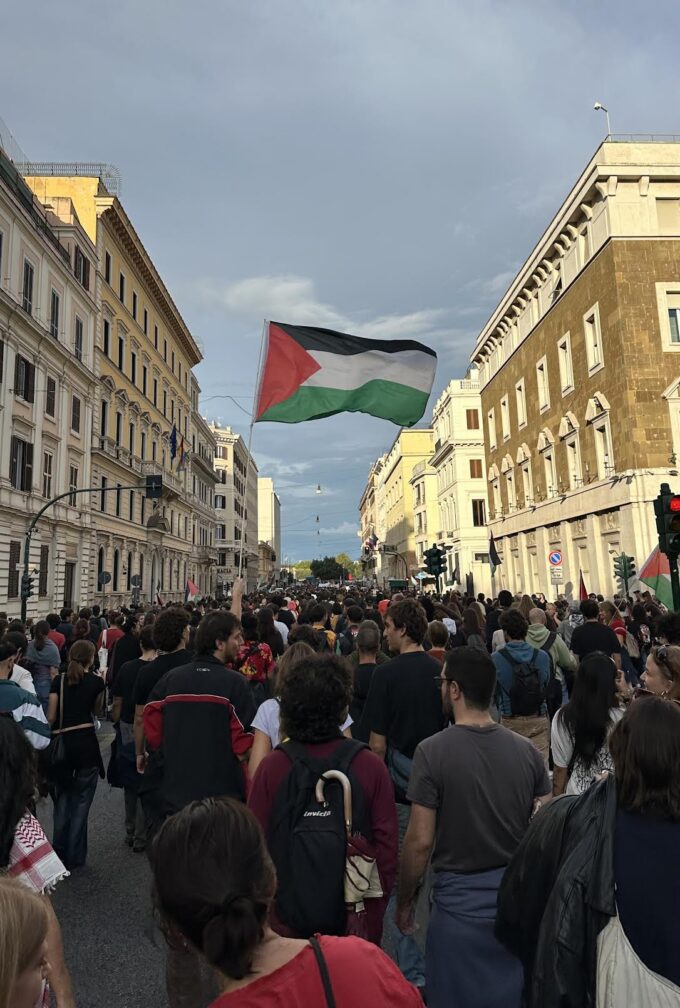
Italy is already in it. On October 10th, a day of global action for Palestine brought hundreds of thousands into the streets in over 80 cities and towns across Italy, including Rome, Turin, Milan, Florence, and Naples. In Rome the march left the Colosseum under banners calling for “The end of genocide and the end of Zionism” and remembering “October 7th: Day of Resistance.” USB, Potere al Popolo, student groups, and grassroots citizens groups were there. In Turin tens of thousands walked behind giant cardboard heads of Trump and Netanyahu, symbolically put on trial, pelted with tomatoes and rocks, stomped and eventually burned. One organizer said the point was to put the genocide back in the headlines.
The same governments funding NATO’s rearmament for Ukraine and complicit in the silence around Gaza now face masses of students carrying Palestinian flags and drivers who can empty the shelves. Israel’s impunity is written into the same budgets that leave the schools leaking and the diesel unaffordable, while the war on Iran helps set the price of that diesel.
 Photograph by Michael Leonardi
A week later the students took the schools. In Florence more than ten high schools were occupied, including Gramsci, Castelnuovo, and Galileo-Michelangiolo. In Rome it was the Montessori, Ambrosoli, Plinio Seniore, Morgagni, and Gullace. In Turin Boselli, Volta, Beccari, Giolitti, and Gobetti. They pointed to leaking roofs, missing teachers, textbook prices, mold, rat infestations, and a government that has chosen rearmament over the buildings they sit in and a viable future. Palestinian flags were prominent in the occupations and the marches that followed.
On the weekend of October 17th and 18th, demonstrations in Milan, Turin, Bologna, Brescia, and Bergamo turned into clashes. In Milan shop windows in the center were smashed. Groups set bins on fire and looted stores. Police used tear gas and water cannons. On Sunday 271 young people were detained; 32 were arrested, 23 of them minors. A 16-year-old from the suburbs, Leonardo, told La Stampa from his hospital bed that he had come to Piazza del Duomo with a friend and a Palestinian flag. Someone hit him in the head from behind. He had a concussion and spent nearly 36 hours in the hospital. No charges.
The government answered by sending 500 army troops to Milan and promising tougher security measures. Meloni, with an election next year, condemned the violence and called a meeting. The rage comes from a system that no longer pretends to deliver the services it still claims to fund. The army is in the city whose schools the students already occupy. The hypocrisy is that the same NATO governments that lecture on rules-based order continue to arm and shield the state committing genocide in Gaza while the illegal war on Iran drives the fuel prices that empty the shelves and the war in Ukraine justifies the military budgets that leave the classrooms falling apart.
That same week the CGIL, Italy’s largest union confederation, mobilized in Rome. On October 17th the “La Via Maestra” demonstration filled the streets from Piazza della Repubblica to Piazza del Popolo. Landini, speaking from the stage, said the crowd numbered more than 100,000. The march was organized by the CGIL together with more than one hundred associations. The platform put work, peace, the environment, welfare, and the Constitution at the center. Palestinian flags were visible throughout the corteo alongside the CGIL red and the peace banners, a centerpiece that had not been present in the same way in previous years of the confederation’s large mobilizations. Opposition leaders including Elly Schlein and Giuseppe Conte walked with the march. From the stage Landini announced the nationwide general strike for November 20th, aimed at the 2027 budget that directs 14 billion euros toward arms. The demands are higher wages and pensions, less precarious work, more money for health and education, and affordable housing.
A separate general strike called by USB and other rank-and-file unions is set for October 30th. Port workers have named eight Italian ports for action that day against arms trafficking and the militarization of the docks. They say they are ready to block shipments. The shelves in the south are already empty for other reasons. The boiling point is the empty shelf, the occupied classroom, and the ship that still leaves with weapons. The government can talk to the drivers about diesel. It has not yet been asked, in the same room, why the ports are still loading arms bound for a state that enjoys total impunity, or why the war on Iran is allowed to set the price of the fuel the drivers cannot pay, or why the war in Ukraine continues to dictate the military share of the budget.
The trucks stopped last week. The blockades began in the South and spread. Truck drivers in Sicily, Calabria, Campania, Puglia, and Molise blocked motorways and secondary roads over diesel prices that have made the job and cost of living impossible. The action disrupted national supply chains. Supermarket shelves emptied. Fresh produce rotted in warehouses. Hospitals reported delayed supplies. Two airports in Calabria couldn’t get aviation fuel. In Ancona the fishing fleet stayed in port. Farmers joined with tractors. Confagricoltura said the problems had moved from buffalo mozzarella to seasonal vegetables and fruit. Massive food producer La Doria stopped production in seven southern plants and put half its workforce on forced leave. Deputy Infrastructure Minister Edoardo Rixi called the disruption in Campania severe. Meloni’s office called “ridiculous” a report that government headquarters in Rome were running out of toilet paper.
By October 20–22 some blocks in Sicily and parts of Calabria were lifting after talks with the government; others in Campania, Puglia, and Calabria continued. The truckers, usually oriented toward individual costs and often aligned with right-wing politics, found themselves on the same roads as the students whose collective demands name the wars and the genocide — in Ukraine, against Iran, on Palestine — and the budgets that produce those costs. The meeting is not yet a program, but the empty shelves and the occupied schools are already in the same sentence.
The government is lining up bribe money. Meloni is chairing a cabinet meeting to approve a decree putting more than 550 million euros into a tax credit for Truckers, a diesel subsidy top-up, and a five-month suspension of vehicle lease payments. Salvini has floated a diesel price cap for a truckers’ union. Some drivers in Sicily and Calabria have lifted their blocks after talks. Most of them have not. Farmers in Calabria and Campania are still out on strike.
The pattern is familiar. The state offers temporary relief when the roads are closed and the shelves are bare, then returns to the same cost structure once the trucks move again. Italy already has some of the highest energy prices and the heaviest tax burden in the eurozone. Real wages have fallen 9.4 percent since 2021. More than five million people live in absolute poverty, including more than a million children. At the same time the government has committed to raising military spending to 3.2 percent of GDP by 2028 and 5 percent by 2035. It has applied for an EU loan of 14.4 billion euros, half of it for the military. By 2025 military spending had reached 42.7 billion euros, nearly double the 2013 figure.
The money is going to rearmament in the name of the war in Ukraine and the broader NATO posture toward Iran. It is not going to the schools the students occupy, or to the diesel the drivers can’t afford, or to anything that would interrupt the supply of weapons and political cover for the genocide in Gaza. The energy giants posted record profits while diesel prices emptied the shelves. The military contractors are booking the orders that the budgets have already locked in. Human needs have been sacrificed for both wars. The generation in revolt has noticed.
The line runs from the Strait of Hormuz and the Ukrainian front to the underfunded classroom, the stagnant wage, and the family that can no longer make ends meet. The same state that can find 550 million for the drivers this week has already committed the larger sums to the weapons that will still be moving when the rebate ends. NATO’s hypocrisy is the gap between its talk of security and the fact that the security it funds is the security of arms makers, of the war in Ukraine, of confrontation with Iran, and of Israel’s impunity, while both wars set the price of the fuel and the shape of the budget.
The same pressure is visible farther west and east. In Portugal young people occupied Rossio square in Lisbon and Dom João I square in Porto with tent camps against a housing crisis in which purchase prices have more than doubled since 2017 and new-lease rents have nearly doubled. Police cleared the camps before dawn on October 20 and arrested 55 people. The protesters returned the same day and voted to pitch the tents again. They are calling for a general strike on November 11, coordinated with actions in Spain, and some have talked about an Iberian strike that would also pull in France. In Spain the housing protests have been running for months.
In Albania a student-led uprising that began as the Flamingo Revolution against a luxury coastal resort linked to Jared Kushner on Sazan Island and protected wetlands has become the sharpest challenge yet to Edi Rama’s long rule. High school and university students joined months of earlier protests over the cost of education, crumbling infrastructure, low wages, and corruption. In Tirana the streets filled for days. Protesters set fires, threw stones, and clashed with police who answered with tear gas, water cannons, and rubber bullets. More than a thousand people have been arrested and hundreds criminally prosecuted. The students say the system has been unacceptable for years. Rama has answered with bonuses for the police and salary increases scheduled for 2027. The crackdown is the same answer everywhere: more force when the system can no longer deliver. The force is available. The housing, the school, and the wage are not.
These are not the same movements, but they are linked by a shared calculation that the existing arrangements will not deliver relief without disruption. French students started with their schools and widened to the cost of living. Italian students took the buildings and carried Palestinian flags into the squares while the government prepared to send troops. Italian drivers and farmers are fighting the price of diesel and the price of staying in business. Port workers are preparing to stop the ships that carry the weapons. Portuguese and Spanish protesters are defending the possibility of renting or owning a place to live. Albanian students are demanding that a prime minister who has governed for more than a decade leave office.
The money spent on rearmament for the war in Ukraine, on the war on Iran, and on the continued supply and silence around the genocide in Gaza is money that will not appear in a wage, a rent subsidy, or a school budget. In Italy the CGIL has called the November 20th general strike. USB, and the port workers are set for October 30th. The drivers, the farmers, and the students moved first. The government is negotiating with the truck drivers because the shelves are empty, and deploying troops because the windows are broken. The boiling point is the recognition that the system has chosen the weapons, the profits, and Israel’s impunity over the people still expected to pay for them. For the moment, the truckers’ focus on immediate costs and the students’ collective naming of the wars that produce those costs have closed the same roads.
Energy prices are skyrocketing. Food prices have not returned to pre-2022 levels. Housing costs in the major cities keep rising. Public services, especially education and health, have been thinned by successive budgets until the infrastructure is crumbling and the schools and clinics are underfunded by design. Governments have answered with temporary subsidies, targeted tax credits, and, when the streets fill, with police and, in Milan, with the army.
In France the Interior Ministry is counting arrests. In Albania the police chief is not denying rubber bullets. In Portugal the tents were cleared at dawn. In Italy the decree is being written while some of the trucks are still parked across the road, the schools are occupied, the ports are preparing to stop arms shipments, and 500 soldiers are being sent to the city where the students carried the Palestinian flag. The capacity to repress is intact. The capacity to meet the stated purpose of the state is not. The energy companies and the arms makers have already booked the returns. NATO’s member states continue to treat Israel’s genocide as a matter outside the rules they claim to enforce.
The movements have not yet answered whether the disruption can be sustained long enough to force a change in the cost structure rather than a temporary rebate, and whether the flags, the arms shipments, and the military budget will stay in the same sentence. France has shown that a school blockade can become a national crisis in weeks. Italy has shown that the people who move the food can empty the shelves, that the students will occupy the buildings and name the wars, and that the port workers are prepared to stop the ships. Portugal and Spain have shown that the housing question can occupy the central squares. Albania has shown that a student generation can put a long-serving prime minister under sustained street pressure.None of these governments has yet offered a program that addresses the underlying prices of energy, housing, and food, or that interrupts the flow of weapons and political cover for Israel, or that ends the wars driving both the price of fuel and the shape of the budgets. They have offered temporary band-aids, police, troops, and the hope that the roads will reopen.
The roads are still closed in places. The schools are still occupied. The tents went back up. The Palestinian flags are still in the squares. The ports have named the day. A generation is in revolt against a system that has broken down, a state that answers with crackdown, and companies that have already counted the profits. The harvest of this autumn is not yet in.
*Michael Leonardi lives in Italy and can be reached at michaeleleonardi@gmail.com
We remind our readers that publication of articles on our site does not mean that we agree with what is written. Our policy is to publish anything which we consider of interest, so as to assist our readers in forming their opinions. Sometimes we even publish articles with which we totally disagree, since we believe it is important for our readers to be informed on as wide a spectrum of views as possible.