


By Rystad Energy
Mar 27, 2026
- The oil market initially absorbed a historic supply disruption thanks to surplus, floating storage, and policy interventions.
- Those buffers are now largely depleted, leaving the system structurally fragile and highly sensitive to new disruptions.
- With spare capacity constrained and inventories falling, even minor supply shocks could now trigger disproportionate price spikes.
The global oil market has been on a rollercoaster since late February, but the price reaction to the largest supply disruption in history has been relatively muted. The calm was not complacency; buffers were there to absorb the shock. But the system that held for four weeks is no longer the system we are operating in today.
The oil market did not underreact to the disruption in the Strait of Hormuz; it absorbed it.
For nearly four weeks, markets have shown remarkable resilience in the face of disruption, supported by a combination of pre-war surplus, crude-on-water, and policy barrels that provided a temporary buffer and kept prices contained.
That phase is now ending.
European refiners are about to feel this directly, as they will have to increasingly compete with Asian buyers for the same Atlantic Basin barrels.
When the next disruption hits, whatever its source, there will be little left to absorb it.
Paola Rodriguez-Masiu, Chief Oil Analyst , Rystad Energy
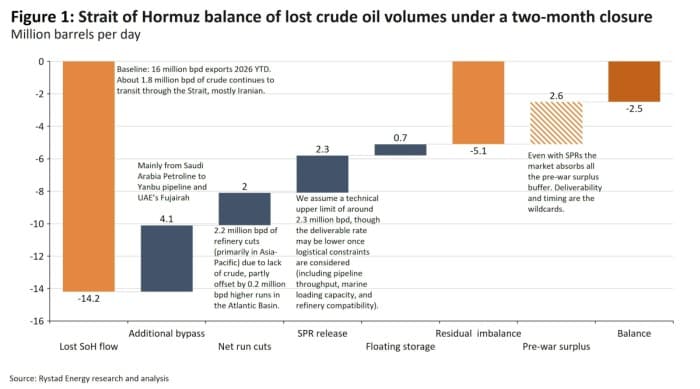
For nearly four weeks, the crude oil market has displayed remarkable resilience, holding together in the face of a 17.8 million barrels-per-day trade flow lost out of the Strait of Hormuz (of which 14.2 million bpd is crude and condensates).
The relatively muted price reaction was possible because the market entered this crisis with a heavily buffered system.
But that buffer has disappeared.
The global oil system can no longer absorb shocks the way it could three weeks ago.
The floor has moved up.
So has the ceiling.
And critically, the distance between a routine supply event and a disproportionate price move has collapsed.
This is no longer a market that is tight for a couple of weeks, it is a market that will be fragile for longer.
That distinction is what the crude oil price does not yet fully reflect.
Before this conflict, the world was expecting a crude oil surplus of roughly 3.0 million bpd this year, onshore and offshore inventories were ample, and there was healthy spare production capacity, albeit very localized.
Those buffers are now largely consumed, and the system that absorbed the initial shock is not the system operating today.
Nearly 500 million barrels of total liquids have been lost in the disruption so far.
The combined policy response of strategic petroleum reserve (SPR) releases by the International Energy Agency (IEA) and waivers of sanctions against Russian and Iranian crude amount to about the same volume. In addition, excluding offshore inventories, the release rate of those policy barrels is far slower than the 17.8 million bpd loss rate of crude and oil products combined.
In past coordinated releases, total IEA flows have not reached above the 2.0 million bpd mark of sustained flows, which provides a good empirical reference point to assume that the actual deliverable volumes at system level will not hover much above that level.
The mismatch goes beyond flow rates.
The IEA release is directed at IEA member countries, which do not include some of the economies most exposed to the disruption, such as Pakistan and India, which receive none of the release directly.
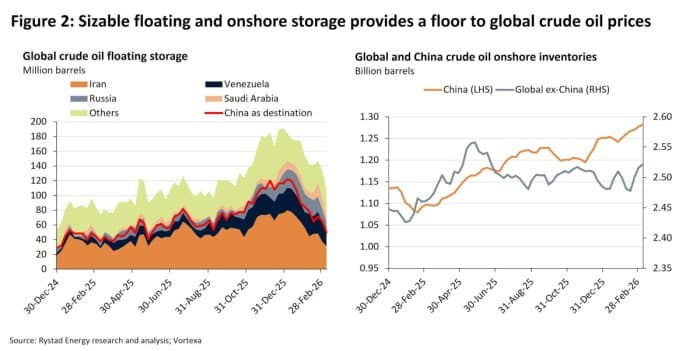
China built up substantial strategic reserves through 2025 and early 2026 but has shown no indication of drawing them down.
India is relying on Russian crude in floating storage following a US sanctions waiver, but only 8.0 million barrels are left.
There are still about 34 million barrels of Iranian and 21 million barrels of Venezuelan crude in floating storage, most of which is expected to head to China.
 Another crucial variable that explains why prices have not moved further is the length of the supply chain.
For the first three weeks of the disruption, oil arrivals were largely unaffected.
The cascading supply chain implications of a sustained shortage are structurally similar to what Covid-19 did to demand in 2020 – but operating from the supply side and with less policy flexibility to respond.
The pipeline of barrels already at sea, in combination with floating storage, SPR releases, and the spare production capacity, have collectively provided a buffer that is now being exhausted in real time.
From this week, every day matters.
Before the Brent crude flat price reacts, the physical markets are the canary in the mine, and differentials are now starting to move as European buyers realize that they will face fierce competition from Asian refiners for Atlantic basin barrels.
.
We remind our readers that publication of articles on our site does not mean that we agree with what is written. Our policy is to publish anything which we consider of interest, so as to assist our readers in forming their opinions. Sometimes we even publish articles with which we totally disagree, since we believe it is important for our readers to be informed on as wide a spectrum of views as possible.