


“The imminence of breaching 1.5°C cannot be an excuse to open the door to defeatism—the focus has to be on accelerating action to limit the magnitude and duration of overshoot.”
By Jessica Corbett
With world leaders, climate campaigners, scientists, and more gathered in Türkiye for the United Nations Climate Change Conference, an independent project that tracks government action warned Thursday that global warming is headed toward “an irrecoverable overshoot of 1.5°C” unless countries “rapidly reduce emissions to limit both the magnitude and duration of this overshoot.”
A series of analyses released in the lead-up to the summit—including the United Nations Environment Program’s “Limiting Overshoot” publication from September, the UNEP’s “The Emissions Gap Report 2026: The Point of Return” from October, and the World Meteorological Organization’s “State of the Climate: Update for COP31” from last week—have all sounded the alarm about at least temporarily surpassing 1.5°C, the Paris Agreement’s global temperature rise limit for this century.
The new Climate Action Tracker (CAT) report, “Without Rapid Action, The World Is Heading to Irrecoverable Overshoot,” lays out real-world action based on current policies; pledges and targets from the nationally determined contributions (NDCs) of countries that have signed on to the Paris Agreement; and the “optimistic scenario” based on all announced ambitions.
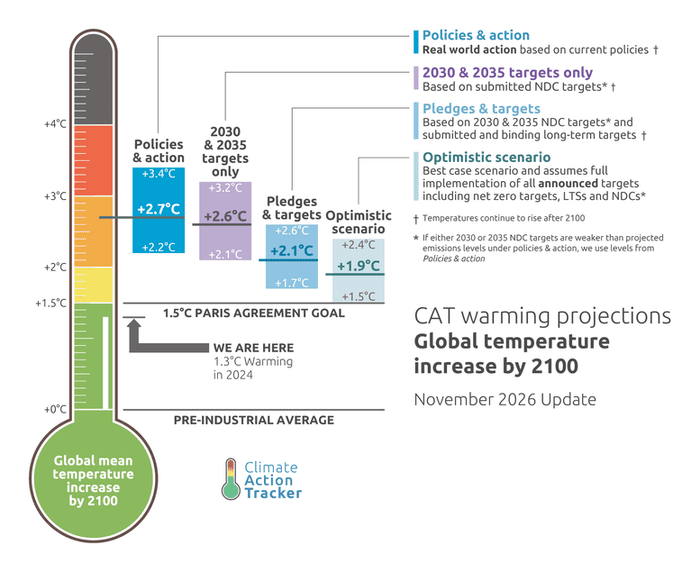
“Aggregated climate action has now essentially stalled for five consecutive years, with positive and negative actions canceling each other out,” says the CAT briefing. “The warming outlook from current policies is leading to 2.7°C in 2100 (slightly up from 2.6°C) as it stood from 2021-2024.”
But the brutal truth is that the positive developments do not yet add up to bending the curve of emissions fast enough. Increasing energy demand and build-out of new fossil fuel infrastructure have led to still rising emissions.
— Climate Action Tracker (@climateactiontracker.org) 12 Νοεμβρίου 2026 στις 8:04 π.μ.
[image or embed]
Bill Hare, CEO of CAT partner organization Climate Analytics, emphasized Thursday that “the stark choice for governments is to either continue to support the fossil fuel industry, which would consign humanity to insurmountable economic damages, rising mortality from heat, and climate-driven diseases and disasters that they are unable to adapt to—or pivot to the solutions which are available and cheaper than ever.”
“The imminence of breaching 1.5°C cannot be an excuse to open the door to defeatism—the focus has to be on accelerating action to limit the magnitude and duration of overshoot,” he argued. “Every increment of warming above 1.5°C means even more significant consequences across climate, nature and human systems.”
The report outlines “five key levers that could cut emissions at the speed and urgency needed to follow a Paris-aligned pathway, limiting the magnitude and duration of overshoot,” which are:
- A transition away from fossil fuels;
- Deep methane cuts;
- Rapid renewables-driven economy-wide electrification;
- Carbon dioxide removal (CDR) as a complement to emissions cuts, not a substitute; and
- An end to deforestation.
“Governments collectively are simply not moving fast enough to adopt the policies that would enable us to escape from the emerging overshoot trap,” said the lead author of CAT’s report, Climate Analytics policy analyst Sarah Heck. “Worse, several are taking their foot off the accelerator and slowing their climate action—or in cases such as the USA, Canada, and New Zealand—rolling it back at a staggering level.”
So far this week, Climate Action Network International has given its satirical “Fossil of the Day” award—long used to call out bad actors during climate summits—to New Zealand, for “dismantling its own climate commitments” under Prime Minister Christopher Luxon, as well as “absent leaders of wealthy countries,” including Canada, Denmark, France, Germany, Ireland, Italy, Japan, the Netherlands, and Sweden.
The stark choice for governments is to either continue to support the fossil fuel industry – or pivot to the solutions which are available and cheaper than ever. The lack of decisive action means that long-term warming is expected to cross the 1.5°C limit around 2030.
— Climate Action Tracker (@climateactiontracker.org) 12 Νοεμβρίου 2026 στις 8:04 π.μ.
[image or embed]
While a key Democratic US senator is attending COP31, President Donald Trump is skipping the summit and has not sent a delegation, even though his country is the world’s worst historical climate polluter. UNEP’s report from last month highlights the dangers of the pro-fossil fuel agenda that the Republican leader has pursued since returning to power last year, including ditching the Paris Agreement, again.
Trump’s ongoing illegal war on Iran has not only led to the deaths of thousands of people but also padded the pockets of those invested in the fossil fuel industry—including himself—while people around the world pay the price at the pump, due to Iran’s restrictions on ship traffic through the Strait of Hormuz.
“With the closure of the Strait of Hormuz exposing our vulnerability to geopolitical shocks,” said Niklas Höhne of CAT partner organization NewClimate Institute, “the case for renewables and electrification has never been stronger—and it does appear that global emissions could be on the verge of a peak and a much faster decline than we had previously thought.”
We remind our readers that publication of articles on our site does not mean that we agree with what is written. Our policy is to publish anything which we consider of interest, so as to assist our readers in forming their opinions. Sometimes we even publish articles with which we totally disagree, since we believe it is important for our readers to be informed on as wide a spectrum of views as possible.