


By: Brian Mier | September 26, 2026
Like many states in Northeastern Brazil, Pernambuco politics is dominated by traditional elite families that control sophisticated local machines spanning multiple political parties. If Tom Jobim once said that Brazil is not for beginners, understanding Northeastern politics is daunting even for Brazilians themselves. The Lula campaign’s initial announcement that it wouldn’t hold a rally in Pernambuco was a result of a local conjuncture in which both leading gubernatorial candidates are campaigning with photos of themselves standing next to him.
Featured Picture: Lula’s rally in Recife city, Capital of the State of Pernambuco. Photo: Brian Mier
“A vote for Bolsonaro is a vote for a guy who wraps himself up in the American flag before going to bed every night,” President Lula told a crowd of 80,000 in Recife (population 1.6 million) yesterday. My story on his surprise visit, announced 2 days prior, for @telesurenglish https://t.co/y3TbvbTSAe
— BrianMier (@BrianMteleSUR) September 26, 2026
The rally was only announced to the public three days prior, and Lula’s schedule is so busy that it was set up to finish at noon, on that Friday (Sept. 25) so that he could fly to São Paulo for a second campaign rally followed by a dinner meeting with a group of business leaders.
Demonstrating my failure to adapt to Brazil’s popular conception of time after 30 years in the country, I arrived on the scene at exactly 8 a.m., the official start time, knowing full well it would take at least two hours before Lula appeared. It was pouring rain, and I stood in the press tent with a gaggle of bored looking camera operators until the rain slowed to a drizzle and I was able to circulate through the growing crowd and interview a few people.
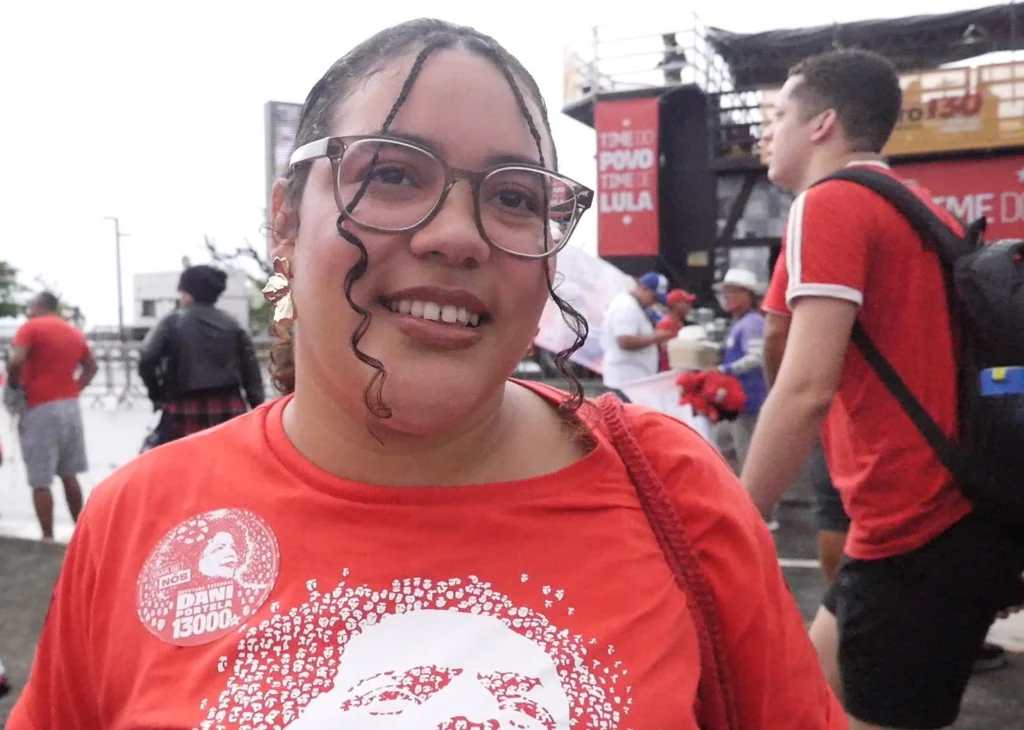
A teacher named Gleise Germana Barbosa told me she had come out to support Lula because of his support for public education and scientific research, two areas that suffered massive funding cuts after the U.S.-backed coup against Dilma Rousseff in 2016.
As I talked with people in the crowd, the subject of the day was speculating how far the U.S. government and its far right allies will go to prevent Lula from staying in power.
On September 19, Brazil’s intelligence agency ABIN announced that U.S. government interference in this year’s presidential elections had reached a “critical” level. On September 24, a group of 31 Democratic lawmakers delivered a letter to U.S. Secretary of State Marco Rubio demanding that the Trump administration halt its ongoing interference in Brazil’s elections.
The U.S. expanded state, primarily its Silicon Valley tech oligarchs, appears to be backing Trump’s regime change plans wholeheartedly, unless it’s a vice versa situation in which Trump is following them. It’s no secret that Peter Thiel and Elon Musk have been gunning for Lula for years now, with Brazil being one of the only countries in the Global South that has managed to impose regulations, albeit timid ones, on crypto, AI and social media.
On August 25, Amnesty International revealed that Meta had failed to block most of 15 AI-generated political disinformation ads about Brazil’s elections that it set up to test the platform’s respect for Brazilian law. On September 16, a similar test run by the Eko Movement showed 87% of the disinformation ads it contracted with Meta were approved, including “AI ads depicting execution style threats against lawmakers and calling for a ‘stop the steal’ style coup.” One week later, Meta pulled down President Lula’s Facebook page and blocked his campaign from running political ads. The page is now back online, but Lula’s electoral coalition says the campaign was damaged while it was down.
Alice Portela de Moraes, a college student who arrived early at the rally, told me:
“Brazil is a sovereign nation and our democracy has to be respected. Our president and our democratic elections also have to be respected. I have no doubt that the Trump administration has been trying to interfere, not only in our elections but in democracies all over the world, in an even more violent way, with all of the military power that they have, with their political power and primarily with their technological power. This is why I think it’s important that so many people have come to the streets today to show their support for a president who respects Brazil’s sovereignty.”
By the time Lula and the other candidates for governor, senator and federal deputy climbed to the top of their sound truck, the crowd was tightly occupying both sides of a road with four lanes for at least 800 meters, which, according to Jacobs’ method, would put it roughly between 40,000 and 65,000 people. But the crowd continued to grow as the truck slowly crossed the Capiberibe River during its trek of about 90 minutes toward Marco Zero, the original founding point of Recife. Afterward, João Campos’ campaign team announced it had used aerial photographs to arrive at an estimate of 80,000 for the crowd gathered at the final point of the parade to watch Lula’s speech.
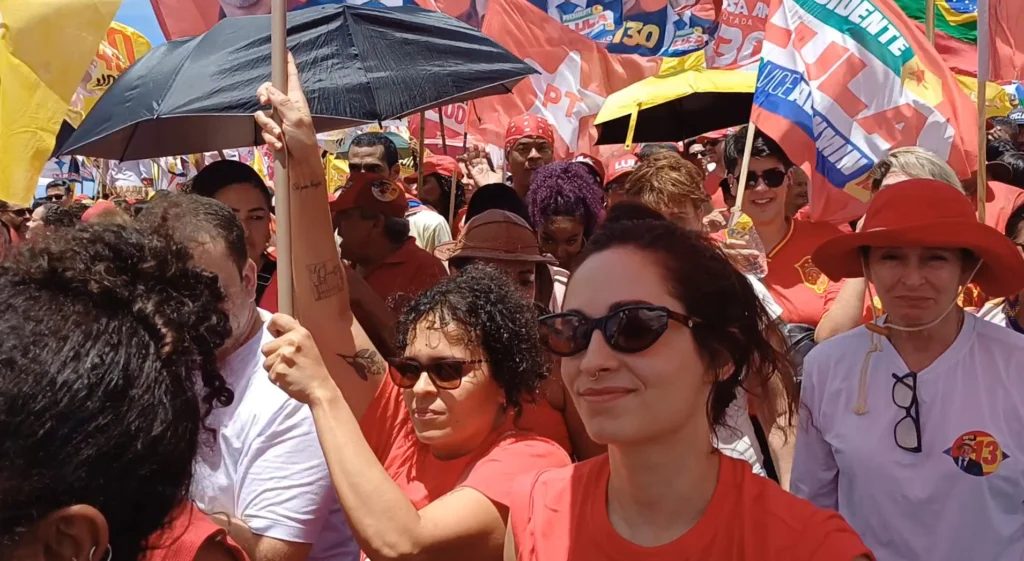
By this point, the sun had come out and was beating down on us full force. From my position on the press stand in front of the sound truck, I watched Lula electrify the crowd with a short, rousing speech.
“I want you to think about what work was done here by the previous government. What did the other presidents of the republic do here, in the history of Pernambuco?” he began. “I ask you, who created the SAMU (public ambulance system)?”
“Lula!” answered the crowd.
“Who created the Farmácia Popular [free prescription drug service]? Who created it for everyone to use?”
“Lula!”
“Who built Highway 101?”
“Lula!”
“Who is finishing the Trans-Northeast Highway?”
“Lula!”
“Who built the Petrobras refinery in Suape?”
“Lula!”
“Who established a pharmaceutical industry in the town of Goiana [Pernambuco]?”
“Lula!”
“Who built seven new federal universities? Who created more jobs? Who created the Minha Casa Minha Vida social housing program?”
“Lula!”
“And what did they ever create?”
“Nothing!”
“They created a gang inside the Social Security Administration that robbed $700 million from retirees. And we discovered it, arrested them, recuperated millions, returned all the money to the pensioners, and this bolsonarista gang is in jail.”
Later in the speech, he addressed the issue of imperialism, which seemed to be on the minds of most people I spoke to before the rally kicked off.
“A vote for the Bolsonaros is a vote for the criminal gang which embezzled retirement pensions,” he said. “A vote for them is a vote for guys who wrap themselves up in the American flag every night when they go to bed. They are traitors!”
Over the past few weeks, many people have complained about an apparent lack of street propaganda for the Lula campaign compared to that of candidates from other political parties, who have filled the streets with people wearing campaign t-shirts, waving flags and handing out stickers and pamphlets. The massive turnout for Lula in Recife this Friday seems to signify an intensification of campaign activity in the final stretch before the first round election on October 4.
Read also: A (brief) analysis of the elections in Brazil and the challenges ahead
We remind our readers that publication of articles on our site does not mean that we agree with what is written. Our policy is to publish anything which we consider of interest, so as to assist our readers in forming their opinions. Sometimes we even publish articles with which we totally disagree, since we believe it is important for our readers to be informed on as wide a spectrum of views as possible.