


Hundreds of secondary schools across France have been hit by protests and blockades as students protest against crumbling buildings, poorly equipped classrooms, overcrowded classes and a lack of teachers.
Some of the demonstrations have been accompanied by violence, with 65 school staff members and 170 students hurt. Nearly 2,000 young people have been arrested. The government has made a flurry of announcements, most of them focused on security, while education minister Édouard Geffray has held a series of emergency meetings with key players in the sector. The aim is to reduce tension ahead of another day of protest on Tuesday, when trade unions have called for strikes in sympathy with the students’ demands.
Geffray, an avowedly technocratic minister, probably thought he could keep things on an even keel at the Ministry of Education until the presidential election next year. After an uneventful start to the new school year, the only major issue appeared to be the government budget, which is always closely watched in a ministry that receives the second-largest share of state spending. In the end, however, it has been basic issues such as broken chairs, out-of-order toilets and badly put-together timetables, heaped on top of a deep-seated sense of social, educational and regional injustice, that have rocked the boat.
In recent days France has been hit by a series of protests from students angry at the state of their secondary schools. In some cases the protests have led to scenes of violence, both against property and in some cases education personnel. At the same time there have been accusations of police adopting a heavy-handed, violent approach when dealing with some young protestors.
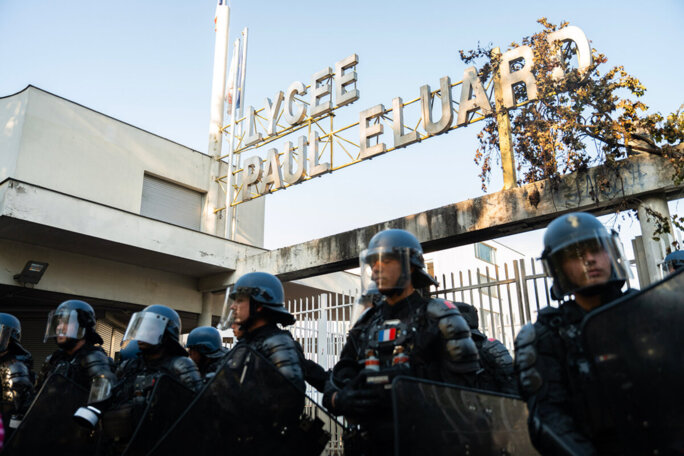
At midday on Friday protests and blockades, either total or partial, were taking place at 564 schools. This was despite the fact that the ministry, in agreement with the local education authorities, had completely closed 400 of the country’s 3,700 secondary schools (which are for pupils aged 15 to 18), while some middle schools (for pupils aged 11 to 15) had also seen disturbances earlier in the day.
.
Nearly 2,000 young people have been arrested since last Monday, with the same number taken into police custody, 90% of them minors. Whatever those who claim the radical-left La France Insoumise (LFI) party is the mastermind behind the disturbances may say, the reality is that the school student protest movement is not under anyone’s control.
“This is a movement that takes many forms, bringing together very different demands and grievances: some can be addressed through budget decisions, but others run deeper and are about how pupils are treated and the prospects that school offers them today,” says Sophie Vénétitay, general secretary of the Snes-FSU teaching union. “And that’s a huge task… That’s what’s making things difficult for everyone today.”
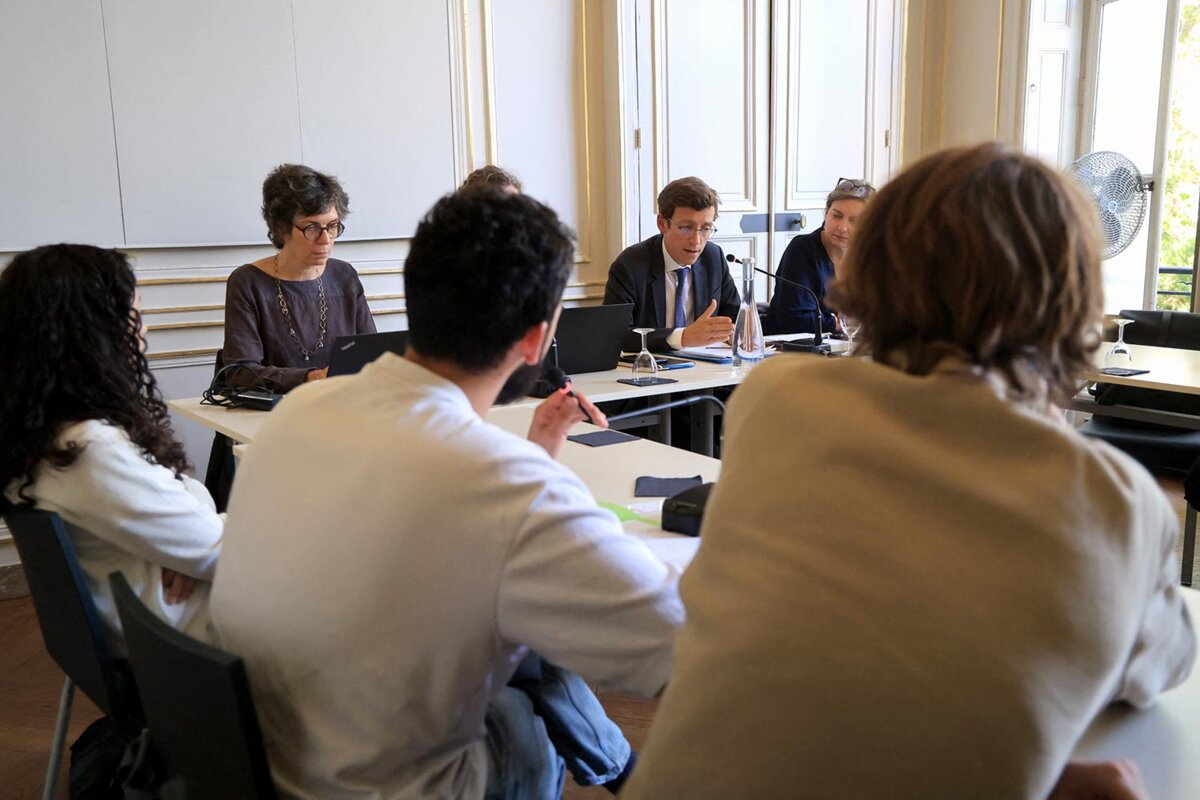
Throughout Friday, as regional education authorities organised talks with school students in areas including Bordeaux in the south-west and Nice in the south, the minister held a series of meetings with different organisations from the education community in an attempt to convince them that there was a way out of the crisis. Ryad Rani, spokesperson for the school students’ union, the Union syndicale lycéenne, afterwards described their meeting at the ministry as a “good step”, but regretted the lack of “concrete announcements”. His organisation, backed by the students’ union the Union étudiante, is calling for the protests to continue and for people to “join act three of the movement” on Tuesday.
“Not much was said,” was the disappointed reaction, too, of Isabelle Vuillet of CGT Educ’action, which, like fellow unions SUD Éducation and the Snes-FSU, is also calling for a strike on October 6th. “The minister repeated that from Monday he was going to launch his much-vaunted platform [editor’s note, an online consultation exercise], with two open questions for school students about their difficulties and their expectations.”
The results of this consultation will be considered after the half-term holiday and, according to the minister, “in parallel” with the debate on the state budget, raising fears that the two will not be linked.
.
“If that’s all he’s got, I don’t think it will be enough,” says Mustafa Ozcelik, vice-president of the parents’ organisation the Fédération des conseils de parents d’élèves (FCPE), which also held talks at the education ministry on Friday. “The response has to be political and educational. The government is discussing the budget right now, so this is the opportunity, let’s put some serious money into schools now!”
Yet for the time being, the government’s plan for 2027 still provides for 1,250 teaching posts to be axed – on the grounds of falling pupil numbers – while 300 medical and social care staff jobs and 13,000 classroom support staff posts for pupils with disabilities are to be created. “Crumbs,” according to the SUD Éducation union.
Serious concerns over safety
Those who spoke with the minister also complain that the state is “passing the buck” over the condition of school buildings, a cornerstone of the protest movement, particularly in poorer areas.
Secondary schools are in fact the responsibility of France’s regional authorities, who point to a steady fall in state funding that they say leaves them unable to fully carry out their duties. Sometimes there are also “political choices” involved. For example, ever since the rightwing Valérie Pécresse became the president of the Paris region authority, the Left has been protesting over her decision to provide generous subsidies to private schools, while some state schools are literally falling apart.
The SNPDEN-Unsa union, which represents school management staff, also attended the talks at the ministry. The union backs the minister’s decision to close several hundred schools on safety grounds, as well as the switch to remote learning, which “temporarily allows teaching to continue”.
In the longer term, however, headteachers want greater clarity, both over the school students’ demands and the government’s response. “Yesterday morning, we had an announcement about an increase in enrolment fees [editor’s note, for BTS vocational courses and preparatory classes] that was scrapped again that same evening,” says Olivier Beaufrère, national secretary of the SNPDEN.
Many of those involved are calling for more ambitious responses, partly out of concern for the safety of students and staff. “I’m very worried about the next fortnight. I fear there will be a tragedy,” says the Snes-FSU’s Sophie Vénétitay, pointing both to the violence of the police response and to the form the youth-led protests have taken. In two weeks, 65 national education staff – including 40 headteachers – and 170 students have already been injured, according to the Ministry of Education, some of them seriously.
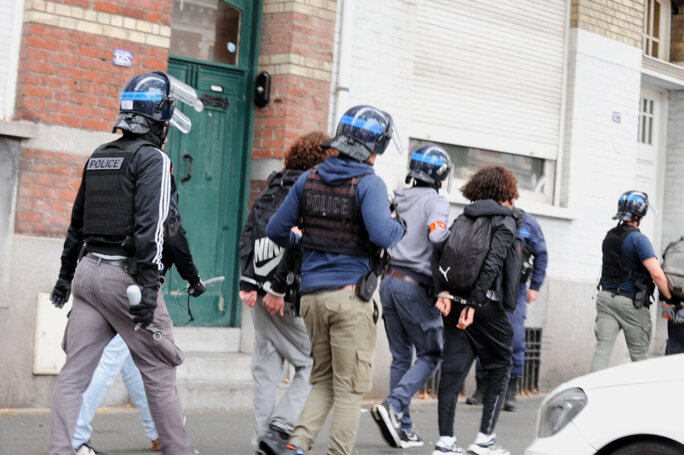 Students taking part in the blockade of the Montebello secondary school in Lille, northern France, are detained by police on September 30th 2026. © Photo Christophe Forestier / Sipa
.
“With our own students, dialogue is always possible, even when there’s a blockade,” insists Olivier Beaufrère, while describing his colleagues as “worn down by the tension”. “The outside [students], on the other hand, can’t be identified and are extremely violent. Headteachers are becoming targets, dozens of colleagues have been injured, and the profession is suffering,” adds the headteacher.
On Friday, a police officer was also beaten up in disturbances on the fringes of a school blockade in Belfort, in eastern France, prompting a fresh wave of outrage.
“It’s probably no coincidence that this climate of harshness and these different forms of violence are coming to the surface now, in the final year of Macron’s five-year term,” says Sophie Vénétitay, a leading figure in the Snes-FSU. “There are not many people left who believe in democracy and dialogue, which is very worrying, but it’s also the result of a certain manner of exercising power.”
Parents called on to help – and treated as culprits
The FCPE parents’ association has meanwhile responded to Édouard Geffray’s call for families to “keep their children at home” as they were “in danger on the streets”.
“The government is asking parents to calm things down, but we’ve already been doing that for two weeks,” retorts Mustafa Ozcelik. “Parents who are involved are outside the schools keeping their kids safe and mediating with the police. They didn’t wait for the minister…”
Justice minister Gérald Darmanin, meanwhile, told RTL radio station that prosecutors should seek to hold parents liable in civil law for damage caused by their children during the school blockades, so as to make them “pay for the repairs”.
His counterpart at the Ministry of Education was rather more circumspect. “I have no problem with the principle that ‘if you break it, you pay for it’,” Édouard Geffray told BFMTV television news channel. “But in this kind of movement, you have a lot of school students who find their protests hijacked by troublemakers, so I’d be more cautious.”
The government’s running commentary therefore veers between repression, understanding and accusations, almost to the point of caricature at times.
“What does the protest movement achieve?” equalities minister Aurore Bergé asked on France Info on Thursday. “It stops our children from studying.” She then followed up with yet another attack on the radical-left LFI.
Economy minister Roland Lescure himself spoke out on Friday. “I think there are two components to this movement,” he said. “There are concerns among school students that we need to listen to, and then there’s also agitation, probably to a large extent fuelled from outside, which needs to be clamped down on because it’s absolutely unacceptable.”
This echoed President Emmanuel Macron’s comments the previous day, which had zero effect on the school student protests.
——————————
- The original French version of this article can be found here.
English version and additional reporting by Michael Streeter
We remind our readers that publication of articles on our site does not mean that we agree with what is written. Our policy is to publish anything which we consider of interest, so as to assist our readers in forming their opinions. Sometimes we even publish articles with which we totally disagree, since we believe it is important for our readers to be informed on as wide a spectrum of views as possible.