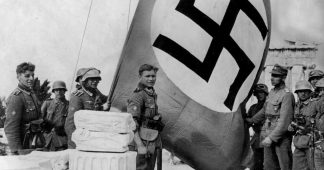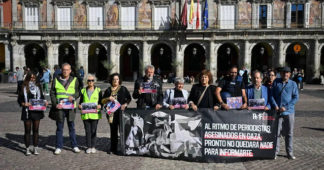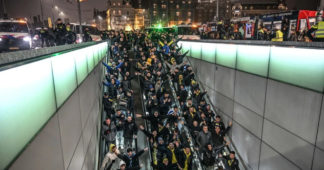
As we commemorate the shipyard workers’ strike in Amsterdam in February 1941 again this year, we do so in the knowledge that workers in several countries occupied by fascism took strike action against the Nazi regime and its war policy. Well known are the strikes in Greece and by miners in Lorraine, who caused massive damage to German arms production by preventing coal deliveries. Such examples can also be found in other occupied countries.
Nevertheless, the shipyard workers’ strike in Amsterdam was something special in this context. With the strike on February 25, 1941, large sections of the working population in occupied Europe resisted anti-Semitic terror with a general strike for the first time. The story has been told many times. However, it is worth remembering it again and again.
Like in all occupied countries, Reich Commissioner Arthur Seyß-Inquart introduced and implemented emergency laws against Jewish people in the Netherlands, as was the case in the German Reich. The anti-Semitic terror was intensified by the collaborators of the NSB (Nationaal-Socialistische Beweging) (chaired by Anton Mussert), who, with their uniformed defense division („Wehrabteilung“ – WA), acted as enforcers of German occupation policy.
The WA provoked incidents in the Jewish quarters of Amsterdam, leading to several physical altercations in which men from the surrounding working-class neighborhoods also came to help the Jews. When a WA leader died after one such brawl and, days later, Jewish merchants defended themselves against attacks by the German police, the occupying power ordered reprisals against Jewish residents. On the afternoon of February 22, 1941, SS assault squads entered the Jewish quarter of Amsterdam and arrested Jewish men at random. On February 23, another raid took place on Waterloo Square in full view of the population.
In view of this occupation violence, the Amsterdam section of the illegal Communist Party of the Netherlands took the initiative and directed its cadres and supporters, who were well connected both in the administration and among shipyard workers, to engage in a publicly visible solidarity action with the Jewish people. On the evening of February 24, leaflets could be found in the working-class neighborhoods and other parts of the city, saying: “Show solidarity with the Jewish part of the working population. Strike, strike, strike!” They demanded that all Jewish prisoners be released and that the WA be dissolved.
And indeed, on February 25, 1941, the city of Amsterdam and its businesses were paralyzed by a general strike. Around 40,000 people demonstrated in the city center. The German occupation forces were completely taken by surprise, but responded with extreme brutality. The police and military were deployed and fired indiscriminately on the strikers.
The result: nine dead and 24 wounded. A wave of arrests and dismissals against strikers began. Eighteen workers were executed as “ringleaders,” others were deported to prisons and concentration camps. Despite all the sacrifices, it was a heroic act that was noticed far beyond Amsterdam.
The memory of this act of solidarity with those persecuted by Nazi terror is an important example of the commemoration of anti-fascist resistance. We also do not forget that in the Netherlands, many Jewish people, not only Anne Frank’s family, were hidden, cared for, protected, and often saved by Dutch neighbors.
February 25, 1941, is thus more than a one-time event; it demonstrates the will to resist and the solidarity of workers and other anti-fascists in the Netherlands. It is important to remember this again and again. The FIR thanks its Dutch comrades in the AfvN and all anti-fascists for keeping this important event alive in the public consciousness for decades, not only through celebrations at the monument to the shipyard workers’ strike in Amsterdam.
We remind our readers that publication of articles on our site does not mean that we agree with what is written. Our policy is to publish anything which we consider of interest, so as to assist our readers in forming their opinions. Sometimes we even publish articles with which we totally disagree, since we believe it is important for our readers to be informed on as wide a spectrum of views as possible.